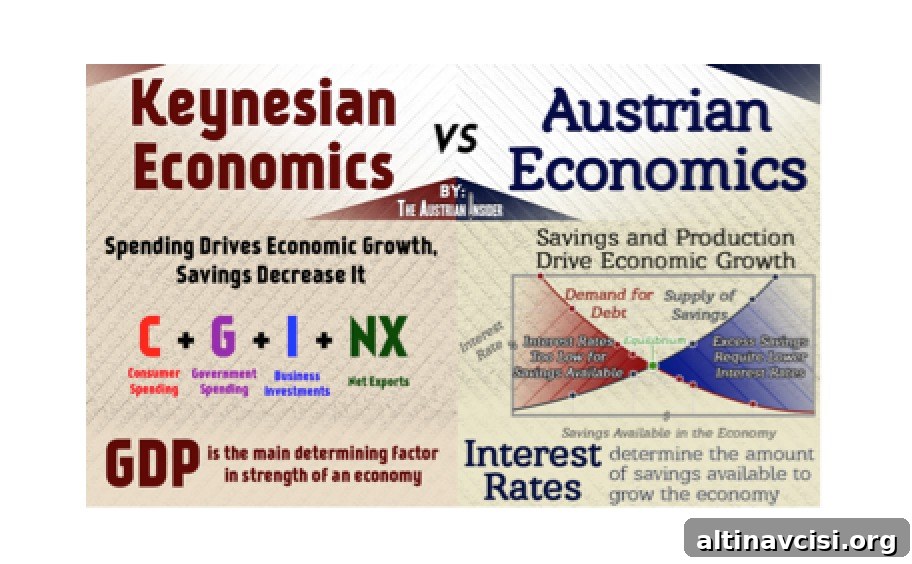
For a larger image please view the original site.
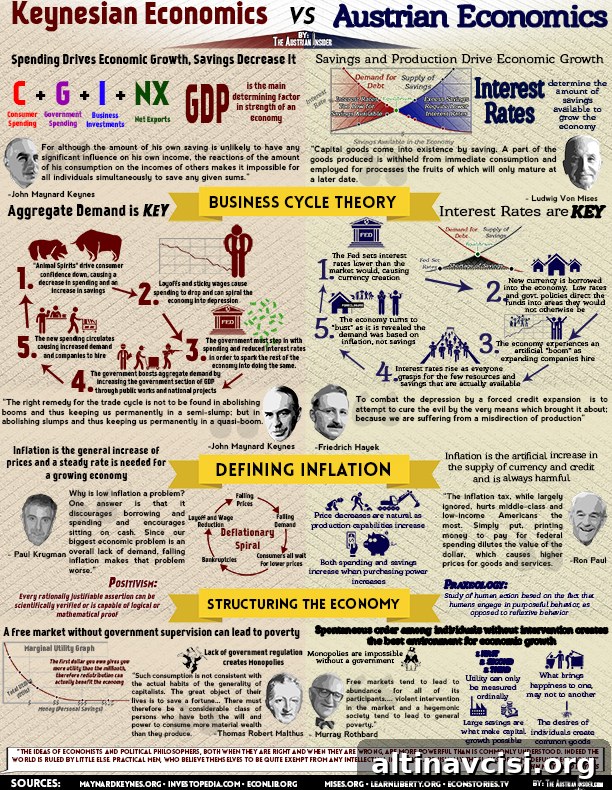
Keynesian vs Austrian Economics: An Overview
Economists have debated for a century whether government intervention helps or harms an economy. At the center of this debate are two contrasting schools of thought: Keynesian economics and the Austrian school. Each offers a distinct perspective on how markets function, the role of government, and the causes of economic cycles.
Keynesian economics emphasizes the importance of aggregate demand. When private demand falls, Keynesians argue that government can and should step in to stimulate spending through fiscal policy—government spending and tax adjustments—or through monetary policy. They highlight concepts such as “animal spirits” to describe the psychological drivers behind investment and consumption decisions, which can lead to volatile swings in economic activity.
The Austrian school focuses on individual decision-making, market processes, and the price mechanism. Austrians stress that distortions from government intervention—especially monetary manipulation and credit expansion—create unsustainable booms followed by painful corrections. They place weight on subjective value and marginal utility, praxeology (the study of human action), and the time structure of production.
The infographic above presents a side-by-side comparison of these two approaches. It summarizes key principles, historical influences, policy prescriptions, and typical critiques each school makes of the other. Viewing the larger image will give a clearer picture of the contrasts in methodology, assumptions, and recommended remedies for recessions and inflation.
Common Clarifications and Reader Feedback
Several readers have pointed out areas that needed clarification or correction. Below are brief responses to those points:
- Animal spirits: This term, used by Keynes, refers to the often-irrational human emotions and instincts that drive investment and consumption. A fuller explanation can be found in standard references on Keynes’s General Theory.
- Perceived bias: The author identifies with the Austrian tradition and attempted to represent Keynesian ideas fairly. Constructive corrections from Keynesian economists were invited to improve balance and accuracy.
- Malthus’s role: While Thomas Malthus is primarily remembered for his writings on population, his ideas influenced later economic thought and have been referenced by some modern economists.
- Ron Paul: Though primarily known as a physician and politician, he has become a prominent public advocate of Austrian economics, authored books on the subject, and been affiliated with the Mises Institute.
- Typographical and labeling corrections: Minor spelling errors and chart labeling issues were corrected in a printable version. In particular, the utility graph was intended to depict marginal utility, which diminishes with each additional dollar of consumption.
- Praxeology: Commenters noted the technical meaning of praxeology as the deductive study of human action. Representing that concept visually is challenging, but the infographic aimed to capture its relevance to Austrian methodology.
Why This Comparison Matters
Understanding these two schools is important because their policy recommendations lead to very different prescriptions during economic downturns. Keynesian policies often support countercyclical fiscal measures and active monetary management to stabilize output and employment. Austrian prescriptions typically call for limiting government intervention, allowing market adjustments, and maintaining sound money, arguing that intervention tends to prolong distortions and delay necessary corrections.
Both perspectives offer insights. Keynesian analysis highlights demand-side failures and the potential for prolonged recessions without support. Austrian analysis emphasizes errors introduced by credit expansion and the importance of market-driven resource allocation. Comparing them helps clarify the trade-offs and assumptions behind competing policy choices.
Sources and Further Reading
The infographic and summary draw on established references and educational resources in economics. These include historical materials on Keynes, accessible explanations of financial concepts, and works associated with Austrian thought. Readers who want deeper, primary-source material will find many of these resources useful for exploring each school in greater detail.
If you think any representation here could be improved, especially regarding technical definitions or historical context, feedback is welcome to refine and balance the presentation.