
Daily News Nuggets | Today’s top stories for gold and silver investors
December 19th, 2025
Gold and Silver on Track for Record-Breaking Year
Gold looks set to close 2025 with gains exceeding 60% and more than 50 all-time highs, making this the strongest year for the metal since 1979. Silver has been even more dramatic, roughly doubling to record levels above $66 per ounce.
Several factors have driven the rally. Central bank purchases remain elevated — topping 1,000 tonnes for the third consecutive year — while investors have returned to ETFs after a period of outflows. Trade tensions, persistent inflation, and a softer dollar have amplified demand for safe-haven assets. For silver, strong industrial demand from solar and electronics, combined with supply constraints, has pushed prices higher.
For investors concerned about inflation and geopolitical risk, precious metals have provided a clear hedge. The market response has drawn attention from Wall Street, where analysts have raised targets in light of the rally.

JP Morgan Sees Gold Breaking $5,000 by Late 2026
JP Morgan has issued a bullish forecast, projecting gold could reach $5,055 by the end of 2026 and approach $5,400 by late 2027 — roughly 25% above current levels. The bank highlights ongoing central bank purchases as a key support for prices.
JP Morgan’s Gold Price Forecasts
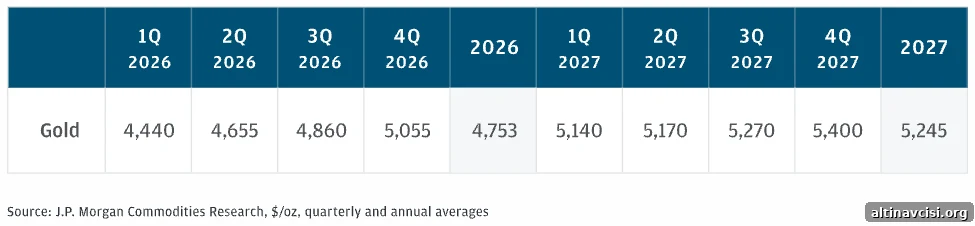
JP Morgan points to structural drivers: major central banks are expected to continue buying bullion — forecasted at around 900 tonnes this year — as nations diversify away from U.S. dollar reserves. Meanwhile, ETF inflows have been robust, reaching roughly 310 tonnes year-to-date, and analysts see further room for investor participation.
“We remain deeply convinced of a continued structural bull case for gold,” says Natasha Kaneva, head of Global Commodities Strategy at JP Morgan. Given ongoing tariff disputes, geopolitical tensions, and sticky inflation, the bank’s outlook represents a strong endorsement for gold from the sell side.
World Gold Council Maps Three Paths for 2026
After gold’s exceptional performance in 2025, the World Gold Council (WGC) outlines three potential scenarios for 2026. The baseline scenario assumes range-bound trading if current conditions persist. A moderate case envisions 5–15% gains in a slower environment, while the bullish case projects a 15–30% surge if global risks escalate materially.
The WGC notes that slower growth, looser policy and lingering geopolitical risks are more likely to support gold than to undermine it. That said, the council also flags a bearish possibility: if reflationary policies drive stronger growth, higher yields and a firmer dollar could trigger a correction of 5–20%.
Central bank demand and recycling flows remain key wildcards that could push prices in either direction. Overall, the WGC expects volatility in 2026 and emphasizes gold’s continued role as a portfolio hedge.
One central variable that could tip the balance is inflation — and how markets interpret recent reports.
Trump Team Touts Lower Inflation — Economists Urge Caution
The White House highlighted November’s headline CPI reading of 2.7% — notably below forecasts — with officials promising “lower prices and bigger paychecks.” However, December’s preliminary data showed inflation nudging back up to 2.9%, extending an upward trend that has kept the Federal Reserve cautious about prompt rate cuts.
Economists emphasize that prices are still rising, even if the pace has slowed, and that inflation remains above the Fed’s 2% target. Core measures, which remove food and energy, eased slightly but did not eliminate concerns about persistent inflation. These mixed signals could delay expected rate cuts and keep interest rates higher for longer, a backdrop that typically pressures risk assets and supports the dollar.
How much weight policymakers and markets should place on the recent lower reading is a subject of debate among experts.
Economists Question “Too Good to Be True” Inflation Data
November’s CPI report initially looked unusually favorable, with headline CPI at 2.7% and core at 2.6%, prompting a positive market reaction. Yet many economists have raised concerns about the reliability of the numbers because a prior government shutdown disrupted data collection in October.
To compensate for missing information, the Bureau of Labor Statistics applied methodological adjustments that were not fully transparent, prompting questions about whether some price categories were effectively carried forward with zero change. Housing components in particular showed anomalies that don’t match other indicators of rent and shelter costs.
Analysts including Michael Gapen of Morgan Stanley and researchers at Wolfe and Wells Fargo have warned that the November reading may be given less weight by the Fed and that some price measures could rebound in December. If that happens, it would reinforce the Fed’s cautious stance on cutting rates and remind investors of the risks embedded in relying on a single monthly print.