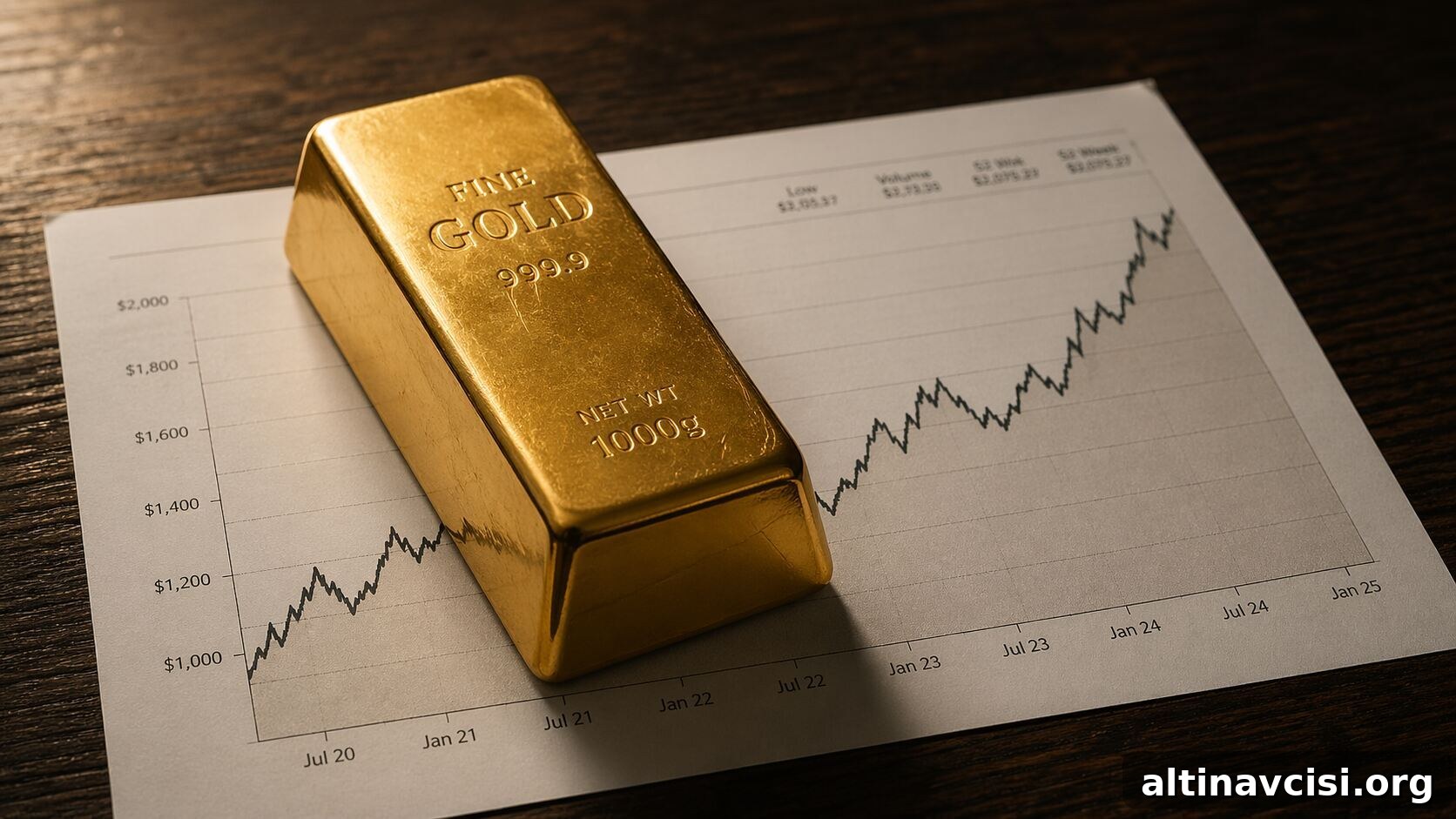
Gold has no single fair value. At around $4,752/oz in April 2026, it sits above its long-term inflation-adjusted average but remains in the middle of its historical range relative to U.S. M2 money supply. A Dow/gold ratio near 10 indicates a mature — not exhausted — bull market.
Gold traded near $4,752 per ounce as of April 22, 2026. That is about 15% below the all-time nominal high reached on January 28, 2026, yet about 43% higher than a year earlier.
A rally of this scale raises an obvious question: is the current price justified, or has the market overshot? The answer depends on the valuation framework you use. The drivers of gold — monetary expansion, central bank accumulation, and persistent inflation — have not diminished; if anything, they have intensified. Different valuation methods, however, point to different conclusions. Below is a clear summary of what the main models show.
What Is Gold Fair Value — and Why Is There No Single Answer?
Gold fair value refers to a theoretically justified price for an ounce of gold based on economic conditions. Pinning it down is difficult because gold does not produce cash flows. Unlike stocks, which can be valued by expected earnings, or bonds, which are valued by yields, gold generates no income. That means every fair value model compares gold to something else: the dollar’s purchasing power, the money supply, or the value of equities.
No single framework is definitive. Each captures a different aspect of what gold does for portfolios and economies. The three most commonly used approaches are the inflation-adjusted price model, the gold-to-M2 money supply ratio, and the Dow/gold ratio.
Does the Inflation Model Say Gold Is Overpriced?
The inflation-adjusted model is the most intuitive starting point. When you express historical gold prices in constant 2025–2026 dollars using the Consumer Price Index, the long-term average since 1980 is roughly $1,400 per ounce. At today’s price near $4,750, gold trades at more than three times that long-run real average.
The 1980 nominal high of $850 occurred amid CPI inflation above 13% and, depending on CPI methodology, equates to roughly $2,800–$3,200 in 2026 dollars. Gold’s more recent peaks pushed it above that inflation-adjusted high for the first time in decades, representing genuine price discovery in real terms.
That historical anchor is important: by this metric, current levels are elevated. The caveat is that CPI may understate broader price changes in financial assets and property. If the dollar’s effective purchasing power has fallen faster than CPI shows, then the inflation-adjusted baseline should be higher — and gold’s relative elevation would be smaller.
What Does the Gold/M2 Ratio Say About Where Gold Should Be?
The gold/M2 ratio compares the price of gold to the M2 money supply, a broad measure of dollars in circulation. If money supply grows while gold supply is stable, gold should rise proportionally. This approach ties gold’s price directly to currency expansion rather than to past nominal prices.
U.S. M2 was approximately $22.7 trillion in early 2026, while U.S. official gold holdings remain limited. Historically, the gold/M2 ratio has ranged widely — from deeply undervalued levels around 20 in 2000 to very low ratios near 2 at the 1980 peak. By early 2026, the ratio was about 5.
After more than doubling in recent years, gold has roughly kept pace with extraordinary money-supply growth. That move represents a normalisation from decades of undervaluation rather than an extreme overvaluation.
What Does the Dow/Gold Ratio Say About the Bull Market?
The Dow/gold ratio divides the Dow Jones Industrial Average by the spot price of gold and shows how many ounces of gold buy one Dow unit. It’s a long-standing way to compare gold’s value to equities.
Key historical benchmarks include: 43 at the dot-com peak in 1999 (stocks at extreme premium to gold); a roughly 50-year average around 15; 6.7 at the 2011 cycle low; and 1.3 at the 1980 cycle low when gold was most expensive relative to stocks. In April 2026 the ratio was near 10.
A ratio of 10 sits below the long-run average, confirming that the gold bull market is substantial and well underway. Yet past cycle extremes arrived at much lower ratios, so there remains room for further compression if the cycle continues.
Why the Models May All Be Underestimating Gold’s Floor
All common valuation models are inherently backward-looking. They do not fully capture a structural shift in demand that has emerged since 2022: persistent, large-scale central bank purchases.
Central banks have been net buyers of gold every year since 2010, but the pace since 2022 stands out. Annual purchases exceeded 1,000 tonnes in 2022–2024 — a level not seen since the 1960s. In 2025 purchases slowed to around 863 tonnes but remained well above pre-2022 averages. Forecasts for 2026 also point to elevated buying versus earlier norms.
These buyers are sovereign institutions making long-term reserve-allocation choices. Their purchases are less price-sensitive and reflect strategic diversification away from some traditional reserve assets. That structural demand can raise the effective floor for gold in ways pre-2022 models do not account for.
So Is Gold Overvalued Right Now?
Gold is above its long-term inflation-adjusted average, but it is not at an extreme by major alternative measures. The inflation model flags a high valuation versus the long-run real average, while the M2 ratio places gold around the middle of its historical range. The Dow/gold ratio, near 10, supports a view of a mature bull market with room to run before historical cycle extremes.
Institutional forecasts reflect continued upside: several major banks raised year-end 2026 targets in early 2026, citing sustained reserve diversification by central banks. Where gold looks most stretched is against certain real assets like some property markets and oil. Against monetary aggregates and financial assets, the valuation case remains defensible so long as inflation stays above the Fed’s 2% target and central bank demand persists. A sharp reversal in either condition would require re-evaluating these conclusions.
The more durable question is whether the structural forces that drove gold’s repricing over the past several years remain in place. Current indicators suggest they do.
Stay On Top of Gold & Silver Prices
Get important market alerts sent straight to your inbox.
People Also Ask
What is the fair value of gold right now?
There is no single fair value. At roughly $4,750/oz in April 2026, the inflation-adjusted model places gold above its long-run average, the M2 model puts it in the middle of its historical range, and the Dow/gold ratio of about 10 signals a mature but not exhausted bull market. Overall: elevated, but not historically extreme on any single measure.
How do analysts calculate gold’s fair value?
Analysts typically use three approaches: adjusting past prices for CPI inflation to create a real baseline; comparing gold to the M2 money supply to gauge currency debasement; and tracking the Dow/gold ratio to compare gold to equities. Combining these perspectives provides a fuller picture.
Is gold overpriced at $4,750 per ounce?
By the inflation-adjusted model, gold is trading well above its long-run real average. By the M2 model, it sits around the middle of its historical range. Institutional forecasts from major banks in early 2026 pointed to additional upside, suggesting many analysts see current levels as part of a broader upward trend.
What was the inflation-adjusted all-time high for gold?
The 1980 nominal peak of $850 equates to roughly $2,800–$3,200 in 2026 dollars depending on CPI methodology. When gold exceeded that range in recent years, it surpassed the inflation-adjusted record for the first time in over forty years.
How does the money supply affect gold’s fair value?
Expansions in the money supply reduce the purchasing power of each dollar unit. Since gold cannot be created at will, it tends to rise relative to a larger money supply. The gold/M2 ratio tracks how far gold has moved relative to money printing; by early 2026 this ratio had shifted from deeply undervalued territory to approximately the middle of its historical range.
Gold’s Floor Has Moved. The Models Are Still Catching Up
Gold’s fair value is not static. The inflation model, the M2 model, and the Dow/gold ratio each tell a slightly different story, but together they show the same broad picture: at around $4,750/oz, gold is above long-run averages while not at the extreme levels that historically mark cycle tops. Structural factors — persistent inflation, a dramatically larger money supply since 1971, and elevated central bank demand — support a higher long-term equilibrium than pre-2022 models implied. If those forces persist, gold’s higher floor is likely to remain.
SOURCES
1. Trading Economics — Gold Price
2. CBS News — Highest Gold Price in History
3. LBMA — Precious Metals Market Report Q1 2026
4. InflationData.com — Inflation Adjusted Gold Prices
5. U.S. Bureau of Labor Statistics — CPI Inflation Calculator
6. MacroTrends — Historical Gold Prices
7. MacroTrends — Gold to Monetary Base Ratio
8. Federal Reserve / FRED — M2 Money Supply
9. World Gold Council — Gold Demand Trends Full Year 2025
10. J.P. Morgan Global Research — Gold Price Analysis
11. Goldman Sachs — Gold Price Forecast
Disclaimer: This article is for informational and educational purposes only. It does not constitute investment advice. Consult a qualified financial adviser before making investment decisions.
You May also like:
- Silver Price Predictions for the Next 5 Years: Data-Backed Scenarios
- Tariff Refunds, Dollar Weakness, the AI Bust: Gold’s Case
- How to Buy Gold for Beginners: Step-by-Step Guide (2026)
- Silver Price Forecast 2026-2027: The bull case and bear case laid out
- How to Buy Silver Bars: The Investor’s Guide
- Why Silver Falls While Gold Rises: What It Means for You
- Why Are BRICS Countries Buying So Much Gold?
- Gold Price Forecast 2026–2027: Key Predictions from Top Analysts