Invest in Precious Metals in 2026: Why Allocations Are Rising
If you’re considering whether to buy precious metals in 2026, you’re not alone. Increasingly, analysts, wealth managers, and large institutional investors are re-evaluating the role that gold and silver play in modern portfolios. Many are concluding that metals deserve a larger allocation than they have held in recent decades, driven by persistent macro risks and changing market dynamics.
This reassessment gained notable attention in late 2025 when a prominent chief investment officer publicly endorsed a 60/20/20 allocation framework — 60% equities, 20% bonds, 20% gold — positioning gold as a core inflation hedge rather than a niche diversifier. For an industry long invested in the traditional 60/40 stock-bond mix, that suggestion represents a meaningful shift in thinking.
Why Institutions Are Increasing Precious Metals Allocation
Institutional interest in precious metals has been rising for several years, and the pace accelerated over the last 18–24 months. Although institutions express the rationale in different ways, research desks and major banks typically point to the same set of drivers:
- Stubborn inflation and uncertainty around long-term price stability.
- Declining real yields, which have historically supported higher gold prices.
- Growing geopolitical risk, increasing the value of non-correlated assets.
- Concerns about high global debt levels and broad money-supply expansion.
Taken together, these factors make precious metals attractive for liquidity, independence, and diversification benefits that traditional financial assets do not fully provide. For investors evaluating whether to buy precious metals in 2026, institutional interest adds credibility and suggests a broader rethinking of portfolio construction in the coming decade.
What Happens If Gold Becomes a Standard 20% Allocation?
Consider a simple thought experiment to illustrate the potential scale of demand.
Scenario 1: U.S. retirees allocate 20% of their portfolios to gold
U.S. retirement accounts collectively hold roughly $45.8 trillion across IRAs, 401(k)s, and pension funds. If these accounts shifted to a standard 20% allocation to gold, collectively that would represent about $9.16 trillion flowing into precious metals. Converting that amount into physical gold equates to roughly 142,454 metric tonnes — more than 44 times the current annual global mine supply. That scale of demand would quickly overwhelm typical yearly production.
Scenario 2: Global investors adopt similar allocations
The U.S. is only one market. If large global pension systems in the world’s biggest markets followed the same model and targeted a 20% gold allocation, the incremental demand would be even larger. Estimates suggest about $11.7 trillion in potential additional demand, equivalent to roughly 181,956 metric tonnes of gold — nearly 57 times annual new mine supply. That magnitude would profoundly affect the structure, pricing, and liquidity of the gold market.
Actual vs. Theoretical Gold Market Cap Under Higher Allocation Chart
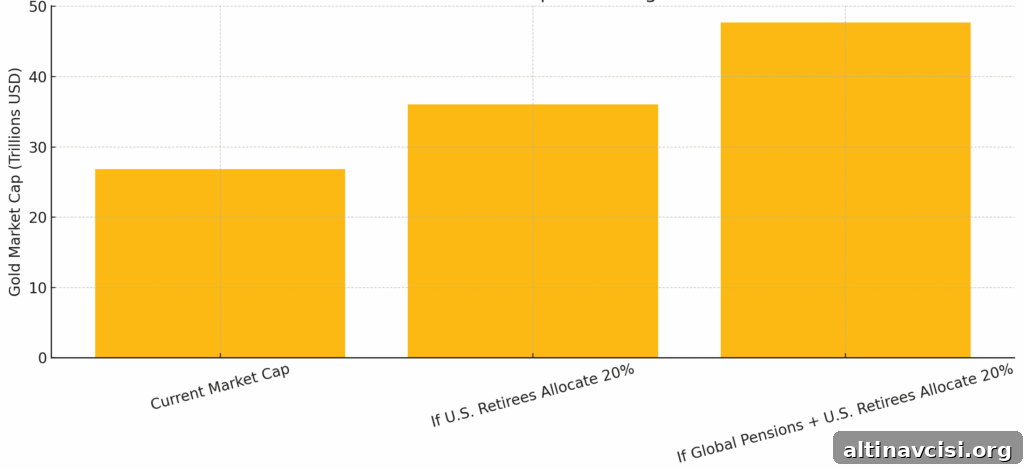
- Current market cap (at $4,000 gold): $26.86T
- If U.S. retirees allocate 20%: +$9.16T → $36.02T
- If global pension funds also allocate 20%: +$11.7T → $47.72T
Demand at that scale would far exceed annual production and could reshape market dynamics. The market does not require universal adoption to shift structurally; even a modest proportion of investors moving toward larger metal allocations would increase long-term demand and influence pricing.
The Academic Case for Higher Precious Metals Allocation
Academic research has long examined the role of gold and silver in portfolios. A broad set of studies shows that portfolios holding a modest allocation—commonly between 5–15%—to gold and silver often achieve better risk-adjusted returns over time. These allocations typically reduce maximum drawdowns during episodes of market stress and produce steadier performance through volatile economic cycles.
The rationale is straightforward: gold historically performs well when equities decline, inflation surprises to the upside, or volatility spikes. Silver adds further diversification and industrial demand exposure, offering both monetary and industrial characteristics within a metals allocation. These effects are measurable across multiple decades of market cycles, which is why many investors now view precious metals as a strategic position rather than a short-term trade.
Why 2026 May Be a Strategic Entry Point
Several macro forces are coming together in ways that could make 2026 an attractive time to consider strategic accumulation:
- Central banks are adding to gold reserves at the highest rates in decades.
- Real yields have been volatile and show a long-term tendency to trend lower.
- In many regions, inflation remains above pre-2020 norms.
- Market cycles appear mature while geopolitical tensions and policy uncertainty remain elevated.
- Structural demand from technology, solar energy, and infrastructure is increasing, particularly for silver.
None of these factors guarantees a specific price path for gold or silver, but together they make a compelling case for viewing precious metals as part of a resilient, long-term portfolio strategy.
The Bottom Line
Whether you are a retiree protecting savings, a long-term investor seeking better diversification, or someone exploring how to buy precious metals in 2026, the landscape is changing. Institutional allocation trends, academic evidence, and broader economic risks all support the idea that gold and silver can strengthen a diversified portfolio.
This shift is not about reacting to fear; it’s about adjusting strategy to reflect changing macro conditions and the demonstrated portfolio benefits that precious metals can provide. Before making any allocation changes, consider your time horizon, risk tolerance, and the role metals should play within your broader investment plan.
Investing in Physical Metals Made Easy
If you’re exploring physical metals as part of a long-term plan, seek reliable education and documented market analysis to inform your decisions.
People Also Ask
Is 2026 a good time to buy precious metals like gold and silver?
2026 may present strategic opportunities for buying precious metals due to persistent inflationary pressures, lower real yields, and continued geopolitical uncertainty. These factors support longer-term demand, but individual timing should align with personal goals and a considered allocation plan.
Why are more investors increasing their allocation to gold?
Investors are increasing gold allocations to hedge against inflation, protect portfolios during equity downturns, and offset the declining real returns of nominal bonds. Gold’s historical behavior during crises and periods of rising prices makes it attractive for diversification.
How big is the current gold market cap at $4,000 per ounce?
At $4,000 per ounce, the global above-ground stock of gold is valued at roughly $26–27 trillion. That figure offers a baseline to compare how large institutional reallocations could expand the market in meaningful ways.
What percentage of a portfolio do experts recommend for gold?
Many academic and quantitative studies suggest a 5–15% allocation to gold and silver can improve diversification and reduce volatility. Some modern portfolio models explore higher allocations depending on risk tolerance and macro outlook.
What would happen if U.S. retirees allocated 20% of their portfolios to gold?
If U.S. retirement accounts shifted to a 20% gold allocation, that would generate roughly $9.16 trillion of demand — more than 44 times annual mine production — significantly altering market supply-demand dynamics and likely driving long-term price pressure.
Get Gold & Silver Insights Direct to Your Inbox
Join thousands of investors who receive expert analysis, market updates, and timely perspectives on metals and macro trends.
Popular Topics
Picked from the archive
-
01
 Topics
Citi Predicts Gold May Hit $3,500 After Weak Jobs Report
-
02
Topics
Gold Climbs on Trade War Jitters Before US Inflation Report
-
03
Topics
Gold Price Nears $3,700 Ahead of Fed Meeting
-
04
Topics
U.S.-Japan Trade Deal Lifts Investor Confidence, Gold Pulls Back
-
05
Topics
Trump’s No-Tariff Pledge Calms Gold Prices
-
06
Topics
Trump’s Allegations Against BLS Ignite Debate on Data Integrity
-
07
Topics
Why Central Banks Are Buying Gold as Citi Warns of Pullback
-
08
Topics
Fed’s Bowman and Waller Support Possible July Rate Cut