Gold and silver market update — May 5, 2026
Key Takeaways
- The IMF abandoned its baseline economic forecast on May 4, 2026, saying its “adverse scenario” — 2.5% global growth and 5.4% headline inflation — is now the working reality rather than a downside risk.
- IMF Managing Director Kristalina Georgieva warned that if the conflict continues into 2027 and oil reaches about $125 per barrel, inflation expectations could “de-anchor,” a shift that historically compresses real yields and strengthens gold’s structural case.
- For holders of physical gold, the $4,560 price on May 5, 2026 reflects a temporary equilibrium. Oil-driven inflation is limiting the Fed’s ability to cut rates, and the IMF’s statement confirms that pressure is intensifying, not easing.
The International Monetary Fund spent weeks preparing an outlook for 2026. On May 4, in Beverly Hills, the managing director said that baseline outlook is no longer applicable.
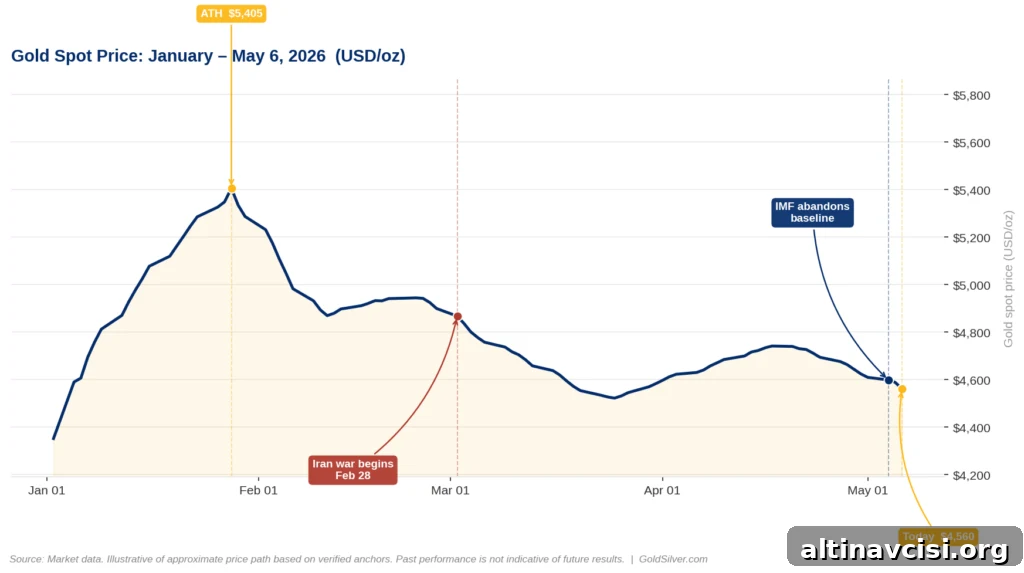
Speaking at the Milken Institute Global Conference, Kristalina Georgieva said the Fund’s reference scenario — built on an assumption of a short-lived Middle East conflict — is “further and further behind in the rear-view mirror.” The world has moved into the IMF’s adverse scenario: slower growth and higher inflation. Gold traded at $4,560.35 on May 5, 2026. This article explains why that price and the IMF’s warning belong in the same context.
Why Did the IMF Abandon Its Own Economic Forecast?
On May 4, 2026, Kristalina Georgieva told the Milken Institute audience that the Fund’s reference scenario — which assumed a short, contained Middle East conflict, 3.1% global growth and 4.4% inflation in 2026 — is no longer credible. Instead, the IMF is operating on its adverse scenario, which implies 2.5% global growth and 5.4% headline inflation for 2026.
Georgieva pointed to three factors that have activated the downside case: the ongoing war, oil prices at or above $100 per barrel, and widening inflationary pressures. For precious metals investors, this matters because it signals that the benign inflation pathway that kept real yields higher and gold suppressed is formally off the table.
The IMF published three scenarios in April based on the Middle East conflict. The reference scenario was the baseline many policymakers used. Georgieva publicly called that baseline obsolete and warned that if the conflict persists into 2027 with oil near $125 per barrel, inflation could climb further and inflation expectations risk “de-anchoring.”
The phrase “de-anchoring inflation expectations” is pivotal: it describes a structural change in how markets, businesses and workers form expectations about future prices, which has powerful implications for monetary policy and safe-haven assets like gold.
The Edge Every Investor Needs
Smarter precious metals investing starts here. The Nuggets Newsletter brings essential market insights, Fed updates, global trends, educational videos, and more.
What Does “De-Anchoring Inflation Expectations” Mean for Gold?
As of May 2026, inflation expectations remain broadly anchored: markets still trust central banks to restore price stability. Georgieva’s warning outlines how that trust could break and why such a shift matters for gold.
When expectations are anchored, households and businesses expect inflation to return to target, so they don’t build permanent price increases into wages and contracts. If expectations de-anchor, a self-reinforcing loop forms: workers demand higher pay to offset expected price rises, firms raise prices to cover higher labor costs, and inflation feeds on itself. That is not a short-lived disruption; it can create a multi-year regime change.
A historical parallel is the 1970s. The U.S. experienced de-anchored expectations combined with fiscal pressure and delayed tightening, and gold surged after the end of the Bretton Woods peg — rising from $35 per ounce in 1971 to roughly $850 by 1980. The eventual cure required aggressive tightening that triggered a severe recession. Today, high government debt and large interest obligations reduce central banks’ room for such an aggressive response, altering the policy choices available and strengthening gold’s role as a hedge.
Georgieva also noted a less-covered transmission channel: fertilizer prices have jumped 30–40% due to supply disruptions from a closed Strait of Hormuz, which will push food prices higher by an estimated 3–6%. That shows inflation is spreading from energy into essentials, broadening its impact on households and core inflation measures.
What Are Central Banks and Major Institutions Doing About It?
One clear institutional response is central bank buying of gold. The World Gold Council reported net central bank purchases of 244 tonnes in Q1 2026, continuing a multi-year trend. These purchases are reserve management, not short-term trades — a repositioning against the type of environment the IMF described, where inflation expectations may de-anchor and fiat currencies face structural pressure.
On the same Milken panel, Chevron CEO Mike Wirth warned that oil shortages will begin appearing worldwide because of disruptions through the Strait of Hormuz, with demand adjustments likely to hit Asia first. That operational perspective from a major energy company supports the IMF’s caution about persistent energy-driven inflation.
A counterargument is straightforward: if the conflict ends and oil prices fall sharply, inflation pressures ease, real yields recover, and gold could face headwinds. A durable ceasefire that reopens shipping lanes is the clearest path to a gold pullback. The IMF’s shift, however, reflects that scenario is no longer being treated as the most likely path.
What Does the IMF Forecast Shift Mean for Physical Gold Holders?
The IMF does not promote gold. It manages the global fiat system. When its managing director abandons the baseline forecast and highlights the risk of de-anchored inflation expectations, she is describing the monetary environment in which gold has historically outperformed paper alternatives.
Mechanically, de-anchored expectations typically compress real yields — the return on cash after inflation — because central banks are constrained in how far they can raise nominal rates without triggering fiscal stress. The U.S. faces substantial annual interest costs on its debt, which limits the scope for aggressive rate hikes that would restore positive real yields. In that policy gap, gold tends to find structural support.
Therefore, the $4,560 gold price on May 5, 2026 should be viewed not as a negation of gold’s thesis but as a current market equilibrium amid energy-driven inflation and constrained monetary policy — conditions the IMF just underscored.
This is not alarmist; it is the IMF’s updated working assumption.
What to Watch: Key Dates for Gold Investors in May 2026
Three dates matter:
Friday, May 8: Nonfarm Payrolls. Consensus for payrolls has dropped sharply. A weak report would revive the debate over rate cuts and compress real yields.
Tuesday, May 12: April CPI. The first inflation print after the IMF’s shift — a hot CPI would validate Georgieva’s framing in real time.
Friday, May 15: Fed leadership change. Jerome Powell’s term as Fed Chair expires. The Senate vote on Kevin Warsh’s nomination is expected the week of May 11. If confirmed, Warsh’s preferred trimmed mean PCE measure could affect the timing of any pivot to cuts.
Watch $4,500 as near-term technical support for gold. Holding above that level — with the CPI print, payrolls, and any Fed developments ahead — could set up a move back toward $4,700.
Stay On Top of Gold & Silver Prices
Get important market alerts sent straight to your inbox.
SOURCES
1. Reuters via Jerusalem Post — IMF chief Georgieva warns of ‘much worse outcome’ if Middle East war drags into 2027
2. International Monetary Fund — World Economic Outlook, April 2026: Global Economy in the Shadow of War
3. World Gold Council — Gold Demand Trends Q1 2026
4. World Gold Council — Central Banks: Gold Demand Trends Q1 2026
5. Congressional Budget Office — Budget and Economic Outlook: 2026 to 2036
6. Bureau of Labor Statistics — Consumer Price Index: Release Schedule
7. CNBC — Trump Fed pick Kevin Warsh clears key Senate hurdle, teeing up final vote
8. CNBC — Kevin Warsh gave his preferred way for measuring inflation
Disclaimer: This article is for informational purposes only and does not constitute financial or investment advice. Always consult a qualified financial adviser before making investment decisions.
You May Also Like:
- What’s Really Driving Gold Prices Today — 5 Key Signals
- Gold Price and the Jobs Report: A Pre-Market Guide
- The Gold-Silver Ratio Is Expanding — and Being Misread
- Gold, Silver, and Stagflation: 5 Signals That Matter Now
- Why Gold Fell on the Hormuz Tanker Strike
- WGC Q1 2026: What Asia Knows That Wall Street Doesn’t
- BEA Stripped Silver From GDP. Here’s What It Means
- PCE at 3.5%, GDP Miss: Why This Is Bullish for Gold