
This morning, President Trump posted on Truth Social announcing that the United States would act as the “GUARDIAN OF THE HORMUZ STRAIT” and that every cargo ship transiting the passage would pay a 20% levy. Gold had already fallen sharply earlier in the session after airstrike headlines, and it dropped another $40 within twenty minutes following the announcement. By early afternoon, the metal had fallen as low as $4,005.
At first glance, that market move seems counterintuitive. War risk, a shipping toll and higher oil prices are the kinds of shocks that typically drive investors toward gold. So why did gold decline?
Why Did Gold Fall When Oil Prices Surged?
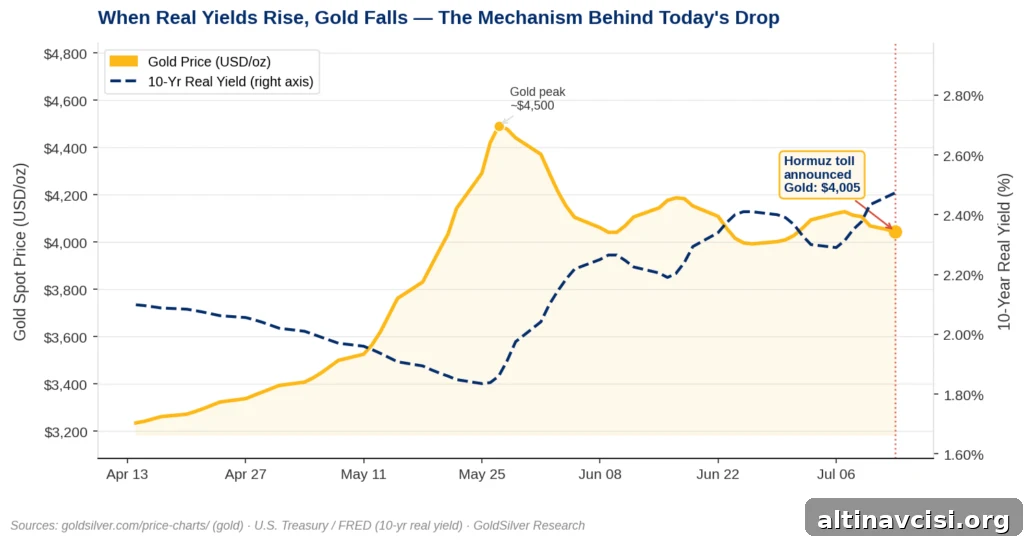
The explanation unfolds as a clear four-step chain. Understanding that chain matters more than focusing on a single price move.
First: the announcement pushed Brent crude higher, reflecting the reality that roughly one-fifth of seaborne oil—and a similar share of global liquefied natural gas—moves through the Strait of Hormuz. When that passage effectively becomes a 20% surcharge on top of existing war-risk premiums and potential rerouting costs, energy expenses stop being a short-lived spike and instead become an added structural cost across global supply chains.
Second: higher embedded energy costs translate into sustained inflationary pressure. That sustained inflation is exactly the kind of environment that forces the Federal Reserve to consider further interest-rate increases.
Third: as markets price in a greater probability of Fed tightening, bond yields rise. Higher yields increase the appeal of interest-bearing assets like Treasury bonds relative to non-yielding assets such as gold.
Fourth: because gold pays no interest, rising real yields make bonds comparatively more attractive and prompt some investors to rotate out of gold and into fixed income. That selling pressure pushes the gold price down in the near term.
Putting those steps together explains why a geopolitical shock that raises oil prices can, paradoxically, cause gold to fall in the short run: the prospect of tighter monetary policy and higher yields outweighs the safe-haven demand, at least until inflation and yields find a new equilibrium.
Markets had already been pricing in a significant chance of an additional Fed rate increase this fall before the announcement, and the oil-driven inflation risk pushed those odds higher. As short-term expectations for tightening rise, gold faces downward pressure until incoming economic data clarifies the Fed’s likely path.
What Does Trump’s Hormuz Toll Mean for Gold Prices Long Term?
Short-term market dynamics and the long-term investment thesis for gold can diverge sharply. The same forces that pressured gold today are also the reasons many investors continue to hold it for the next three to five years.
If the Hormuz announcement becomes an enduring cost layer—one that shipping companies, manufacturers and retailers factor into prices—then this disruption effectively reduces the purchasing power of currency over time. A persistent increase in the cost of moving goods is not easily reversed by central banks. When real economic costs rise structurally, savers who hold paper currency or low-yielding nominal assets are vulnerable to erosion of purchasing power. Gold, as an asset outside the fiat system, retains a unique role as a hedge against that persistent loss of purchasing power.
That is not a short-term forecast of price action next month. Instead it is a description of how a permanent or long-lasting change in the cost structure of the global economy reinforces the case for holding real assets. Monetary and fiscal dynamics that buoyed gold to prior highs—monetary expansion, elevated deficits and shifting global reserve preferences—have not been reversed. An enduring increase in shipping costs accelerates those trends rather than negating them.
Is the Structural Case for Gold Still Intact?
Yes. Central bank behavior remains illustrative of the longer-term picture. Major reserve managers continued to add to official gold holdings even during volatile periods, signaling that official buyers view gold as a long-term reserve asset rather than a tactical trade tied to headlines.
Gold is trading well below its recent all-time highs, but the core drivers behind those peaks—persistent monetary expansion, ongoing fiscal imbalances and structural shifts in global reserve allocation—remain present. Those structural forces support the case for gold over multi-year horizons, even if short-term price action is driven by changes in yield expectations and risk sentiment.
Watch upcoming inflation readings and central-bank commentary closely. If inflation remains stubbornly high, rate-hike odds and short-term downward pressure on gold may increase. If inflation softens, yield pressures could ease and gold may recover. The near-term path will follow incoming data; the long-term case will depend on whether structural economic costs and monetary trends persist.
Stay On Top of Gold & Silver Prices
Get important market alerts delivered to your inbox.
Subscribe for market alerts (form disabled on this copy).
Disclaimer: This article is for informational purposes only and does not constitute financial or investment advice. Always consult a qualified financial adviser before making investment decisions.
You May Also Like:
- Gold Fell 1.4% on an Iran Strike. One Number Tomorrow Morning Could Change Everything.
- Trump Declared the Ceasefire Over. Gold Barely Moved.
- HSBC Cut Its Gold Forecast by $304. Then Said Gold Will Hit $4,750 by Year-End.
- The Fed Named AI Its Top Inflation Risk. Gold Noticed.
- Five Days From Now, Two Numbers Will Decide Gold’s Second Half
- Bank of America Cut Its Gold Forecast. The Reason Is More Bullish Than It Looks.