Convinced a recession is here? Worried the stock market isn’t done crashing?
It’s possible conditions could worsen.
That raises a natural question: how do gold and other precious metals typically perform during these events?
Looking at historical data reveals a clear pattern for many of them.
Precious Metals vs. Recessions
The most common definition of a recession is two consecutive quarters of negative GDP growth. Because GDP is reported with delay, a recession is a lagging indicator—you often only know you’re in one months after it began.
Since 1970 the U.S. has experienced eight recessions. We reviewed how the major precious metals—gold, silver, platinum, and palladium—behaved over the official time span of each recession.
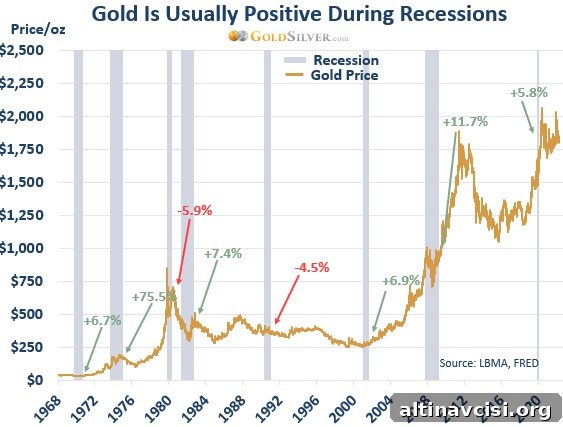
First, here’s how gold has performed during those periods of negative economic growth.
In six of the eight modern recessions, gold finished higher than it began. The two declines were modest; one occurred just after an exceptional surge in gold’s price.
This is encouraging for investors: gold rose during the recession that followed 9/11, it rose during the Great Financial Crisis, and it rose during the Covid recession. In other words, several of the worst modern crises coincided with higher gold prices.
That pattern makes sense. A slowing economy raises uncertainty, and gold is often viewed as a safe haven when fear spreads among investors.
A Bloomberg analysis that compared gold and the S&P 500 around the last seven recessions examined the 24-month window centered on each recession (12 months before the start through 12 months after). On average, gold outperformed the S&P 500 by roughly 50% across those two-year spans.
- History shows gold can act as a hedge for portfolios during recessions.
Now let’s consider the other precious metals.
Silver has generally underperformed during recessions. That outcome is logical because about 55% of silver demand is industrial, and industrial activity typically slows during economic downturns.
Platinum and palladium have fared worse. Platinum fell in every recession since 1970 except one when it was essentially flat. Palladium also declined in nearly all recessions.
These metals are heavily used in vehicle emissions systems—roughly 90% of platinum and palladium demand is automotive—so lower vehicle production and sales during recessions tend to depress their prices.
Precious Metals vs. Stock Market Crashes
Stock market crashes can deal severe blows to investment portfolios. How do precious metals perform in those episodes?
Over the past 50 years there have been ten significant market crashes (declines of 19% or more in the S&P 500). Examining metal performance during each crash window shows a clear tendency for gold to hold up better than equities.
Historically, gold has often risen during market crashes. In the few instances when gold fell, two times the decline was smaller than the S&P fall, and the only larger drop occurred immediately after an unusually large prior gain.
Silver presents a mixed picture. It frequently declines when stocks sell off, although about half the time its drop is smaller than the S&P’s move.
Platinum and palladium have generally performed poorly during crashes. Since the 1970s platinum has rarely risen in these episodes, and palladium has not risen during any of them. Remember this analysis measures performance during the crash window itself, not the longer-term recovery that may follow.
Got Gold?
Historically, gold has outperformed other precious metals during recessions and stock market crashes. When fear and uncertainty increase, gold commonly serves as a portfolio hedge. For that reason, many investors choose to hold some gold alongside silver.
Gold is more than a speculative safe haven: it has long functioned as money. As monetary systems evolve and face pressures, gold’s role as a store of value can become more apparent to investors.
If you want to maintain purchasing power and diversify risk, owning some physical gold is a straightforward approach.
About Jeff Clark
Jeff Clark is an active investor and respected commentator on precious metals. With family roots in mining and years of experience in the field, he regularly speaks at industry events and provides analysis to investors. He serves on the board at Strategic Wealth Preservation in Grand Cayman and contributes market commentary to GoldSilver customers.