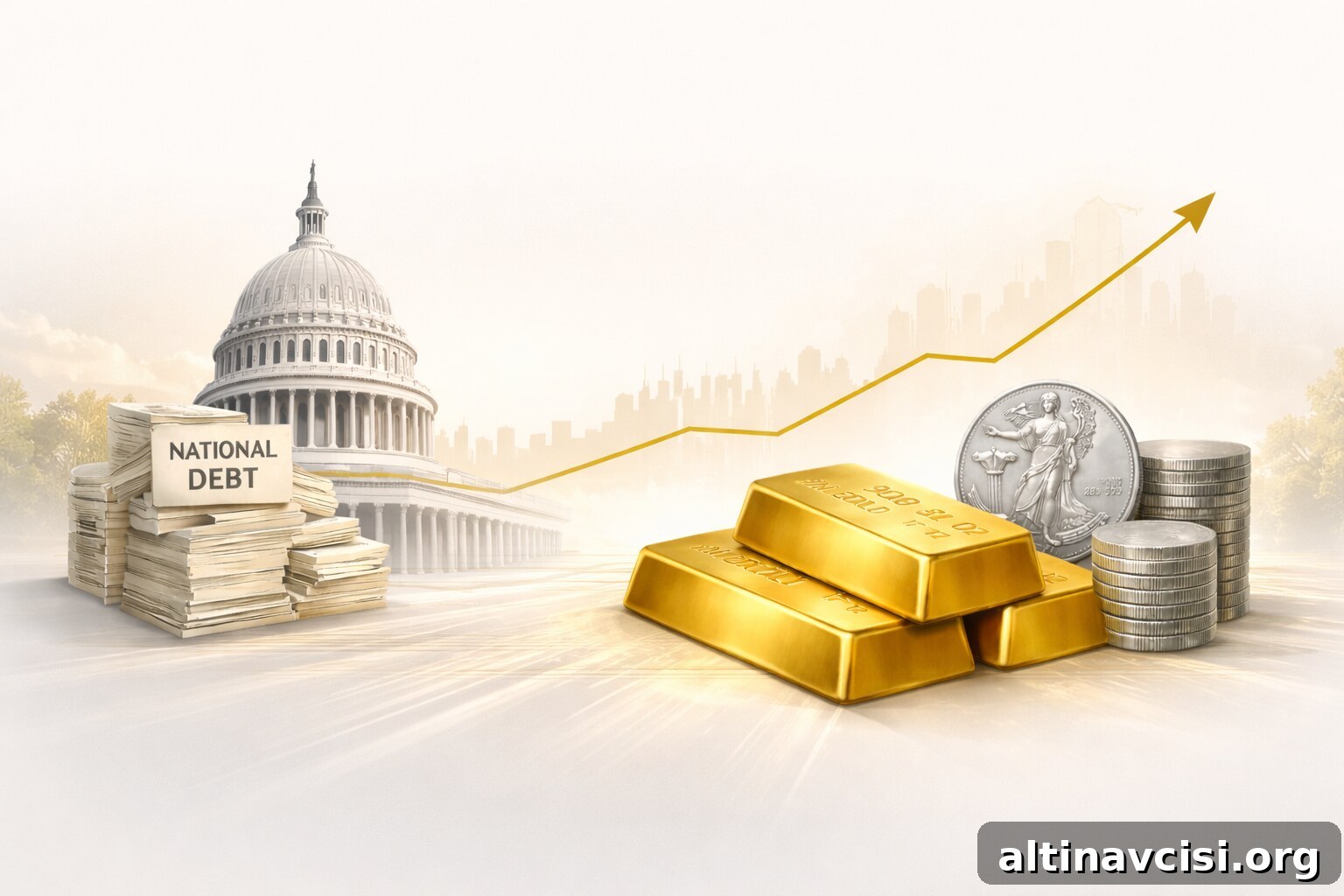
Government debt is one of the defining financial realities of our time. The U.S. national debt recently topped $36 trillion, and many other major economies are facing rising fiscal pressure. For investors, the key question is: how does increasing government debt affect the price and performance of gold and silver?
In short, higher sovereign debt is generally bullish for precious metals — but the connection is complex. Knowing the channels through which debt influences markets can help you decide if, when, and how to include gold and silver in your portfolio.
What Is the Relationship Between Government Debt and Precious Metals?
The link between government debt and precious metals comes down to confidence. When investors trust a government’s fiscal management and the stability of its currency, paper assets such as bonds, cash, and stocks tend to perform well. If that confidence weakens, capital often moves to assets outside the financial system—historically, gold and silver.
Precious metals are not someone else’s liability: they aren’t promises backed by taxes, political choices, or central-bank policy. Their value does not depend on future receipts from a sovereign balance sheet. That makes them especially attractive when sovereign debt rises to historically high levels worldwide.
How Rising Government Debt Affects the Economy
When debt grows faster than economic output, governments face limited options: raise taxes, cut spending, restructure or default, or allow inflation to reduce the real burden of debt. Historically, inflationary policies—via monetary expansion, low rates, or fiscal stimulus—have been the common route.
Expanding the money supply—through quantitative easing, suppressed interest rates, or direct fiscal measures—erodes purchasing power over time. Fiat currencies can continue to function, but each unit buys less as money supply grows faster than goods and services.
Gold’s supply cannot be altered by policy; it increases gradually through mining, typically 1–2% per year. When the supply of fiat currency expands more rapidly than gold’s physical supply, gold usually rises in price in currency terms. This pattern appears repeatedly in history.
The Financial System Isn’t Safer — And You Know It
As risks mount, see why gold and silver are projected to keep shining in 2026 and beyond.
Historical Evidence: Debt, Inflation, and Gold
The 1970s: Debt, Inflation and Gold
After the U.S. left the gold standard in 1971 and government spending increased, inflation accelerated throughout the decade. Gold climbed from $35 per ounce in the early 1970s to over $800 by 1980. Much of that move reflected a repricing of gold relative to an expanding money supply rather than pure speculation.
The 2020 Stimulus Response
In 2020, governments injected trillions into the global financial system to blunt the pandemic’s impact. U.S. federal debt rose by more than $4 trillion in a single year. That year gold gained roughly 25% while silver rose nearly 48%, illustrating how large-scale monetary expansion can drive investor flows into precious metals.
Debt-to-GDP: The Metric That Matters
Many investors watch the debt-to-GDP ratio—the size of government debt relative to economic output. When debt outpaces GDP growth, fiscal stress increases:
- Interest payments consume a growing share of tax revenue
- Governments borrow more to service existing obligations
- Central banks face pressure to keep rates artificially low
The United States today carries debt that exceeds 120% of GDP; historically, ratios above 90–100% have correlated with slower growth and fiscal strain. Globally, total debt has climbed to more than 320% of GDP—roughly double the level at the turn of the century.
Global Debt-to-GDP Has Nearly Doubled Since 2000
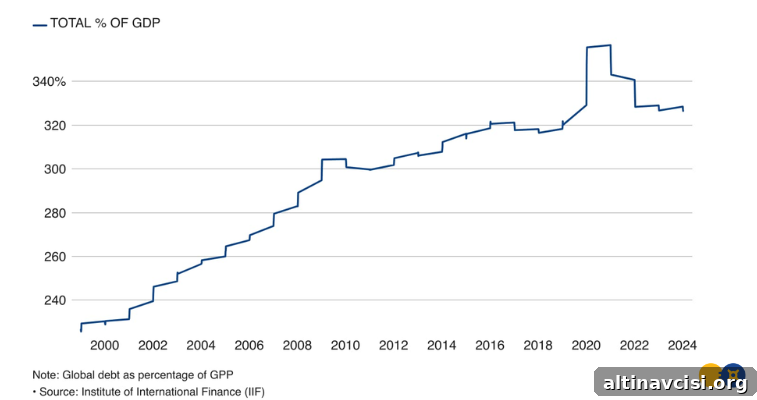
Source: Institute of International Finance (via Reuters)
When debt reaches high levels, governments rarely default outright. More commonly, they rely on financial repression—keeping nominal rates below inflation—to erode the real value of debt over time. In such environments, gold has often outperformed traditional fixed-income assets.
Real Yields and the Gold-Bond Relationship
Gold does not pay interest, which some view as a disadvantage. The more relevant measure, however, is the real yield—bond returns after inflation. When real yields are negative, bondholders lose purchasing power. In those periods, gold’s lack of yield matters less because bonds are delivering negative real returns and investors seek assets that preserve value.
Over the past decade, real yields have often been near zero or negative, and gold has performed well during those stretches. If debt expansion keeps real yields suppressed for longer, gold’s relative appeal as a store of value improves structurally.
The Safe-Haven Effect: Confidence and Counterparty Risk
Debt affects gold not only via inflation but also through confidence. When investors doubt a government’s fiscal discipline or a currency’s long-term stability, they seek assets with no counterparty risk. Gold is unique in that it:
- Is not issued by a government
- Has no default risk
- Does not depend on a financial institution’s solvency
That explains why central banks have increased gold reserves in recent years. When sovereign debt rises globally, central banks diversify into assets outside the bond system—sending a strong signal about the limits of traditional reserve assets.
Silver’s Dual Role: Monetary and Industrial
Silver often follows gold during periods of monetary stress but exhibits greater volatility. In addition to its monetary role, silver benefits from industrial demand in areas such as:
- Solar panels
- Electronics
- Electric vehicles
- Grid infrastructure
Large-scale government spending on energy transition and technology can increase structural demand for silver. This gives silver two distinct drivers: a monetary hedge during inflationary periods and an industrial component tied to growth and investment in infrastructure and clean energy. For investors comfortable with higher volatility, silver can amplify exposure to precious metals alongside gold.
Has Gold Already Priced In the Debt Risk?
It’s reasonable to ask whether gold’s current price already reflects fiscal risks. Major gold bull markets have historically coincided with sustained negative real rates, rising debt-to-GDP ratios, weakening currency confidence, and heightened geopolitical risk. Those conditions are present to varying degrees today.
That does not guarantee immediate price gains—market timing is uncertain. Structurally, however, today’s macro backdrop resembles prior multi-year periods of strong precious-metals performance, suggesting the case for these assets is not necessarily exhausted.
Putting It in Context
Rising government debt does not automatically push gold prices higher, but it increases the likelihood of dynamics that have historically favored precious metals: monetary expansion, persistent inflation, currency depreciation, financial repression, lower real yields, and waning confidence in sovereign balance sheets.
Gold and silver are among the few asset classes that exist outside the traditional financial system while remaining integrated into global markets. For long-term investors worried about purchasing power, understanding this structural position matters more than short-term price fluctuations.
Stay On Top of Gold & Silver Prices
Get important market alerts sent straight to your inbox.
People Also Ask
Does rising government debt increase gold prices?
Generally yes. Rising government debt often leads to monetary expansion and inflation, which reduce the purchasing power of fiat currency. Investors frequently respond by moving capital into gold, a finite tangible asset, which can push its price higher.
Why are gold and silver considered safe-haven assets during debt crises?
Gold and silver carry no counterparty risk and are not promises backed by a sovereign. When confidence in government finances weakens and real yields turn negative, investors shift into precious metals to preserve value outside the financial system.
How does inflation caused by government borrowing affect silver prices?
Monetary expansion from government borrowing drives inflation, which benefits silver as a monetary hedge similar to gold. Because silver also has significant industrial uses, it can outperform during inflationary periods that coincide with strong industrial demand.
What historical trends show the link between national debt and precious metals?
Periods of heavy deficit spending and fiscal stress have frequently coincided with strong precious-metals returns. Notable examples include the inflationary 1970s and the stimulus-driven gains in years such as 2020, when both gold and silver registered substantial increases amid large-scale fiscal and monetary responses.
What percentage of my portfolio should be in gold or silver given high debt levels?
Guidelines often recommend 5–15% of a portfolio in precious metals, depending on risk tolerance. Conservative investors might hold 8–10% in gold and 2–3% in silver. More aggressive allocations could include a smaller gold position and a larger silver weighting to capture silver’s higher volatility and upside potential.
Disclaimer: This article is informational and not investment advice. Past performance does not guarantee future results. Consult a qualified financial advisor before making investment decisions.
You May Also Like:
- Gold vs Silver: The Liquidity Difference That Matters
- Silver Price Components: Premium, Spot, and Dealer Markup Explained
- Silver Price Forecasts Revisited: Why Wall Street Got It Wrong
- Gold’s Purchasing Power: What One Ounce Buys Over Time
- Why Metals Dominated Every Asset Class in 2025 [and What It Means for 2026]