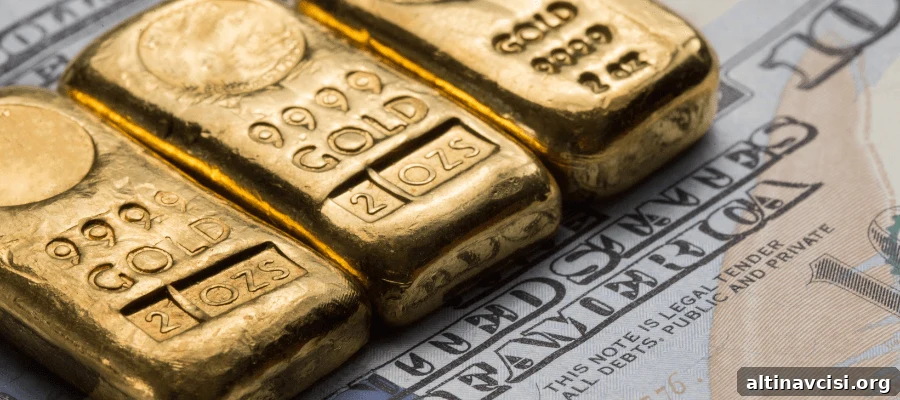
The U.S. government holds more than 8,100 tonnes of gold—the largest official reserve on Earth. However, on its balance sheets that gold is still valued at the long‑standing statutory price of $42.22 per ounce, a figure set decades ago. That accounting treatment records the U.S. gold stock at roughly $11 billion on paper, while market prices above $3,000 per ounce would place its real market value in the neighborhood of $700–800 billion.
Why hasn’t this official valuation been updated? Adjusting the book value of government gold would amount to a formal recognition that the dollar’s purchasing power has declined substantially since the statutory price was fixed. For policymakers, a revaluation carries political and economic implications they have been reluctant to confront.
There have been occasional discussions about revisiting that policy. During the previous U.S. administration, some officials and commentators raised the idea that a revaluation could provide the Treasury with a one‑time accounting boost, instantly increasing the recorded value of federal gold holdings without any physical transactions.
That notion invites a broader hypothetical: what if other nations treated their gold resources similarly? Take Australia, for example. Geologically, Australia is estimated to contain about 9,500 tonnes of undiscovered or unmined gold—roughly 17% of global underground reserves. If Australia developed and retained a large portion of that gold, its total bullion holdings could conceivably rival or exceed official reserves held by other countries.
When assessing mining economics, industry analysts use a metric called all‑in sustaining cost (AISC). AISC bundles the full range of production, sustaining capital and other operating expenses into a single per‑ounce figure. Globally, many producers report average AISCs in the range of roughly $1,000–1,400 per ounce, depending on mine grade and location; a commonly cited benchmark sits near $1,200 per ounce.
Using conservative price assumptions, even modest estimates point to substantial value. At a gold price of $3,000 per ounce, Australia’s 9,500 tonnes of unmined gold would represent hundreds of billions of U.S. dollars in potential market value—on the order of about $600 billion USD—and several hundred billion more when expressed in Australian dollars, depending on the exchange rate.
If a formal gold revaluation were ever implemented—whether by the U.S. or by other nations—the strategic and fiscal significance of undiscovered and stored gold would grow. Such a move would spotlight the latent wealth beneath national territories and could shift how governments, investors and central banks view precious metals within broader reserves and macroeconomic policy.
Investing in Physical Metals Made Easy
Get Gold & Silver Insights Direct to Your Inbox
Join thousands of investors who receive expert analysis, market updates and exclusive offers each week.