
KEY TAKEAWAYS:
- Gold’s roughly 2% drop was driven by margin liquidation after an oil spike, not by a change in fundamentals.
- The Hormuz blockade adds energy-driven inflation to an already stagflationary backdrop (CPI 3.3%; rate cuts for 2026 appear unlikely).
- Central banks continue accumulating gold: the PBOC extended purchases into a 17th month, and major banks have raised multi-year targets.
- The petrodollar required a naval blockade to defend; gold requires no such enforcement.
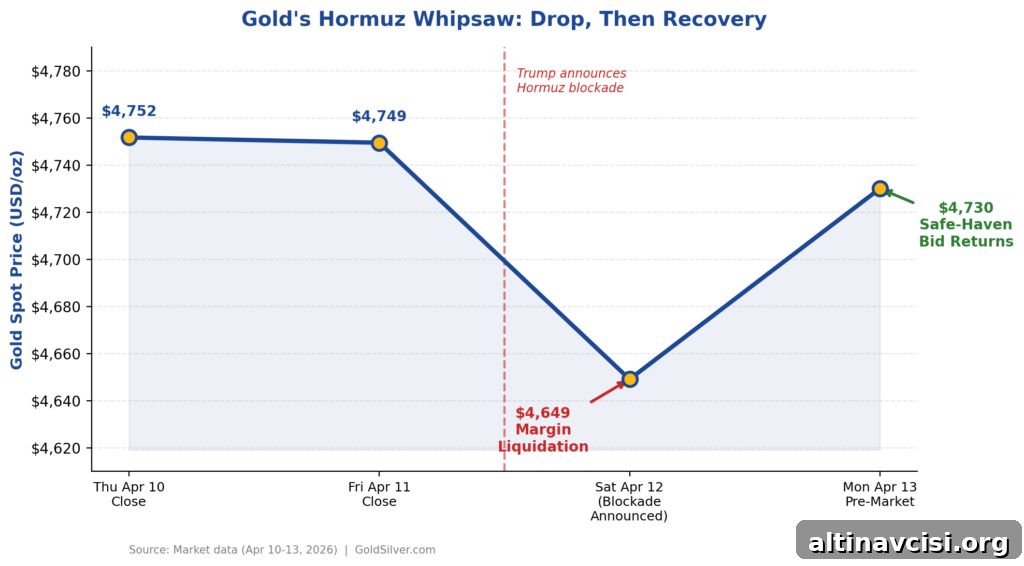
Gold fell about 2% in early Monday trading after President Trump ordered the U.S. Navy to blockade the Strait of Hormuz, which pushed oil above $100 a barrel for the first time in over a year.
Silver was hit harder, dropping nearly 4%.
The more important detail is how quickly gold recovered. By mid-morning spot gold had climbed back above $4,700. That rapid rebound shows the initial move was liquidity-driven rather than a signal that gold’s long-term story has changed.
How 21 Hours of Failed Diplomacy Closed 20% of the World’s Oil Supply
The blockade announcement followed 21 hours of U.S.-Iran nuclear talks in Islamabad that ended without agreement. Vice President Vance returned with no deal; the sticking point was Iran’s nuclear program. In response, the president directed the Navy to block ships entering or leaving the Strait of Hormuz — the chokepoint carrying roughly 20% of global seaborne oil. CENTCOM confirmed enforcement would begin at 10 a.m. ET Monday.
Oil reacted as expected: Brent surged more than 7%, energy stocks rallied, and gold initially dropped despite rising geopolitical risk.
Why Did Gold Drop When Geopolitical Risk Rose?
The key explanation is margin liquidation. A sudden oil spike forces margin calls throughout commodity markets. Traders with leveraged energy positions must post collateral quickly, and the most liquid asset to sell is often gold. That forced selling is a technical plumbing issue rather than a shift in gold’s intrinsic value.
Evidence for this is the speed of the rebound: safe-haven demand returned within hours once the initial liquidity squeeze eased. In past crises that drive energy prices higher, gold often dips on the liquidity squeeze and then rallies on its structural bid.
The Structural Case Just Got Stronger
The Hormuz blockade strengthens several elements of the medium-term gold thesis:
1) Energy-driven inflation is back. CPI printed 3.3%, the hottest reading since May 2024. With oil above $100 and threats to other chokepoints such as Bab el-Mandeb adding further supply risk, inflation expectations can rise and push real yields lower. That dynamic reduces the opportunity cost of holding gold.
2) Central banks continue to buy. The PBOC extended its buying streak into a 17th consecutive month, and major banks have raised multi-year gold targets. These are institutional reserve decisions, not short-term retail momentum plays.
3) The petrodollar was defended by military force. The blockade interrupted an active experiment in settling oil trades outside the dollar system, including purchases in yuan. When settlements occur in non-dollar currencies through a major chokepoint at scale, it challenges dollar dominance. A naval blockade to maintain that dominance highlights the political cost of displacing the dollar — a contrast often noted by proponents of gold, which functions without state enforcement.
What This Means for You
The 10-year Treasury yield has risen to about 4.40%, up roughly 45 basis points in recent weeks. That higher nominal yield may appear attractive, but with CPI at 3.3% and rising energy costs, the real yield on cash and bonds is compressed. If oil remains elevated, inflation could persist and erode real returns further.
Gold provides no yield, but it has historically preserved purchasing power through inflationary and monetary crises. In a stagflationary environment where real yields shrink, the relative appeal of gold as a non-yielding store of value increases.
The Hormuz blockade did not undermine gold’s fundamental case; it sharpened it.
For reference: gold closed Friday at $4,749.46, dipped to about $4,649 during weekend trading, and recovered to roughly $4,730 by Monday morning.
Stay On Top of Gold & Silver Prices
Get important market alerts sent straight to your inbox.
People Also Ask
Why did gold drop when the Strait of Hormuz was blockaded?
Gold fell initially because the oil price spike triggered margin calls across commodities. Leveraged traders in energy positions sold gold to meet collateral requirements. This forced liquidation is temporary and typically reverses once liquidity pressures ease.
What is the Strait of Hormuz and why does it matter for gold?
The Strait of Hormuz is a narrow waterway between Iran and Oman that carries roughly 20% of global seaborne oil. Threats to or closures of the strait push energy prices higher, which raises inflation expectations and lowers real yields — conditions that historically boost demand for gold as a store of value.
Is gold a good hedge against stagflation?
Gold has historically performed well during stagflationary periods — when inflation stays high while growth stagnates. As real yields compress, the opportunity cost of holding gold falls. With CPI at 3.3%, oil above $100, and rate cuts increasingly unlikely for 2026, the current environment resembles past stagflationary settings where gold was an effective hedge.
SOURCES
Sources referenced in the original article include central bank reserve data, major investment bank forecasts, official statements about the Strait of Hormuz, and recent CPI and Treasury yield releases.
This article is for informational purposes only and does not constitute financial or investment advice. Consult a qualified financial advisor before making investment decisions.
You May Also Like
- $88 Billion a Month: Why U.S. Debt Is Driving Gold Prices
- CPI Hits 3.3%, GDP Stalls — Is Stagflation 2026 Here?
- War Risk, Stagflation Signals, and a $6,300 Gold Target
- Gold and Oil Brace for the Strait of Hormuz Deadline
- Iran War Deadline Puts Gold and Silver Prices on Edge
- Why Is Gold Falling When the World Is on Fire?
- Gold Jumps 2% as Trump Plans Iran War Address Tonight