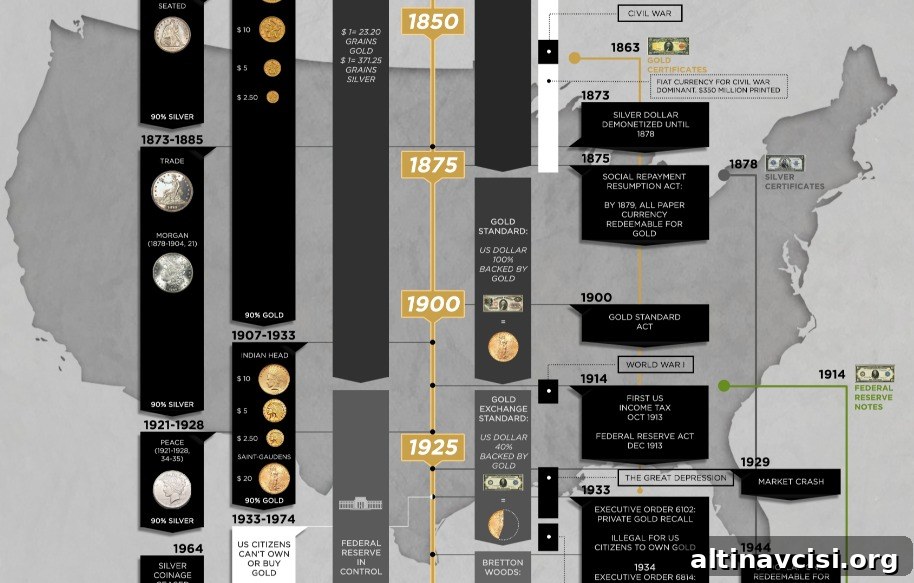
Ever wondered how the United States ended up with a fiat monetary system? Throughout much of American history, the nation relied on money backed by gold or silver. Only over time did that backing disappear, leading to the modern dollar that can be expanded at the government’s discretion.
Inspired in part by a suggestion from a reader, we created a scrollable infographic that traces the history of money in the U.S. As you review each step, you’ll see how successive policy changes reduced the metal backing of the currency. The story begins with currency largely backed by gold and ends with a dollar that no longer has any official gold backing.
With each monetary change, the ability of the dollar to retain intrinsic value diminished. Where there was once a direct tie to gold, government policy and economic pressures gradually loosened that connection until it vanished. That process made it possible for the money supply to be increased without a corresponding rise in gold reserves, allowing the currency to be diluted.
Observers such as financial historians and market commentators have warned that sustained fiat expansion can lead to instability. Some argue that the global monetary system may be vulnerable to a reset—an event that could cause serious economic disruptions worldwide. While predictions vary, the historical pattern yields a clear question for individuals: which form of money provides the most durable store of value?
For many people the choice comes down to two basic options: fiat paper currency, which depends on government policy and monetary institutions, or physical precious metals like gold and silver, which have a long history as stores of value. Each has advantages and trade-offs. Fiat currency is convenient for everyday transactions and for responding flexibly to economic shocks, but its purchasing power can be eroded by inflation and monetary expansion. Physical gold and silver are tangible assets with intrinsic scarcity, often sought as protection against inflation and currency debasement, though they carry storage, liquidity and price-volatility considerations.
Understanding the historical shifts in U.S. monetary policy can help clarify why these debates persist. The move away from metal-backed currency reflected changing economic realities, political choices and the need for greater policy flexibility. Yet those same choices introduced risks tied to unchecked monetary growth and the potential loss of long-term purchasing power.
As you explore the timeline, consider your own priorities: liquidity and convenience, or preservation of purchasing power through tangible assets. Whether one favors modern fiat systems or prefers the perceived security of gold and silver depends on personal circumstances, risk tolerance and outlook for the future of global finance.