
Gold vs Stocks & Bonds — The Quick Answer
- Stocks: Growth potential, but vulnerable to sudden large drawdowns.
- Bonds: Income and stability historically, but their diversification benefit has weakened.
- Gold: Crisis protection, stability, and genuine diversification that neither stocks nor bonds reliably provide.
Many portfolios still rest on a simple assumption: stocks provide growth while bonds offer protection. That framework worked for decades, but recent data shows the picture has shifted. When stocks and bonds move together, the traditional 60/40 approach can leave investors exposed. Gold fills that gap by offering a different kind of downside protection.
This guide explains how gold behaves relative to equities and fixed income — not as a replacement, but as a complementary asset that provides protection and diversification when other assets fail to do so.
Gold vs Stocks and Bonds — What the Data Shows
The classic 60/40 allocation assumes a negative correlation between stocks and bonds: when equities fall, bond prices rise. That dynamic drove diversification for years. Today, however, that engine is losing power.
Recent cross-asset research documents a clear shift: stocks and bonds are increasingly moving together instead of in opposite directions. The 2022 inflation shock illustrated this vividly — stocks plunged and long-duration bonds dropped too, producing one of the worst calendar years for a 60/40 mix in recent memory. That outcome highlighted a structural change rather than a one-off event.
Part of the problem is persistent inflation and limited central-bank policy scope. With inflation still elevated, the Federal Reserve has less room to cut rates quickly; those cuts historically helped bonds act as a ballast during equity selloffs. Without that mechanism, bonds are less reliable as a crisis hedge — which is exactly the space where gold can add value.
Gold Has Outperformed
Every Major Asset Class
Does Gold Actually Protect You When Markets Crash?
Gold and stocks serve different roles, and the historical record reflects that. Across recent decades, gold has often posted positive returns during years when equities were under stress.
From 2014 to 2023, gold recorded positive returns in seven of ten years, and its biggest gains frequently coincided with periods of market turmoil. In 2020, when global markets reacted to the pandemic, gold rose more than 25% while many equity indices declined. During the 2008 financial crisis, gold posted gains while the S&P 500 dropped sharply.
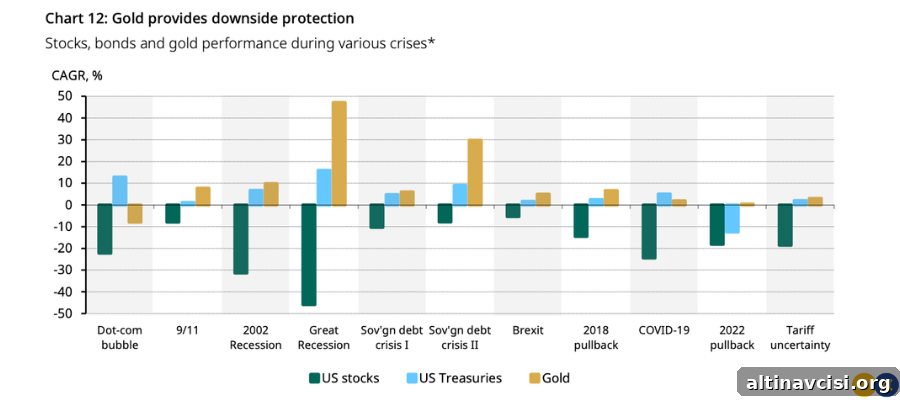
Source: World Gold Council, Why Gold 2026: Cross-Asset Perspective
Gold’s purpose is not to outperform stocks in every bull market. Its value comes from acting differently when other assets are falling. Stocks respond to earnings, growth, and sentiment; gold reacts to inflation expectations, real rates, and demand for safety. Those distinct drivers are why adding gold can make a portfolio more resilient.
Are Bonds Still a Better Safe Haven Than Gold?
Long-duration Treasuries once offered reliable protection: when equities fell, bond yields dropped and prices rose. That dynamic has weakened. When inflation rises and central banks tighten, both stocks and bonds have fallen together, undermining that traditional hedge.
In such episodes, gold tends to behave differently. For example, in 2022 Treasuries fell alongside equities as the Fed raised rates aggressively; gold finished the year roughly flat, effectively preserving capital when bonds could not provide shelter. In an environment where real rates are low or negative, the opportunity cost of holding a non-yielding asset like gold decreases, which historically supports its price.

The Financial System Isn’t Safer — And You Know It
As risks rise, see why gold and silver are expected to remain relevant in 2026 and beyond.
Does Gold Actually Hedge Against Inflation?
Short answer: yes, but not as a perfect month-to-month CPI hedge. Over long periods, gold has preserved purchasing power in ways fiat currencies have not. Its supply grows slowly and cannot be increased arbitrarily by a central bank.
Over shorter horizons, gold responds to expectations. It tends to move when markets and households anticipate rising inflation or doubt central-bank control over price stability. When public confidence in policy weakens, gold often benefits. Current data shows elevated household inflation expectations, which historically correlates with stronger demand for gold.
Why Do Most Investors Own So Little Gold?
Research and data on gold are widely available, so lack of information is not the main reason investors remain underexposed. Behavioral factors explain much of the gap.
Recency bias leads investors to overweight assets that performed well recently — equities have been dominant for years, so many allocate heavily to them. Income bias discourages some investors because gold pays no dividend or coupon. That misses the point: gold’s value is about protecting a portfolio when income-generating assets suffer large losses. Finally, institutional inertia keeps the 60/40 framework in place across advice, models, and retirement plans, even as its assumptions change.
The outcome: many portfolios remain optimized for a world of falling rates and reliable bond protection — conditions that may no longer be the norm.
What Percentage of a Portfolio Should Be Gold?
A common question is how much gold belongs in a diversified portfolio. Research suggests a modest allocation can materially improve resilience.
The World Gold Council’s analysis indicates an optimal range of roughly 5–8% of a portfolio. Within that band, gold has historically improved risk-adjusted returns by reducing drawdowns without significantly trimming long-term gains. More conservative investors focused on capital preservation may lean higher in that range, while growth-oriented investors can still see benefits from a smaller allocation.
Despite evidence supporting this allocation, most private portfolios are far below those levels — a meaningful gap that reduces overall resilience to market stress.
Is the Stock Market Overdue for a Correction — And What Happens to Gold If It Does?
Many warning signs that have preceded past market dislocations are visible today. Valuations on some US equities are stretched relative to historic norms, margin debt rose sharply in late 2025, and credit spreads remain compressed. Low spreads and high leverage mean risks may be concentrated and can reprice quickly when sentiment shifts.
Analyses highlighting stretched valuations and persistent macro risks suggest these conditions can drive safe-haven demand higher. Gold is not a speculative bet on a crash; it is a hedge against risks baked into current market pricing — risks that many portfolios are ill-equipped to absorb.
So, Should You Add Gold to Your Portfolio?
The evidence supports considering gold as a complement, not a substitute, for stocks and bonds. Gold has protected capital during crises, served as a structural hedge against inflation, and offered diversification when bonds fail to act as a buffer. No other mainstream asset consistently accomplishes all three.
The 60/40 allocation remains useful for many, but relying on it alone in an environment of rising stock-bond correlation, sticky inflation, and stretched valuations introduces a different type of risk. Allocating a modest portion to gold can materially enhance portfolio resilience.
Stay On Top of Gold & Silver Prices
Get important market alerts sent straight to your inbox.
People Also Ask
Does gold outperform stocks over the long term?
Not consistently — and that is not the point of owning gold. Gold tends to outperform during crises, periods of high inflation, and times of market stress. Over the 2014–2023 period, gold posted positive returns in seven of ten years, often when equities were weak. Its main benefits are downside protection and diversification, not matching stock-market bull runs.
Why is gold considered a hedge against inflation?
Gold has maintained purchasing power across long timeframes in ways fiat currencies have not. It cannot be created by monetary policy and its supply grows slowly. When inflation expectations increase and real interest rates fall, the appeal of gold typically rises, making it a structural buffer against inflation’s erosion of wealth.
What is the correlation between gold and stocks?
Gold generally shows a low or negative correlation with equities, meaning it often moves independently or opposite to stock markets. That characteristic is why gold enhances diversification. During major equity drawdowns, such as 2008 and 2020, gold produced positive returns while stocks declined.
How does gold compare to bonds as a portfolio hedge?
Bonds historically hedged equity risk, rising as stocks fell. That relationship has weakened as stock-bond correlation has increased. In 2022, both stocks and bonds fell amid an inflation shock, while gold was effectively flat for the year — demonstrating that gold can provide defensive benefits when bonds do not.
How much gold should I have in my portfolio?
Research suggests an allocation of about 5%–8% to gold is optimal for many investors, depending on risk tolerance. Even a modest 5% allocation has historically improved risk-adjusted returns by reducing drawdowns without materially sacrificing long-term growth. Many investors currently hold far less than this recommended range.
Disclaimer: This article is for informational purposes only and does not constitute investment advice. Consult a qualified financial advisor before making investment decisions. Past performance does not guarantee future results.
You May Also Like:
- Silver Price Crash History: What Happens After the Biggest Drops
- Gold IRA vs Physical Gold: Which is Best for Your Portfolio?
- When Should You Sell Gold and Silver? (And What to Buy Next)
- Could the US Revalue Its Gold Reserves to Pay Down Debt?
- How Gold Performs in Recessions: What History Tells Us
- Gold vs Inflation: What 100 Years of Data Shows