After a historic run in precious metals, investors are no longer only asking whether to own gold or silver — they’re asking how to think about gold and silver investments in 2026.
The 2025 gains were dramatic: gold rose roughly 65%, breaking above $4,500 per ounce, while silver rallied about 147%. Both metals outperformed many traditional asset classes, but strong past returns don’t guarantee future performance. Markets reset, conditions shift, and policy uncertainty, rising debt, and geopolitical tension all affect outlooks. A more useful question is what role each metal can play in a resilient portfolio, rather than which metal will “win.”
This article does not predict prices. Instead, it explains the principal differences between gold and silver — their strengths, risks, and how many investors think about owning both.
The Macro Context: Why Precious Metals Remain Relevant
Before comparing the two metals, it helps to understand why precious metals are still part of the conversation.
Monetary policy and real interest rates
Gold and silver tend to do well when real interest rates — nominal rates adjusted for inflation — are low or negative. Non-yielding assets become more attractive when alternatives offer little or negative real return. Markets currently price in potential monetary easing, but the path is uncertain. If inflation stays sticky while growth slows, central banks may face constrained options. That kind of stagflationary environment has historically favored gold in particular.
Currency confidence and fiscal deficits
Large structural deficits and elevated global debt raise questions about fiat currency purchasing power. Gold has a unique role here: it carries no counterparty risk and functions as a neutral reserve asset. That explains why central banks have accumulated gold at near-record levels. Silver shares some monetary tailwinds but does not have the same official reserve status.

The Financial System Isn’t Safer — And You Know It
As risks mount, see why gold and silver are projected to keep shining in 2026 and beyond.
What Gold Does Well: Stability and Liquidity
Gold’s primary role is dependability rather than excitement. It is one of the world’s most liquid assets, trading around the clock across global markets. During systemic stress — financial crises, currency instability, or geopolitical shocks — gold has a long track record of holding value when other assets falter.
Prominent macro investors have argued every serious portfolio should include a meaningful gold allocation. The case is structural: gold can hedge inflation and currency debasement and provides liquidity and diversification that many investors undervalue. That reasoning influences how many institutional and individual investors approach allocation decisions.
Gold’s risks in 2026
After a historic multi-year run, consolidation would be normal. A rebound in real yields could pressure gold prices, and a significant easing of geopolitical tensions could reduce safe-haven demand. These are legitimate near-term risks to consider.
What Silver Does Well: Industrial Demand and Leverage
Silver occupies a different niche. It is both a monetary and an industrial metal. That dual identity creates appeal and complexity: silver is essential to solar panels, electric vehicles, semiconductors, and many electronics. As renewable energy infrastructure and advanced manufacturing expand, industrial demand for silver grows.
Silver’s market is much smaller than gold’s, so capital inflows move prices more sharply. Investors often call it “gold with leverage”: when conditions favor precious metals broadly, silver can amplify those moves because a thinner market reacts more strongly to flows and sentiment changes.
Silver’s risks in 2026
That leverage cuts both ways. A global growth slowdown or a drop in industrial activity would disproportionately weaken silver demand compared with gold. Post-rally speculative positions can unwind quickly in smaller markets, producing notable volatility. Silver rewards investors who understand and accept larger price swings; for others, that volatility undermines the rationale for owning it.
The Gold-to-Silver Ratio: A Useful (But Imperfect) Lens
The gold-to-silver ratio measures how many ounces of silver are needed to buy one ounce of gold. Historically, government-decreed ratios were fixed around 15:1 or 16:1, but since 1971 both metals have traded freely and the ratio has swung with market forces.
Over much of the past decade the ratio sat between 70:1 and 90:1 — above long-run averages of 40:1 to 60:1 — leading many analysts to argue silver was undervalued relative to gold. After silver’s rally, the ratio compressed to the mid-50s, close to historical norms.
Gold-to-Silver Ratio Over 10 Years
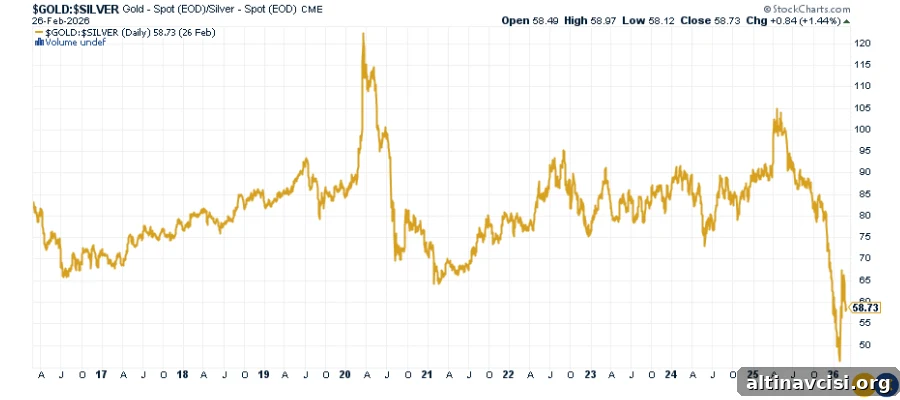
When the ratio reaches extremes, it has tended to revert toward the mean: very high readings have often preceded silver catch-ups, while compressed readings have sometimes preceded gold strength. Traders use the ratio to time relative entries, but it is not a precise timing tool. The ratio can remain stretched for long periods, and industrial demand, macro conditions, and sentiment can override historical tendencies.
Today’s ratio near historical norms shifts the decision from “obvious opportunity” to a consideration of which metal’s risk profile matches an investor’s goals.
How Many Investors Approach Owning Both
Rather than choosing one metal, many investors hold both as complementary positions. Gold anchors the allocation with stability, liquidity, and long-term purchasing power protection. Silver provides a growth component with higher upside potential and greater volatility.
Conservative allocations often lean 70–80% gold and 20–30% silver. Growth-oriented investors may allocate more to silver. The right balance depends on time horizon, risk tolerance, and the role precious metals are intended to play in a broader portfolio. Dollar-cost averaging can be useful after large multi-year gains, spreading purchases over time to reduce the risk of mistimed entry.
The Bottom Line
This article is not a prediction about future prices. Nobody knows with certainty where gold or silver will go next. What is clear is that both metals have served meaningful roles in portfolios over modern financial history. Gold offers stability, deep liquidity, and structural central bank demand. Silver offers industrial tailwinds, a smaller market with more volatility, and the potential for larger percentage moves when precious metals broadly are in favor.
A smarter framework for investing in 2026 focuses on understanding what each metal does, being realistic about your risk tolerance, and building positions that can hold up across different economic scenarios rather than betting on a single forecast. In an uncertain world, financial security is better supported by assets that have preserved purchasing power across generations, not by confident short-term predictions.
Stay On Top of Gold & Silver Prices
Get important market alerts sent straight to your inbox.
People Also Ask
Is gold or silver a better investment in 2026?
There is no universal answer — it depends on objectives. Gold is generally favored for stability and wealth preservation, supported by deep liquidity and central bank demand. Silver offers higher upside potential because of its smaller market and industrial demand, but with greater volatility. Many investors combine both: gold as an anchor, silver as the growth component.
Why did silver outperform gold so dramatically in 2025?
Silver’s large rally reflected its monetary and industrial roles. Persistent supply deficits, rising demand from solar, semiconductors, and EV manufacturing, and silver’s smaller market size all amplified price moves. Silver often lags gold early in a metals bull market, then catches up aggressively — a pattern seen through 2025.
What is the gold-to-silver ratio telling investors in 2026?
After spiking above 100:1 in April 2025, the ratio has compressed to the mid-50s, near its long-term norm of 40:1 to 60:1. Extreme readings historically tend to revert to the mean, and that reversion helped drive silver’s strong performance. The current ratio suggests a more historically normal relationship between the metals, shifting the decision toward matching risk profiles with investor goals.
How much of my portfolio should be in gold and silver?
Allocations vary widely based on goals and risk tolerance. Common guidance ranges from 5% to 15% of a total portfolio in precious metals, with the split between gold and silver reflecting desired volatility. Conservative investors typically favor gold; those seeking more upside may increase silver exposure. Consult a financial advisor for tailored guidance.
What are the biggest risks of investing in silver in 2026?
Key risks include a slowdown in industrial demand and heightened volatility after 2025’s rally. Smaller commodity markets can reverse sharply, and speculative positions can unwind quickly. Silver suits investors who accept significant price swings and understand the metal’s dual demand drivers.
Disclaimer: This article is for informational purposes only and does not constitute investment advice. Past performance is not indicative of future results. Always consult a qualified financial advisor before making investment decisions.
You May Also Like:
- Gold Silver Prices: Short-Term Noise, Long-Term Signal
- Silver Canadian Maple Leaf: Why It’s One of the World’s Top Bullion Coins
- Gold Portfolio Allocation 2026: What J.P. Morgan’s Forecast Means for Investors
- How Government Debt Affects Gold and Silver
- Gold vs Silver: The Liquidity Difference That Matters
- Silver Price Components: Premium, Spot, and Dealer Markup Explained