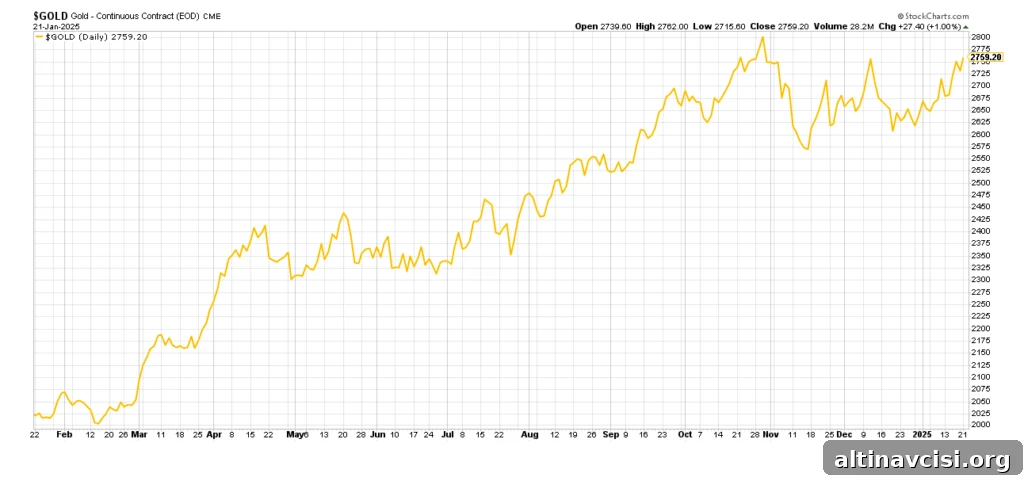
Gold has broken out of the consolidation that formed during December, showing renewed bullish momentum since the recent U.S. presidential transition. After a period of compressive price action, the metal staged a decisive move higher that confirms a change in market behavior from indecision to directional strength.
The breakout cleared a key resistance level around $2,721. That breach is significant because it ended the sideways trading range that had capped gains and invited uncertainty. With price decisively above that barrier, market participants now view the structure as favoring buyers, at least in the near term.
Technical indicators reinforce the bullish case. Momentum readings—most notably the MACD—show expanding bullish momentum consistent with an uptrend. The MACD line crossing above its signal line and widening histogram bars support the view that buying pressure has increased. Trend-following traders tend to interpret these signals as confirmation that the market is more likely to continue higher than reverse immediately.
Market technicians are eyeing $2,800 as the next logical objective. That level represents the next psychological and technical barrier where previous supply could re-emerge. Reaching $2,800 would not guarantee sustained gains, but it would mark a meaningful step higher from recent ranges and could attract additional trend-following flows.
Despite the near-term bullish setup, the longer-term outlook retains uncertainty. Major resistance might be encountered at higher price points, and macroeconomic or geopolitical developments could quickly alter market sentiment. Factors such as real interest rate expectations, central bank policy, and dollar strength remain important fundamentals that can either support or undermine the current advance in gold.
Traders are actively looking for practical entries on the daily and 4-hour timeframes. A common approach is to wait for pullbacks toward former resistance (now support) around the $2,721 area or toward shorter-term moving averages, then to enter on signs of renewed buying momentum. Using timeframes like the 4-hour chart allows traders to fine-tune entries with lower intraday risk while the daily chart provides the broader directional context.
Risk management remains essential. Given the potential for sudden reversals or false breakouts, defined stop-loss levels and position sizing aligned with individual risk tolerance are prudent. Traders often place stops below the breakout level or under a nearby swing low to protect capital if price fails to hold above key support.
In addition to mechanical entries and stops, monitoring volume and momentum can improve trade quality. Higher-than-average volume accompanying sustained advances generally supports the breakout’s validity, while weakening volume or diverging momentum indicators may signal a loss of conviction and an increased chance of pullback or consolidation.
Fundamentally, gold’s response to policy shifts and macro events will shape its path. The metal often reacts to inflation expectations, real yields, and currency moves; therefore, any sharp shifts in these variables can either accelerate the rally or trigger corrective phases. Traders and investors should stay aware of economic calendar events and central bank communications that could drive volatility.
To summarize: gold has exited its December wedge and cleared the $2,721 resistance level, backed by expanding MACD momentum. The next price target near $2,800 is on many participants’ radar, but caution is warranted because higher resistance levels and macro uncertainty could slow or reverse gains. Practical trade plans generally focus on buying pullbacks on the daily and 4-hour charts, using disciplined stops and attention to volume and momentum to validate entries.