
Gold and Silver market update — April 20, 2026
Key Takeaways
- The US Navy seized the MV Touska, oil surged about 7%, and gold fell roughly 1%—far less than prior conflict-driven moves. The market’s structural floor has shifted higher.
- Gold is being priced as a monetary hedge rather than purely a geopolitical one. The main driver is fiscal dominance: US debt interest heading toward $1 trillion, consecutive Fed operating losses, and accelerating central-bank de-dollarization.
- The bull case for gold does not require the war to end. It requires the Federal Reserve to remain trapped between inflation and rising debt service costs—an ongoing constraint.
- 2026–2027 bank targets for gold range widely: Goldman Sachs $5,400 (year-end), J.P. Morgan $6,300, Deutsche Bank $6,000, Bank of America $6,000, Wells Fargo Investment Institute $6,100–$6,300, and Société Générale $6,000.
On Sunday morning, the US Navy destroyer USS Spruance fired on and seized an Iranian-flagged vessel in the Gulf of Oman. The Strait of Hormuz—through which roughly 20% of seaborne oil passes—briefly closed. Oil futures jumped about 7%, stock futures dropped, and gold declined by roughly 1%.
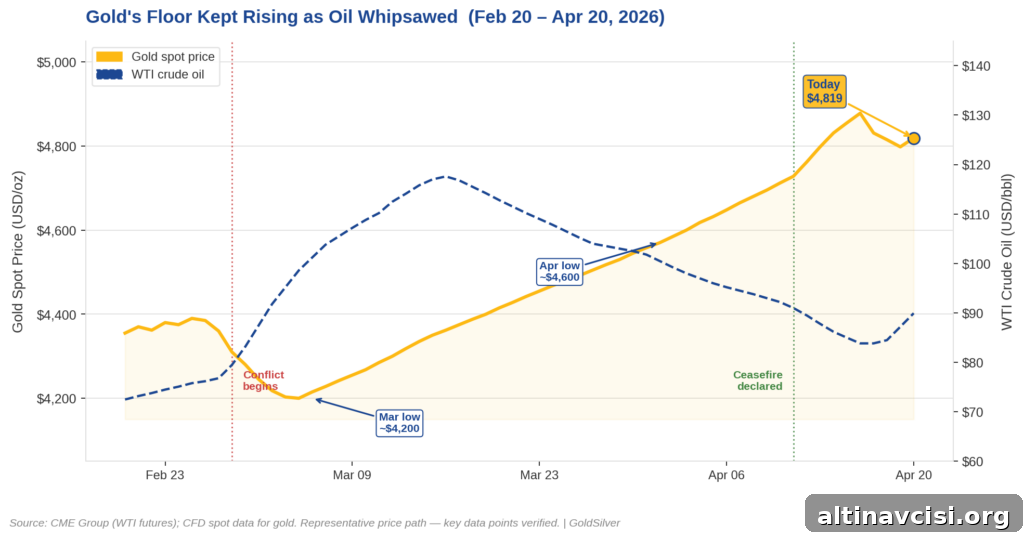
That drop was far smaller than the sharp moves seen earlier in the conflict. Gold opened Monday near $4,819, holding a floor that did not exist in February. The relevant question is not why gold fell at all this weekend, but why it didn’t fall further.
Where Is the Gold Price Right Now?
Gold: approximately $4,819/oz, down about 1% from Friday’s close of $4,831. Silver: around $80.13/oz, down roughly 2%. Gold-silver ratio: 59.7—indicating a modest safe-haven rotation into gold while silver underperformed. DXY near 98.29, up 0.20%. WTI crude trading in the $89–$90/bbl range. Oil was the headline; gold remains the longer-term signal.
What Happened Over the Weekend?
The weekend followed a familiar pattern: brief optimism followed by renewed escalation. On Friday, Iran announced a 10-day ceasefire and said the Strait was “completely open.” Oil dropped about 10%, stocks hit highs, and gold briefly rallied to $4,878 intraday.
By Saturday, the situation reversed. Negotiations stalled over demands to lift the naval blockade on Iranian ports. The Strait closed again, commercial vessels faced harassment, and on Sunday the USS Spruance intercepted and fired on the Iranian-flagged MV Touska after it ignored warnings—marking the first ship seizure linked directly to the conflict.
Sunday evening: WTI +7.14% to $89.94/bbl; Brent +~6% to $95.71; S&P 500 futures -0.67%; Dow futures -0.88%; Gold -~1%.
The Edge Every Investor Needs
Smarter precious metals investing starts here. The Nuggets Newsletter delivers market insights, Fed updates, global trends, and educational content.
Why Isn’t Gold Falling More When Oil Spikes?
Escalations normally pressure gold from multiple angles: a stronger dollar, higher oil, rising inflation, a hawkish Fed response, higher yields, and forced selling to meet margin calls. When the conflict first intensified in March 2026, gold dropped 2–3% amid that chain reaction.
This weekend, gold only fell about 1% and held above $4,800. That muted reaction signals a meaningful change in how markets price gold.
What is fiscal dominance—and why does it matter for gold?
Fiscal dominance occurs when government debt and interest obligations become so large that the central bank’s policy space is constrained. The Fed has held rates at 3.50%–3.75%, and markets priced a very high likelihood of no move at the April 28–29 meeting. A senior Fed official warned rate cuts may be delayed if oil stays high. The Fed posted operating losses recently, limiting remittances to the Treasury and underscoring rising fiscal strain. With US debt interest approaching $1 trillion for the fiscal year—exceeding some major budget items—the Fed cannot hike aggressively without sharply increasing the government’s interest bill. That constraint creates a structural floor for gold independent of short-term geopolitical headlines.
What Are the Big Banks Forecasting for Gold in 2026?
Major banks are factoring fiscal math into their gold outlooks. Goldman Sachs set a year-end 2026 target of $5,400. Several other large institutions put 2026–2027 forecasts in the $6,000 range, and J.P. Morgan projects a sizable increase in official-sector gold purchases for 2026. Central-bank buying and official-sector moves are reshaping the supply-demand picture and signaling less confidence in the existing paper-money framework.
Central banks buying gold are effectively voting with their balance sheets against the status quo.
Has the Gold Price Floor Permanently Shifted Higher?
The gold floor today is driven by fiscal and monetary constraints, not by whether the Strait of Hormuz is open. The Fed faces a dilemma: raising rates would spike debt service costs, while cutting is risky with inflation still above target and oil elevated. Gold sits outside—and often benefits from—those policy dilemmas.
Prior to the conflict, gold traded around $4,300–$4,400. March lows touched about $4,200, April lows near $4,600, and recent trading has established higher lows around $4,700–$4,800. Central-bank accumulation, including repeated net buying by major buyers, supports this higher baseline. Headlines like the ship seizure matter for volatility, but the broader story is a structural repricing tied to fiscal dominance and shifting official balances.
What Should Gold Investors Watch This Week?
Pakistan talks (Tuesday): Any ceasefire headlines could push gold down 1–2% in the near term, but monetary constraints remain the dominant driver.
FOMC meeting (April 28–29): A rate hold is highly likely. Investors should watch commentary from Chair Powell on inflation versus growth and any signaling on the timing of cuts for 2026.
$4,750 support: This level now represents a structural floor—daily closes below it would indicate the floor is weakening.
WTI above $85: If oil holds above this level into the Fed meeting, the “higher for longer” interest-rate narrative strengthens, reinforcing gold’s case as a monetary hedge.
Stay On Top of Gold & Silver Prices
Get important market alerts sent straight to your inbox.
SOURCES
- U.S. Energy Information Administration — Amid regional conflict, the Strait of Hormuz remains a critical oil chokepoint.
- CME Group — Market quotes and the FedWatch tool for gold and crude futures.
- Reuters — Coverage quoting Fed officials on the timing of rate cuts.
- Federal Reserve — H.4.1 release and monetary policy reports showing recent operating results and balance-sheet developments.
- Congressional Budget Office — Budget and economic outlook projections for debt service.
- Peter G. Peterson Foundation — Tracker on interest costs related to the national debt.
- U.S. Bureau of Labor Statistics — Consumer Price Index data for March 2026.
- J.P. Morgan Global Research — Analysis and longer-term gold demand forecasts.
- World Gold Council — Reports on seasonal demand and central-bank activity.
By the GoldSilver Editorial Team — helping investors understand sound money since 2005. This article is informational and not financial, investment, or tax advice. Consult a qualified advisor before making investment decisions.
You May Also Like:
- Oil Crashed 11%. Gold Went Up. That Tells You Everything.
- $1 Trillion in Debt Interest Is Why Gold Keeps Climbing
- 5 Signals That Say Gold’s Bull Case Just Got Stronger
- The Largest Gold ETF Outflow Ever – But China Disagrees
- Silver Market Deficit 2026: Six Years and Getting Worse
- Is the Petrodollar Ending? What the Iran War Means for Gold
- France’s Gold Repatriation Is Done. Germany Is Next
- Gold/Silver Ratio Hits 61.1 — Silver’s Turn to Run