Gold and silver market update — May 8, 2026
Key Takeaways
- The World Gold Council’s April 2026 commentary is titled “The Return of Transitory,” referencing the 2021 inflation misjudgment
- Equity markets have largely priced the Hormuz crisis as temporary; oil futures have not — Brent December contracts trade at a 22–25% premium over pre-crisis levels
- JPMorgan warns global oil inventories could reach an operational floor by September if the disruption continues
- COMEX gold positioning is neutral — not crowded long, leaving room for fresh buying
- Gold: $4,707.65 (+0.46%) | Silver: $80.50 (+2.71%) | G/S Ratio: 58.47 — as of 8:23 AM ET, May 8, 2026
In May 2021 the Federal Reserve described rising inflation as “transitory.” The term fell out of official use by the end of that year, but the consequences were significant: by June 2022 CPI reached 9.1%, prompting the Fed’s fastest tightening cycle in decades. That episode frames the gold price outlook heading into the summer of 2026.
“Transitory” became shorthand for one of the largest institutional misjudgments in a generation.
On May 7, the World Gold Council released its April 2026 Gold Market Commentary under the headline “The Return of Transitory.” Its central observation matters for gold: equity markets are treating the Iran-Hormuz disruption as a short-lived shock, while oil futures continue to price in a longer-lasting disruption. That divergence is one of the clearest signals for gold right now.
Why Are Stock Markets and Oil Futures Telling Opposite Stories?
US equity markets have calmed in recent weeks. Inflation breakevens rose when the Iran conflict escalated in late February, then retraced most of that move as risk appetite recovered. Stocks are pricing the Hormuz crisis as temporary.
Oil futures are signalling something different.
The WGC notes Brent crude December 2026 contracts trade at a 22–25% premium to where oil traded before the first missile on February 28. Commercial hedgers — refiners, airlines and other energy users — appear to be betting the disruption could last through year-end.
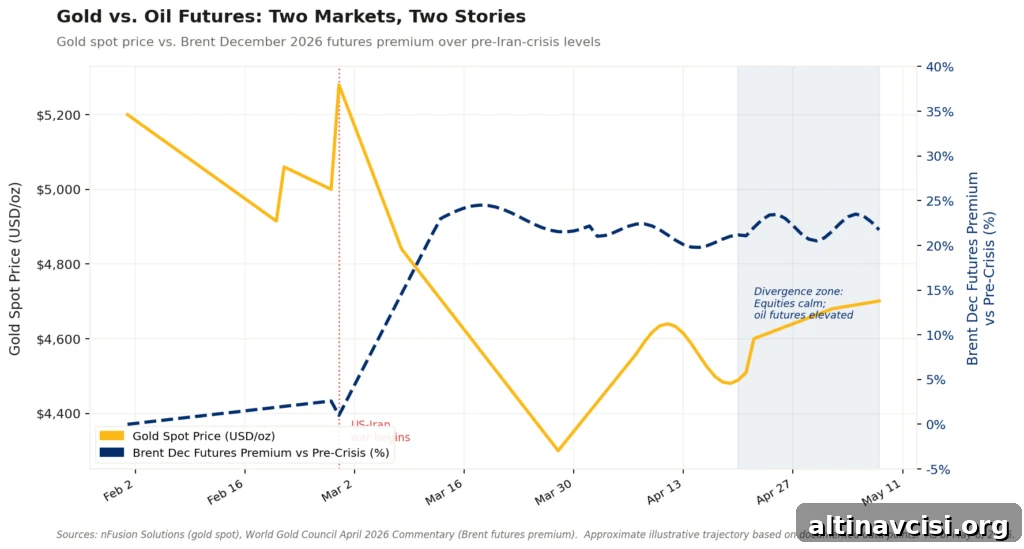
One of these markets will prove incorrect. That gap — between optimistic equity pricing and cautious oil markets — is fertile ground for gold.
The Edge Every Investor Needs
Smarter precious metals investing starts here. The Nuggets Newsletter brings essential market insights, Fed updates, global trends, educational videos, and more.
What Does This Divergence Mean for the Gold Price Outlook?
The outcome depends on which market is correct.
If equity markets are right — Hormuz reopens, oil falls and inflation cools — the Federal Reserve would have room to cut rates. Real yields would compress and gold would benefit. Goldman Sachs has a $5,400 year-end target and JPMorgan $6,300; both forecasts assume inflation relief and easier policy, which would support higher gold prices.
If oil futures are right — the disruption persists and inflation stays elevated — the Fed remains constrained. JPMorgan’s commodity team warns that prolonged closure of Hormuz could push global oil inventories to an operational floor by September 2026, increasing the risk of disorderly price moves and demand destruction.
Both scenarios are supportive of gold over the medium term, but they imply very different price paths in the next six months.
What Is the WGC Actually Watching?
The World Gold Council highlights three indicators.
First, stagflation risks appear to be increasing: economic surprises are weakening while inflation surprises remain positive. That combination has historically favored gold.
Second, COMEX managed-money positioning was neutral at the end of April 2026. Speculators are not heavily long gold, so there is room for fresh buying rather than a crowded trade at risk of rapid unwinding.
Third, European gold ETFs led inflows in April. European investors are more exposed to energy disruption from Hormuz and have been more defensive than some US investors; their buying is a noteworthy sign of real demand.
The WGC’s conclusion is that the crisis reinforces structural reasons to hold gold — inflation uncertainty, fiscal stress, weaker bond diversification, and gradual reserve diversification away from the dollar — leaving a fundamentally supported gold price outlook even if the near-term path depends on which market proves right.
Gold and Silver Prices This Morning
Gold stood at $4,707.65 as of 8:23 AM ET, up 0.46%. Silver was $80.50, up 2.71%. The gold/silver ratio tightened to 58.47 from 62.05 three days earlier.
Silver is outperforming for a clear reason: if Hormuz reopens, silver benefits from the same drivers as gold — lower oil and cooling inflation — while also regaining ten weeks of suppressed industrial demand. That dual boost compresses the gold/silver ratio when relief is priced in.
The Sound Money Read
When major institutions previously called inflation transitory, holders of physical gold and silver benefited by staying the course. The mistake unfolded over more than a year, not the brief period implied by the word.
The WGC does not predict an identical repeat, but it warns markets may be underestimating the duration of a large, unresolved shock. If oil markets are correct about persistent disruption, the structural case for gold would reassert itself quickly.
Prices as of 8:23 AM ET, May 8, 2026.
Stay On Top of Gold & Silver Prices
Get important market alerts sent straight to your inbox.
SOURCES
1. U.S. Bureau of Labor Statistics — Consumer Price Index, June 2022: CPI up 9.1%, largest increase in 40 years
2. Federal Reserve — Powell Congressional Testimony, November 30, 2021 (retirement of “transitory”)
3. Federal Reserve Bank of Richmond — A Rate Cycle Unlike Any Other, August 2023 (eleven hikes, sixteen months, fastest since 1982)
4. World Gold Council — Gold Market Commentary: The Return of Transitory, May 7, 2026 (Brent 22–25% premium; COMEX neutral; European ETF inflows led global buying)
5. J.P. Morgan Global Research — Gold Price Predictions 2026 (JPMorgan $6,300 year-end target; September oil inventory floor estimate)
6. CNBC — Goldman Sachs sees $5,400 gold on central bank buying, March 25, 2026
7. nFusion Solutions — Live spot price feed (gold, silver prices as of 8:23 AM ET, May 8, 2026)
Disclaimer: This article is for informational purposes only and does not constitute financial or investment advice. Always consult a qualified financial adviser before making investment decisions.
You May Also Like:
- Why Silver Hit $82 Today: Iran, Oil, and the Fed
- Gold Hits $4,746 as Oil Crashes. Here’s Why That’s Bullish
- Gold Price and Nonfarm Payrolls: Why the Fed Is Trapped
- Gold Is Decoupling From Geopolitics. Here’s the Proof
- The Fed Is Frozen. The Debt Is Growing. Gold Is Watching.
- Gold Jumps on Iran Deal Hopes. The Real Driver Is the Fed
- What the IMF’s Inflation Forecast Shift Means for Gold
- What’s Really Driving Gold Prices Today — 5 Key Signals