
Gold sits at a crossroads. The metal slipped to $4,448 this week (as of June 5, 2026), marking its weakest weekly performance in a month. Short-term headlines focus on rising rate-hike expectations and the fears they spark for gold. But the structural picture — central bank buying, historical patterns, and the sound-money argument — paints a more nuanced view.
This digest highlights five developments that matter to anyone holding precious metals. Short-term noise points one way; long-term evidence points another. Investors should understand both.
Why Are Gold Rate Hike Fears Driving Prices Down This Week?
Gold fell to $4,448.72 per ounce on Friday (as of June 5, 2026), about 2% lower than Monday’s open. Silver moved lower with gold, trading near $72.65 per ounce. Platinum and palladium also posted weekly declines.
Two main factors pushed prices down. First, hopes for a U.S.-Iran peace deal faded as Hezbollah rejected a proposed ceasefire for Lebanon and Israel signaled it would keep troops in the country. That geopolitical stalemate kept oil prices elevated and sustained inflation expectations, which support a hawkish Federal Reserve stance.
Second, rate-hike fears intensified. Comments from a Regional Fed official framed the choice as either holding rates or raising them further to tame inflation that has persistently run above target. Markets now price a significant chance of a Fed rate increase by late 2026, which raises the opportunity cost of holding non-yielding assets like gold. That mechanics — higher expected rates — is the dominant driver of this week’s weakness.
The Edge Every Investor Needs
Smarter precious metals investing starts here. The Nuggets Newsletter brings essential market insights, Fed updates, global trends, educational videos, and timely analysis.
What Does the U.S. Jobs Report Mean for Gold Today?
Gold is holding just above its 200-day simple moving average (around $4,432). That level is the immediate line in the sand. The May nonfarm payrolls report — due later today — will likely determine whether gold breaks below that support or rebounds.
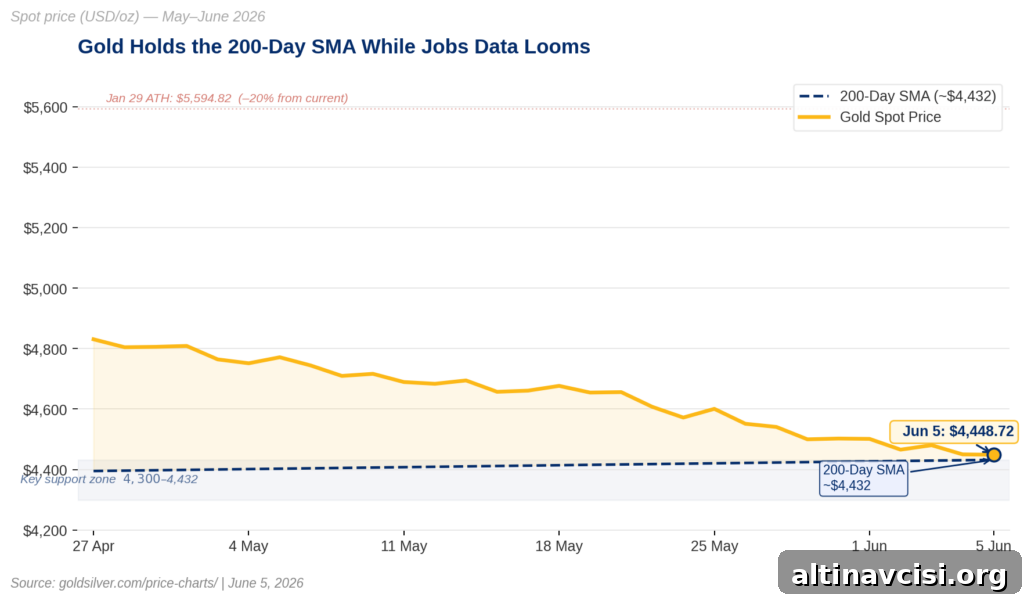
Economists expect headline payrolls of roughly 85,000 for May, down from 115,000 in April, with the unemployment rate steady at 4.3%. A stronger-than-expected print would reinforce the Fed’s case for restrictive policy or additional hikes and would likely push gold lower toward the $4,350–$4,300 range. A weaker reading would reduce rate-hike odds and could allow gold to reclaim the 21-day moving average near $4,551.
Technical indicators show momentum favors the downside: the Relative Strength Index sits near 40, suggesting lingering bearish tilt, and the MACD has slipped below zero. Neither signal is catastrophic, but absent a fresh catalyst the near-term path looks sideways to lower.
Why Are Central Banks Still Buying Gold While Retail Investors Pull Back?
Central banks bought roughly 244 tonnes of gold in Q1 2026, a pace that, if annualized, ranks among the highest since 1950. Purchases have consistently exceeded 200 tonnes per quarter since early 2025, reflecting sustained official accumulation.
Retail demand has cooled. Global jewelry demand fell about 25% year-over-year in Q1 2026 to roughly 260 tonnes. ETF inflows slowed dramatically, and policy changes such as higher import taxes in key markets have weighed on consumer buying.
The divergence between official and retail demand is important. Retail buyers are price-sensitive; central banks respond to long-term structural concerns. Many official buyers view gold as a reserve asset with no counterparty risk that cannot be frozen or devalued by third-party actions — a contrast with sovereign bonds. Since early 2022, some central banks accelerated diversification away from dollar-centric reserves, and that trend remains in place.
In the near term, gold’s direction will still depend on U.S. rates, the dollar, and inflation. Over a longer horizon, the structural floor provided by central-bank accumulation supports higher-than-historical baseline prices.
Is Gold’s Pullback From January Highs Normal, or Is Something Different This Time?
Gold hit an all-time high of $5,594.82 per ounce on January 29, 2026, and has since retreated roughly 20% to current levels near $4,448. Corrections of this magnitude after strong rallies are common in gold’s history. Past cycles show periods of sharp gains followed by extended drawdowns.
The January peak was driven by an unusual alignment of forces: elevated central-bank purchases, strong retail demand from large consumer markets, and investor inflows driven by inflation worries and reserve diversification. Those forces have since shifted. Central-bank buying remains significant but has moderated; retail demand has cooled; and investor focus has shifted to interest-rate expectations.
The critical question is whether structural drivers — de-dollarization, fiscal deficits, and persistent official demand — have permanently repriced gold relative to other assets. Current evidence indicates those forces have shifted the baseline higher, suggesting the move was more than a short-term speculative bubble. That aligns with the view held by many long-term analysts and institutions.
What Does the Sound Money Case for Gold and Silver Look Like Right Now?
Some economists and commentators continue to argue that the global fiat system is structurally inflationary and that precious metals offer protection from currency debasement and negative real yields. Over the past two years, gold and silver have advanced significantly, bringing prices into historically notable ranges.
Proponents highlight that physical gold and silver carry no counterparty risk and do not depend on bank operations, digital infrastructure, or an issuer’s solvency. For savers facing negative real rates and deposit exposure, allocating a portion of assets to physical precious metals is presented as a hedge against long-term currency erosion.
How Should Investors Position Between Gold and Silver Right Now?
A prudent, institutionally backed recommendation is to hold both gold and silver as liquid assets. The balance between them depends on the economic cycle: favoring gold in expansions and increasing silver exposure during contractions. The gold–silver ratio can help inform allocation decisions but should be used alongside broader analysis rather than as a lone signal.
Institutional buying, persistent structural concerns, and long-term monetary arguments together indicate the case for holding precious metals remains intact. This is a long-term positioning stance, not alarmist rhetoric.
Stay On Top of Gold & Silver Prices
Get important market alerts sent straight to your inbox.
SOURCES
1. GoldSilver — Live Gold & Silver Price Charts
2. CME Group — FedWatch Tool
3. World Gold Council — Gold Demand Trends Q1 2026
4. ING Economics — Commodities Research, Ewa Manthey
5. Ludwig von Mises Institute Germany — Thorsten Polleit
Disclaimer: This article is for informational purposes only and does not constitute financial or investment advice. Always consult a qualified financial adviser before making investment decisions.
You May Also Like:
- Gold at $4,480: Physical Demand Hits a 50-Year Milestone
- Gold Holds $4,481 With Rate Hike Risk Rising. Here’s the NFP Decision Map.
- Gold Surges 1.5%: ADP, ISM, and Beige Book Trap the Fed
- Gold at $4,454 Says the Fed Is Trapped. Here’s Why.
- Central Banks Picked Gold Over Treasuries. Should You?
- Central Banks Just Crossed a Line Not Seen Since 1996
- Factory Costs Hit 82.1. That Number Is Now Working for Your Gold.
- Gold at $4,500: What Fort Knox, China, and Silver Are Telling You
- Silver Has Two Engines. Stagflation Is the One Condition That Fires Both at Once.
- The Buyer List for Gold Just Got Longer. These Countries Have Never Bought Before.
- PCE Hit 3.8%. GDP: 1.6%. Gold Went Up. Here’s the Mechanism.