Daily News Nuggets | Today’s top stories for gold and silver investors
March 17th, 2026 | Brandon Sauerwein, Editor
Today’s gold price outlook for 2026 looks different than it did a month ago — not because the end targets changed, but because recent events have shifted the backdrop. Below is a concise update on the forces most likely to shape bullion and silver markets in the coming months.
What Will the Fed Actually Signal Tomorrow?
The Federal Reserve’s decision is due tomorrow. Markets are effectively certain on the immediate outcome — futures imply a 99% probability the Fed keeps the policy rate at 3.5%–3.75%. Yet the policy decision itself is only part of the story.
Investors will be watching the updated dot plot and Chair Powell’s press conference for guidance on the Fed’s path forward. The key question: how will the Fed respond to an oil-led inflation surge tied to the Iran conflict? Those projections and commentary will determine whether rate cuts remain on track or are delayed.
Expectations have shifted quickly. A few weeks ago, markets were leaning toward multiple cuts beginning mid-year. Now April is essentially off the table, June looks uncertain, and some economists forecast only one cut — or none — in 2026. A more hawkish scenario is possible too: if energy-driven inflation climbs toward the mid-3% range this summer, the Fed may need to reconsider easing and could even contemplate hikes.
The Fed is balancing slowing growth against persistent inflation. If oil prices keep rising, the window for rate cuts narrows rapidly — and rising prices, tighter policy, and economic stress are conditions that historically increase interest in gold.
Why Isn’t Gold Reacting to the Iran Conflict?
Most 2026 gold forecasts accounted for geopolitical risk, but few priced in the current scale of disruption. Still, gold’s reaction has been more muted than many would expect. Prices have risen, but they haven’t spiked to extreme levels despite heightened tensions.
A primary reason is that much of the risk appears to be already priced in. Markets have adapted to an extended period of global conflict, supply-chain strains, and geopolitical friction. That sustained background support has limited the immediate shock effect that typically sends prices sharply higher.
Monetary policy is another restraining factor. Elevated real yields and a relatively strong dollar reduce the immediate incentive to shift large allocations into gold. The market is therefore caught between geopolitical forces that push bullion up and tight financial conditions that hold it back. A decisive move from either side would likely drive a significant next leg in gold’s price.
Can Silver Break Out After Lagging Gold?
Silver followed gold’s early reaction to the Iran headlines — an initial spike followed by a pullback as investors rotated into the dollar and yield-bearing assets. But silver’s drivers differ from gold’s because silver is both a monetary hedge and an industrial metal.
That dual role means silver’s near-term performance will depend heavily on the global growth outlook. If higher energy costs and trade disruptions slow industrial activity, demand for silver could weaken. Conversely, longer-term structural factors — constrained supply, rising costs tied to energy, and industrial demand from solar and electrification — support a constructive case for silver over time.
Historically, silver often lags gold in the early stages of a bullish cycle and then outperforms as moves broaden. If inflation re-accelerates or monetary policy shifts toward easing, silver could quickly switch from follower to leader.
How Much Does Gold Really Back U.S. Debt Today?
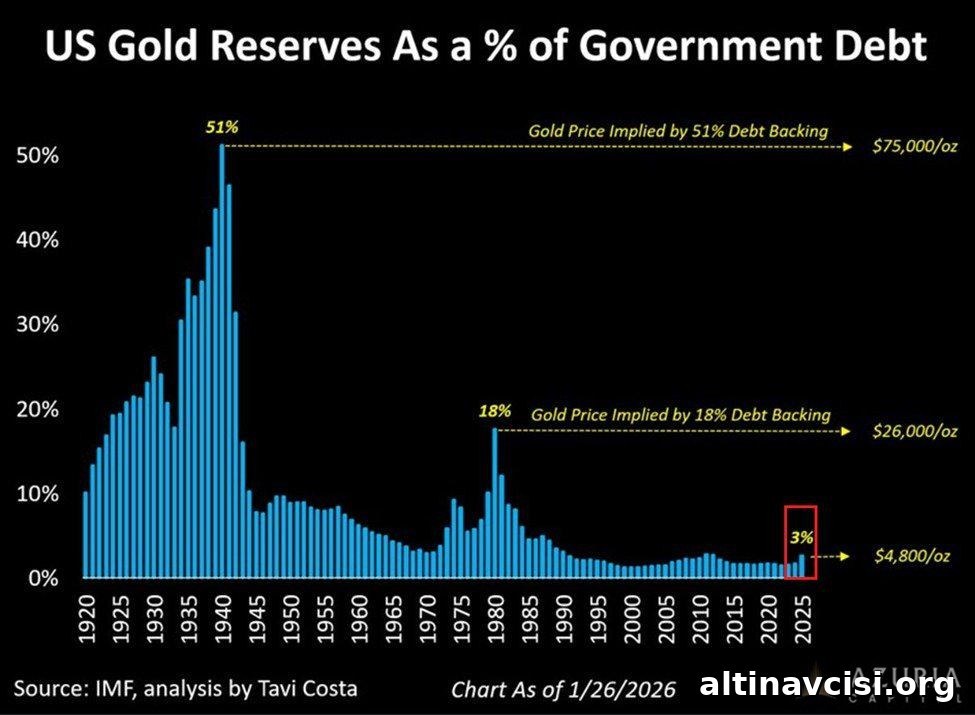
A chart from Azuria Capital’s Tavi Costa highlights how the role of gold has changed over decades. In the 1940s, U.S. gold reserves covered more than half of government debt; today that ratio is closer to 3%.
Source data: IMF / Tavi Costa / Azuria Capital (@TaviCosta).
That dramatic shift reflects a broader transition: the global financial system now depends far more on confidence in fiat currency than on tangible reserves. The divergence between rising government debt and static gold reserves underscores how much leverage has grown relative to hard assets.
Concretely, returning to the levels of gold backing seen in the 1980s would imply an extraordinarily high gold price by today’s standards — a theoretical illustration rather than a prediction. What matters practically is that gold’s role has moved from formal backing to a form of informal insurance: a hedge against currency and fiscal risk in an increasingly leveraged system.
Where Do the Big Banks See Gold Going by End of 2026?
Major banks’ year-end 2026 price targets remain firmly bullish despite recent pullbacks. Gold has been trading near $5,000 per ounce, and several banks view that level more as a base than a ceiling.
J.P. Morgan has cited a year-end target near $6,300 per ounce, pointing to central bank demand, ETF inflows, and a weakening dollar. Bank of America has a $6,000 target, highlighting Fed policy uncertainty and historically low investor allocations to gold. BNP Paribas increased its 2026 average forecast, flagging a likely peak above $6,250, while Wells Fargo projects a $6,100–$6,300 range for year-end.
Although the specific numbers vary, the rationale is consistent: high sovereign debt, limited confidence in paper assets, and ongoing central bank buying create structural support for higher prices. These bank targets were largely set before the recent surge in oil above $100 related to the Iran conflict, which adds an additional geopolitical premium to the existing structural case.
Gold retreated from roughly $5,200 to $5,000, yet those institutional targets have not materially changed. In past multi-year bull markets, intermediate pullbacks often look modest in hindsight once the cycle progresses.
You May Also Like
- Gold and Silver Prices Today: Stagflation, the Fed, and What Comes Next
- Gold Supply Outlook: As Prices Rise, Producing Nations Want a Bigger Share
- Why Oil Is Surging and Gold Isn’t (Yet)
- Gold Price Rises as Iran War Escalates
- February 2026 CPI Report Shows Inflation Calm Before Oil Shock Hits