
A government that won’t audit its gold. A rival power that can’t stop accumulating it. Manufacturers warning inflation isn’t over. Fourteen state legislatures making physical metal easier to own. And a metals market where silver just signaled shifting risk appetite.
Five developments, one through-line. Below is what each means for investors and the broader monetary landscape.
Key Takeaways
- Fort Knox reports roughly $662 billion in gold and has not had a full independent audit since 1953. The Gold Reserves Transparency Act (H.R. 3795) would require a complete public inventory but remains stalled in Congress.
- China’s net gold imports via Hong Kong rose 81.2% in April and have increased for 13 consecutive months — a structural accumulation trend rather than a seasonal blip.
- The ISM prices‑paid index reached 82.1 in May 2026, marking 20 months of expanding input costs. Markets have largely priced out U.S. rate cuts for 2026.
- Alaska is the latest of 14 states in 2026 to pass sound‑money legislation that reaffirms gold and silver as constitutional money and removes local sales taxes on purchases of physical metal.
- Silver is outperforming gold roughly 2:1 today, compressing the gold‑silver ratio to about 59.3. The Silver Institute reports 2026 is the sixth straight year of a structural silver supply deficit.
Why Is Trump Calling for a Fort Knox Gold Audit?
On May 27, 2026, FBI agents recovered 303 gold bars from a Virginia residence belonging to a former senior CIA official. Prosecutors allege the bars and currency could not be traced or justified. The seizure revived calls to audit the nation’s gold holdings. Fort Knox reports holding 147,341,858 fine troy ounces of gold as of April 30, 2026 — a value roughly equal to $662 billion at current prices. The last comprehensive independent audit occurred in 1953 under President Eisenhower. A partial congressional inspection in 1974 covered only about one‑fifth of the bars and did not include a full public assay.
Representative Thomas Massie’s Gold Reserves Transparency Act (H.R. 3795) would require a full independent inventory and assay of U.S. gold reserves. The bill remains stalled in Congress and no audit date has been set. For holders of private metal, the central point is transparency and verifiable custody: whether or not Fort Knox is found lacking, private owners who control and verify their own holdings avoid that uncertainty.
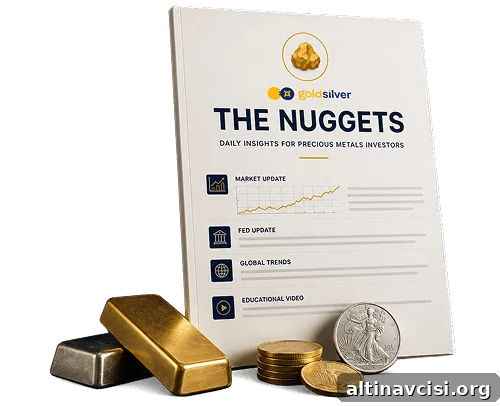
The Edge Every Investor Needs
Smarter precious metals investing starts here. The Nuggets Newsletter delivers market insight, Fed updates, global trends, and educational content.
Why Has China Been Buying Gold for 13 Straight Months?
China’s net gold imports via Hong Kong jumped 81.2% in April from March, totaling 86.7 metric tons — the strongest monthly inflow in over a year. More important than any single month is the streak: net imports have risen for 13 consecutive months. Short‑term spikes can reflect seasonality or logistics; a year‑plus run points to structural reallocations by Chinese institutions, not opportunistic trading.
Hong Kong recently surpassed Switzerland as the world’s largest cross‑border wealth hub, with cross‑border assets near $2.9 trillion driven by mainland capital flows. The expanding gold pipeline and Hong Kong’s wealth hub status are aligned signals: large institutional actors appear to be positioning away from dollar‑centric risk. That extended buying streak suggests a sustained belief in a weaker dollar outlook or a strategic move to diversify reserves.
What Does an ISM Prices Index of 82 Mean for Gold?
The ISM Manufacturing PMI rose to 54.0 in May 2026, the strongest reading since May 2022. But the prices‑paid subindex — which measures input costs — registered 82.1 in May, the 20th straight month of expanding raw material costs. Survey respondents pointed to steel and aluminum cost increases, tariffs, and petroleum price impacts tied to geopolitical disruptions as primary drivers. Many firms cited pricing volatility and the regional conflict as direct concerns.
When input inflation remains elevated while growth persists, the Federal Reserve faces a policy dilemma. Markets have largely priced out rate cuts for 2026 and some traders are even pricing a potential hike later in the year. Higher rates into an inflationary environment can squeeze real growth and raise uncertainty — conditions in which physical gold tends to attract interest as a store of purchasing power while monetary policy priorities shift.
Why Are 14 States Formally Calling Gold and Silver Constitutional Money?
On May 29, 2026, Alaska enacted legislation removing local sales taxes on gold and silver purchases and formally reaffirming both metals as constitutional money under Article I, Section 10. The bill passed overwhelmingly. It is part of a broader 2026 trend: 14 states passed sound‑money measures during the legislative session, and now 45 states have fully or partially eliminated sales taxes on precious metal purchases.
The immediate effect is simple: removing sales taxes lowers the cost of owning physical metal. For buyers previously subject to 5–8% local sales taxes, that is a meaningful reduction in upfront cost. The wider implication is political and cultural: state legislatures are increasingly codifying the view that gold and silver function as money. That shift reduces friction for savers who prefer physical metal and signals broader acceptance of precious metals as part of personal and institutional portfolios.
Why Is Silver Outperforming Gold — and What Does the Ratio Signal?
Today silver is up about 2.0% versus gold’s 0.99%, tightening the gold‑silver ratio to roughly 59.3. The ratio is a reliable market thermometer: when fear dominates, gold typically outperforms and the ratio widens. When industrial demand gains relative to fear, silver tends to outperform and the ratio narrows.
Earlier in the year, geopolitical shocks pushed the ratio toward 65 as investors sought gold’s safety. The current compression toward 59 reflects easing risk premia — tentative progress in ceasefire discussions — combined with steady industrial demand confirmed by the ISM report. Around 40% of silver’s annual demand is industrial — solar, electronics, and manufacturing — so improvements in those sectors boost silver’s performance relative to gold. A ratio near 59 sits closer to silver’s historically undervalued range within the modern era average of 60–80, making the move notable for investors weighing tactical allocations between the two metals.
The Structural Case: Six Years of Supply Deficit
The Silver Institute’s World Silver Survey 2026 confirms 2026 is the sixth consecutive year of a structural global silver supply deficit, projected to widen to tens of millions of ounces this year. That deficit represents a structural floor beneath silver prices that does not disappear with a single day’s trading. For longer‑term investors, persistent supply shortfalls combined with rising industrial demand create a compelling backdrop for exposure to silver alongside gold.
SOURCES
1. Yahoo Finance — coverage of the Fort Knox-related arrest and audit calls.
2. U.S. Treasury Fiscal Data — status report of U.S. government gold reserves.
3. Congress.gov — Gold Reserves Transparency Act (H.R. 3795).
4. Hong Kong Census and Statistics Department — trade statistics for gold.
5. World Gold Council — China gold market updates.
6. BCG — report on Hong Kong as a cross‑border wealth hub.
7. ISM — Manufacturing PMI report, May 2026.
8. Federal Reserve — FOMC minutes and policy context.
9. Anchorage Daily News — Alaska legislation on gold and silver.
10. Sound Money Defense League — state legal tender movement tracker.
11–14. Industry price and survey sources for gold, silver, and LBMA benchmarks.
Disclaimer: This article is for informational purposes only and does not constitute financial or investment advice. Consult a qualified financial adviser before making investment decisions.
You May Also Like:
- Silver Has Two Engines. Stagflation Is the One Condition That Fires Both at Once.
- The Buyer List for Gold Just Got Longer. These Countries Have Never Bought Before.
- PCE Hit 3.8%. GDP: 1.6%. Gold Went Up. Here’s the Mechanism.
- Gold Targets Are Falling. The $8,000 Forecast Isn’t.
- Gold Radar: 5 Stories the Price Chart Isn’t Telling You
- Silver Lost 3.3% While Gold Lost 1.6%. That Gap Is Not Random.
- Gold Down 1.2%, Silver Down 2.8% — The Floor Holds
- UBS Just Cut Its Gold Target by $400. The Part They Kept Is the Real Story.
- Why Gold Is Falling Today — And Why $4,500 Is Holding.