
🌆 Evening News Nuggets | Today’s top stories for gold and silver investors
March 19th, 2026 | Brandon Sauerwein, Editor
Gold’s price drop today surprised many investors. Here’s what actually moved markets Thursday — and what it could mean heading into the weekend.
Is This a Gold Selloff — or the Setup for the Next Leg Higher?
Gold’s decline today was sharp, sliding toward $4,650 — down roughly 3.5% on the day. On the surface, it looks like the metal is breaking down at an inopportune moment: geopolitical risk is rising, yet gold is falling. What’s going on?
The short answer: oil. A jump in crude prices reawakens inflation concerns and pushes expected rate cuts further into the future. Higher-for-longer interest rates are a direct headwind for gold. That’s the mechanical explanation.
There’s a deeper dynamic, though. When liquidity tightens quickly, investors sell what they can, not what they want. Gold is liquid, so it tends to be sold first. Sharp, counterintuitive pullbacks like this are often a feature of late-stage pressure rather than proof that a bull market is finished.
The structural case for precious metals hasn’t changed. War-driven energy shocks, a national debt topping $39 trillion, and a Fed constrained by inflation are not temporary, one-off events. These are slow-building pressures that typically force policy responses over time.
When those responses arrive, gold rarely drifts — it moves quickly. This episode looks less like a permanent breakdown and more like a market pausing while it waits for the next catalyst.

What Does a $200 Billion War Do to a $39 Trillion Debt?
This morning’s $39 trillion debt milestone was quickly overshadowed. By afternoon, the Pentagon confirmed it requested more than $200 billion in supplemental war funding. Defense leaders indicated the figure could change, but the magnitude is significant.
The arithmetic is stark. The conflict’s early hours consumed billions; at roughly $1 billion per day, a $200 billion package would finance many months of operations. Officials offered no clear end date, underscoring the likelihood of an extended commitment.
For perspective: $200 billion exceeds the annual defense budget of every country except the United States. It arrives atop a debt that’s already increasing at nearly $2 trillion a year.
Faced with that math, governments have few politically palatable options: cut spending, raise taxes, or increase the money supply. The first two are difficult; the third historically benefits hard assets like gold.
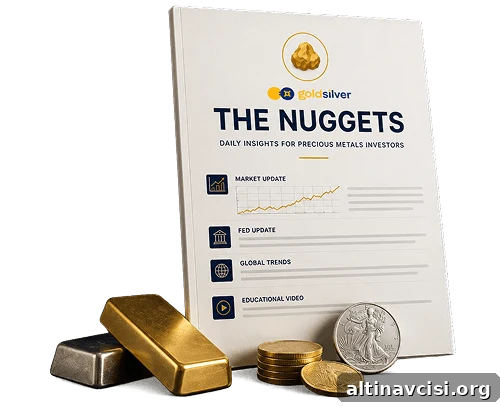
The Edge Every Investor Needs
Smarter precious metals investing starts here. The Nuggets Newsletter brings essential market insights, Fed updates, global trends, educational videos, and concise analysis to help you make informed decisions.
Is the DOJ Investigation Into Powell a Threat to Fed Independence?
President Trump reiterated support for the Justice Department’s criminal inquiry into Fed Chair Jerome Powell, framed publicly around renovation cost overruns at the Fed’s headquarters. A federal judge reviewing the matter concluded the subpoenas appeared intended to apply pressure — potentially to influence rate decisions or prompt a leadership change.
Timing complicates matters. Powell kept policy unchanged just a day earlier. His term ends in May; the president has nominated Kevin Warsh as a successor, but some senators have pledged to block confirmation unless the investigation is dropped. That standoff has created uncertainty around the transition.
The unintended consequence may be prolonged tenure: Powell has said he won’t step down until the issue is resolved. Central bank credibility erodes slowly and can collapse quickly. A Fed perceived as responding to political pressure is a different institution — and such institutional risk historically increases demand for tangible assets like gold.
Silver Crashed 10% Today. Retail Investors Bought More.
Silver fell more than 10% Thursday, yet many retail investors responded by buying. Data showed small investors acquired over $19 million in the iShares Silver Trust in the first two hours of trading — putting SLV on pace for its strongest buying day since early March. At the same time, gold ETFs were seeing net outflows, suggesting traders were shifting allocations within precious metals.
This behavior echoes prior episodes. When silver plunged 31% in late January, retail buying also picked up. Throughout this correction, smaller buyers have repeatedly stepped in on declines.
Whether that pattern reflects conviction or a conditioned reflex is the key question. What’s clear: retail demand for silver has been resilient on the downside, while patience for gold has waned. That divergence offers insight into sentiment and where the next volatile move in the metals complex might originate.
Stay On Top of Gold & Silver Prices
Get important market alerts sent straight to your inbox.
You May Also Like
- Why Is Gold Falling While a War Is Raging?
- Gold Price Outlook: Fed Holds, PPI Climbs
- Gold Price Today Holds at $5,000 — What’s Driving It
- Gold Price Forecast 2026: Fed, Iran, and the $6,000 Question
- Gold and Silver Prices Today: Stagflation, the Fed, and What Comes Next