
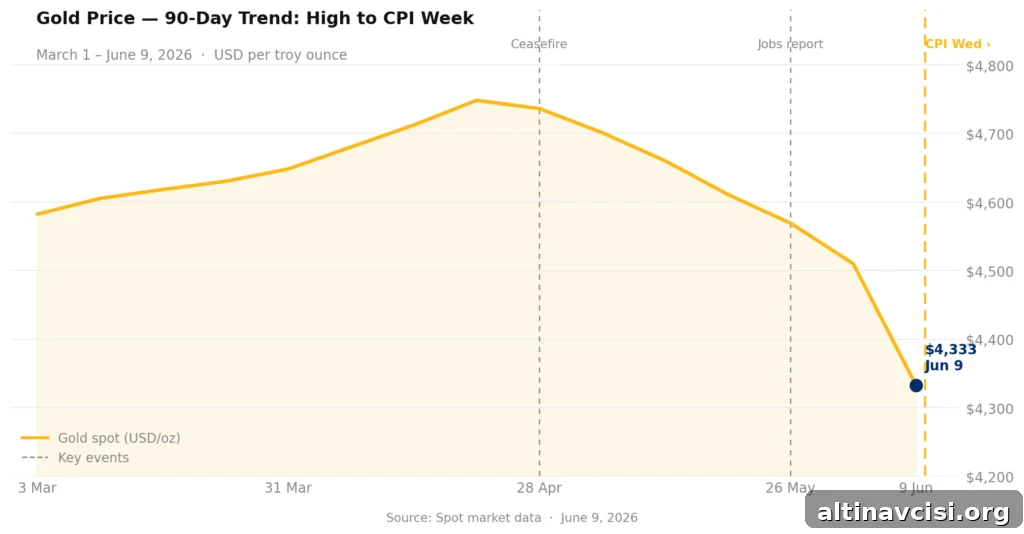
Gold is trading around $4,329 this Tuesday afternoon, roughly 9% below its late‑April peak. One key inflation release — the May CPI data due at 8:30 AM ET on Wednesday — could push prices meaningfully in either direction.
Key Takeaways
- Why is gold falling in June 2026? Gold has pulled back about 9% from late April highs near $4,800. Two main forces drove the decline: a reversal of the geopolitical risk premium after a partial Iran–Israel ceasefire, and a stronger‑than‑expected May jobs report that pushed the market to price in a higher chance of Fed rate hikes by December.
- What does the May CPI report mean for gold? May CPI is released June 10 at 8:30 AM ET. Consensus expects headline +4.2% year‑over‑year and core +0.3% month‑over‑month. A hotter‑than‑expected core print (above +0.3% m/m) would likely pressure gold toward the $4,280–$4,300 support zone short‑term. An inline or softer print would tend to stabilize prices and could lead to a rebound toward $4,400–$4,450.
- Is the pullback a structural reversal? No. The recent move is driven by rising real yield expectations and short‑term repricing of Fed policy, not a fundamental reversal of the longer‑term thesis that supported gold’s advance from roughly $1,200 in 2018 to its 2026 highs. This is best read as mid‑cycle consolidation.
- What is the fiscal constraint argument? With federal debt near $39 trillion, aggressive Fed tightening would materially raise debt service costs, limiting the Fed’s room to fight inflation conventionally. Over a 3–5 year horizon, that constraint remains a structural tailwind for gold under multiple CPI outcomes.
To be clear: that number refers to the May CPI forecast, not the price of gold.
What’s Happening to Gold Right Now?
Since late April gold has been consolidating. Spot briefly reached the mid‑to‑upper $4,700s on April 20 but, as of June 9, 2026 trades near $4,329 — the lowest level since late March. Two events within eight days changed the market dynamic.
First, a conditional halt to hostilities between Iran and Israel removed much of the geopolitical risk premium that supported gold in April. Risk premia tend to unwind quickly when geopolitical tensions ease.
Second, the May jobs report surprised to the upside: nonfarm payrolls rose by 172,000 versus an 85,000 consensus, and the unemployment rate held at 4.3%. The bond market reacted immediately, repricing Fed policy expectations.
On the CME FedWatch tool, the probability of at least one 25‑basis‑point hike before December 2026 jumped to roughly 68–70%, up from about 14% five weeks earlier. That shift in expected policy is the proximate cause of gold’s pullback — higher expected real yields raise the opportunity cost of holding a non‑yielding asset.
This is a change in the short‑term cost of holding gold, not a refutation of the structural reasons investors hold physical metal.
The Edge Every Investor Needs
Smarter precious metals investing starts here. The Nuggets Newsletter brings essential market insights, Fed updates, global trends, educational videos, and more.
Why Does a Rate Hike Threat Push Gold Down?
Gold does not pay interest. When bond yields rise — or when the market expects them to — the opportunity cost of holding gold increases. Higher Treasury yields become competing assets for investors, prompting marginal sellers to reduce gold exposures.
Empirically, the 10‑year real yield (nominal Treasury yield minus inflation expectations) is a strong short‑term predictor of gold price moves. When real yields rise, gold tends to retreat; when they compress, gold generally advances. At present, nominal yields are growing faster than inflation expectations, lifting real yields and pressuring gold.
That explanation is accurate for short‑term dynamics, but it omits the broader structural context.
What the Rate‑Hike Story Is Missing
The simple narrative — “Fed might hike, gold under pressure” — holds for immediate moves but doesn’t capture the structural backdrop supporting gold.
Recent NFIB data showed small‑business optimism below long‑run averages and a rising uncertainty index, suggesting persistent price pressure beyond energy markets. Forecasts for May CPI point to headline inflation around +4.2% y/y and core CPI near +2.9% y/y, driven by tariff pass‑through and wage pressure rather than only energy costs.
Given roughly $39 trillion in federal debt, aggressive tightening would substantially raise debt service costs, constraining the Fed’s ability to fight inflation conventionally. A central bank constrained by fiscal realities complicates the policy response and tends to be supportive for gold over multi‑year horizons.
What Does a Hot CPI Print Actually Mean for Your Gold?
For physical holders, the key outcomes hinge on how May CPI prints relative to expectations.
Scenario A — CPI Prints Hot
Above consensus: Bond yields spike and the market pushes rate‑hike odds above 70%. Gold would likely test $4,280–$4,300 support in the near term. That would be the market’s expected outcome and could create an entry window for long‑term buyers, including central banks and institutional allocators who continue to accumulate gold.
Scenario B — CPI Prints Inline or Softer
At or below consensus: The rate‑hike narrative would lose momentum, real yields could stabilize or compress, and gold would likely stabilize at current levels or rebound toward $4,400–$4,450. That outcome aligns more comfortably with the longer‑term thesis supporting gold.
Either scenario leaves the structural case intact. Gold’s advance from roughly $1,200 in 2018 to nearly $5,600 in January 2026 was driven by central bank diversification, persistent inflation, and broad monetary expansion. A 9% pullback caused by short‑term repricing of Fed expectations represents consolidation, not a structural reversal.
Past episodes of rising real yields, such as Q3 2023, produced 6–8% pullbacks before gold resumed its structural trend — a similar pattern appears to be playing out now.
What Does the CPI Core Number Actually Tell You?
The May CPI report arrives at 8:30 AM ET on Wednesday, June 10. The most important figure for near‑term market reaction is core CPI month‑over‑month, where consensus sits at +0.3%. A reading of +0.4% m/m or higher would strengthen the rate‑hike narrative and likely move gold lower in the morning session.
Beyond that print, the FOMC meets June 16–17 and is widely expected to hold policy steady. The critical question is whether core inflation reaccelerates in the coming months; this CPI release is the first data point in that sequence. For long‑term physical holders, this release should not change the 3–5 year investment case for gold, though it may alter short‑term entry prices.
Stay On Top of Gold & Silver Prices
Get important market alerts sent straight to your inbox.
SOURCES
1. LBMA — Precious Metal Prices & Historical Data
2. Bureau of Labor Statistics — The Employment Situation, May 2026 (USDL‑26‑0786)
3. CME Group — FedWatch Tool, 30‑Day Federal Fund Futures
4. Kiplinger — What to Expect From the May CPI Report
5. Morningstar — May CPI Forecasts Show Continued Lofty Inflation
6. NFIB — Small Business Optimism Index, May 2026
7. Joint Economic Committee — Monthly Debt Update, June 2026
8. World Gold Council — Central Bank Gold Statistics, April 2026
9. CNBC — Jobs Report May 2026: Payrolls +172,000
10. Trading Economics — Gold Spot Price, Historical Data
11. Reuters — Gold Hits All‑Time High, January 29, 2026
Disclaimer: This article is for informational purposes only and does not constitute financial or investment advice. Consult a qualified financial adviser before making investment decisions.
You May Also Like:
- Gold Price News: Goldman, China, CPI, and the Fed Explained
- Gold Near $4,330 as Rate‑Hike Bets Hit 70% and China Acts
- Gold Is Down 22% — The Same Drop as 2022. The Floor Is Not the Same.
- Silver Falls 6% on Jobs Beat. The Six‑Year Deficit Didn’t.
- Gold Rate Hike Fears Are Weighing on Prices. Here’s the Full Picture.
- Gold at $4,480: Physical Demand Hits a 50‑Year Milestone
- Gold Holds $4,481 With Rate Hike Risk Rising. Here’s the NFP Decision Map.
- Gold Surges 1.5%: ADP, ISM, and Beige Book Trap the Fed
- Gold at $4,454 Says the Fed Is Trapped. Here’s Why.
- Central Banks Picked Gold Over Treasuries. Should You?
- Central Banks Just Crossed a Line Not Seen Since 1996