Daily News Nuggets | Today’s top stories for gold and silver investors
January 23rd, 2026
Precious Metals Close in on Historic Milestones
Precious metals are approaching two major psychological benchmarks. The gold price is moving toward $5,000 per ounce, while silver is pushing toward $100 per ounce.
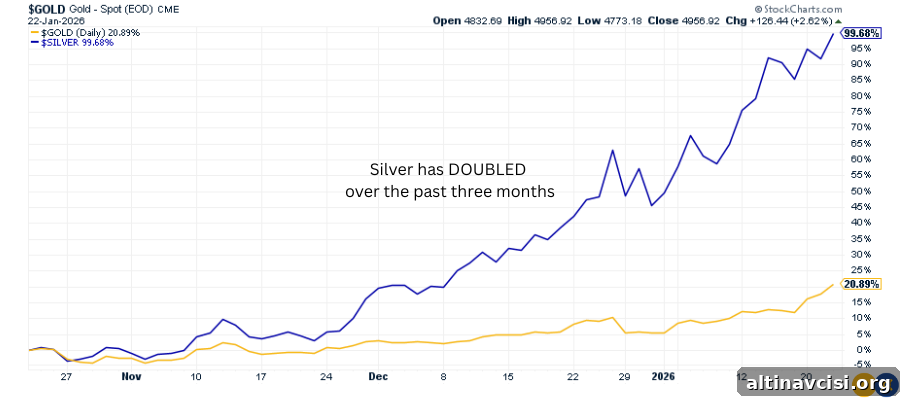
The rally has been dramatic. Over the past three months, gold has gained more than 20% and silver has nearly doubled in value. Both metals are trading at or near all-time highs, drawing fresh attention from investors and the media alike.
Gold and Silver Returns, 3 Months
When assets cross large round numbers they tend to attract mainstream interest: headlines increase, social conversations intensify, and retail investors often enter the market after institutional moves have already taken place.
Analysts expect billions of dollars in fresh retail capital could flow into precious metals as these milestones are reached. That inflow can extend rallies, but it also often marks a shift in market dynamics as sentiment broadens beyond professional investors.
Momentum remains strong and both metals are within striking distance of their targets. However, not every asset labeled a “store of value” is participating in the move.
Bitcoin’s “Digital Gold” Narrative Tested as Precious Metals Surge
As gold nears $5,000 and silver heads toward $100, Bitcoin has remained roughly around $89,000 — about 26% below its all-time high. That divergence raises fresh questions about Bitcoin’s standing as “digital gold.”
The performance this month highlights the contrast: gold has rallied roughly 14% in January and silver about 38%, while Bitcoin has traded relatively flat. Betting markets show strong odds that gold will reach $5,000 before Ethereum does, and some major banks have raised year-end gold forecasts.
Geopolitical tension, central-bank diversification away from the dollar, and persistent inflation concerns are pushing capital toward proven safe havens. Bitcoin was expected to benefit from these conditions but has so far lagged, suggesting investors may favor established stores of value when uncertainty intensifies.
That rotation is visible across global markets as investors reassess risk and seek assets with long-term track records in turbulent environments.

The Financial System Isn’t Safer — And You Know It
As risks mount, see why gold and silver are projected to keep shining in 2026 and beyond.
Investors “Quiet Quit” US Assets as Capital Flows to Emerging Markets
Global investors are shifting billions away from US assets in what strategists describe as a “quiet-quitting” of American bonds and stocks. Emerging-market equities have outpaced major U.S. indexes, rising about 7% this year while the S&P 500 is up roughly 1%.
The largest emerging-market ETF posted its biggest monthly inflow since 2012, attracting more than $6.5 billion in January. Currencies across Latin America and Asia have strengthened as capital seeks higher growth and diversification.
Drivers include geopolitical tensions, renewed questions about U.S. fiscal sustainability, and a decline in confidence around dollar dominance. Emerging markets are offering alternatives: stronger near-term growth prospects, fiscal discipline in some countries, and exposure to the global AI and infrastructure boom.
At the same time, central banks are reacting by adding gold to their reserves. Poland recently approved plans to acquire another 150 tons, and portfolio managers report quiet diversification away from Treasuries as institutions search for better risk-adjusted returns.
Precious metals are not the only commodities feeling supply pressure. Demand and constrained supply in several raw materials are creating cross-commodity inflationary forces that monetary authorities are watching closely.
Copper Shortage Looms as AI and Electrification Collide
Copper supply is tightening at a time when demand is set to surge. Projections suggest global copper demand could grow by as much as 50% by 2040, driven by data centers, electric vehicles, renewable energy projects, and rising defense spending.
The International Copper Study Group now expects a deficit for 2026 after earlier forecasts showed a surplus. Structural constraints on supply are significant: mine production growth has slowed, ore grades are declining, major operations have suffered setbacks, and new mines take many years to develop.
S&P Global has warned that a sustained shortfall would represent a systemic risk to global growth. Copper prices have already reached record levels, and that pressure can spill over into broader inflation measures — something central banks must consider when setting policy.
Stay On Top of Gold & Silver Prices
Get important market alerts sent straight to your inbox.
Bank of England May Diverge From Fed as Rate Cuts Risk Fueling UK Inflation
A Bank of England policymaker has warned that the Bank may need to resist following the Federal Reserve’s path on rate cuts. Megan Greene, a member of the Monetary Policy Committee, said aggressive Fed easing could lower UK bond yields, lift equity markets, and stimulate export demand — all of which could loosen UK financial conditions and push inflation higher.
UK inflation rose to 3.4% in December, well above the 2% target, and forward indicators like wage growth and inflation expectations remain elevated. While the Bank reduced rates to 3.75% in December, markets have tempered expectations for further cuts in the near term.
If major central banks move in different directions, policy divergence can increase volatility and complicate cross-border capital flows — an important consideration for investors and policymakers alike.
You May Also Like
- Gold Eases on Greenland News, But Banks See $5,400+
- Gold Hits New Record; $5,000 Target in Sight
- Gold Clears $4,700 on Global Turmoil
- Central Banks Keep Buying Gold at Record Prices
- Silver Eyes $100 as Geopolitical Tensions Explode