How Gold’s Correction Impacted Portfolios
Last verified October 2026.
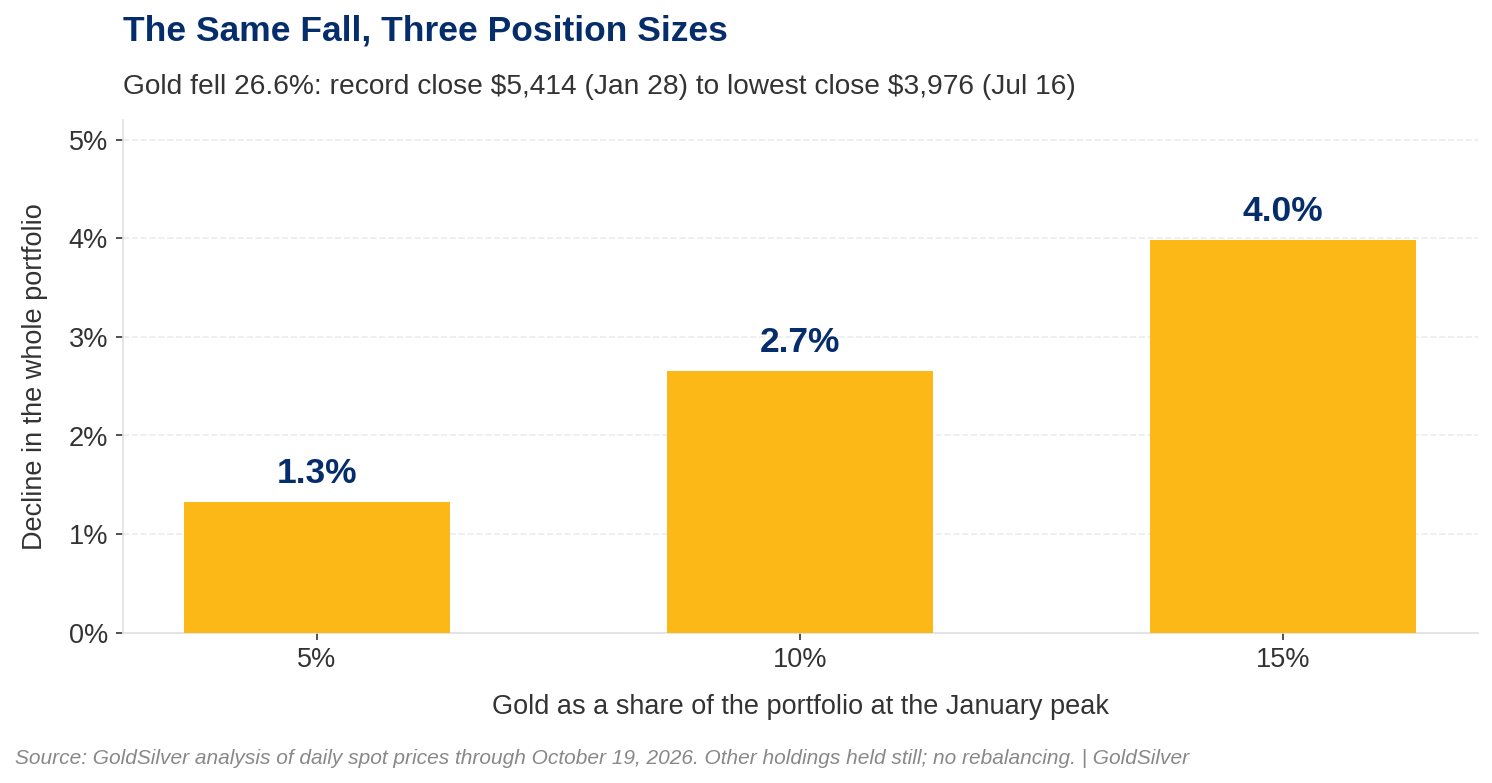
The gold correction of 2026 took gold 26.6% below its record close at its low. So say an owner held 10% of a portfolio in gold at the January peak. That fall then cost the whole portfolio about 2.7%. Position size set the damage. The Fed’s next move did not.
Gold trades in the mid-$4,100s on Monday, October 19, 2026, about 23% below that record close.
Key takeaways:
- The gold correction took gold to a $3,976 close on July 16, 2026, 26.6% below its record close. A 10% position at the January peak cost the portfolio about 2.7%, other holdings held still.
- The same arithmetic cost 1.3% at a 5% weight and 4.0% at 15%. Silver fell 52.4% over the same stretch. A smaller silver weight therefore does the same job.
- Fed Chair Kevin Warsh declined on October 16, 2026 to preview the next decision, the Associated Press reported. Position size is the one decision an owner makes before the headlines, and it can be revisited.
What Did the Fed Chair Say on October 16?
Federal Reserve Chair Kevin Warsh declined, at an International Monetary Fund event in Bangkok, to preview the October 27-28 meeting. “I don’t prejudge meetings,” he said on October 16, 2026, according to the Associated Press. The AP’s October 16, 2026 report adds that most Fed officials expect another increase this year. According to its September 16, 2026 statement, the Fed raised its target range to 3.75% to 4%. The Bureau of Labor Statistics’ October 14, 2026 report puts September consumer price inflation at 3.7% over 12 months.

The Edge Every Investor Needs Smarter precious metals investing starts here. The Nuggets Newsletter brings you essential market insights, Fed updates, global trends, educational videos, and much more.
How Does Position Size Turn a 26.6% Gold Correction Into a 2.7% Event?
In our daily spot data, gold’s record close was $5,414.49 on January 28, 2026. Its lowest close since was $3,976.14 on July 16, 2026, a fall of 26.6%. Say gold made up 10% of a portfolio at the peak. Ten percent of 26.6% is 2.66%. On a $100,000 portfolio, a $10,000 gold position lost about $2,660.
| Gold weight at the January peak | Portfolio hit at the July low | Portfolio hit at today’s price |
|---|---|---|
| 5% | 1.3% | 1.2% |
| 10% | 2.7% | 2.3% |
| 15% | 4.0% | 3.5% |
We hold the other assets still on purpose, because it isolates what gold alone did. Real portfolios move, and trimming or adding along the way changes the result. These weights only illustrate the arithmetic. There is no single right percentage, and choosing a portfolio share depends on each owner’s goals and other assets.
Silver fell further, 52.4% at its closing low. A 5% silver weight therefore cost 2.6% of a portfolio, about what a 10% gold weight cost.
What Does the Gold Correction Arithmetic Leave Out?
This is not to say the position was a good one. Still, the owner who bought at the peak holds something worth 26.6% less.
Public benchmarks agree. LBMA’s Precious Metals Market Report of July 15, 2026 puts the benchmark record at $5,501.70 on January 29, 2026. That figure is a single morning auction price. Gold closed that day below its January 28 close, so our closing peak falls a day earlier. The July 15, 2026 report also describes a fall of nearly 27% by the end of June.
Gold has fallen harder and longer before. From September 2011 to December 2015, its close fell 44.6%. That would cost a 10% holder 4.5%. Gold’s longest declines run longer still, roughly 70% over nearly two decades after January 1980.
The same record shows gold up about 136% over five years. Yet it is down about 2% over the past year and about 4% this year. Sizing does not make a decline painless. Instead, it makes the decline survivable without a snap decision.
Why Does a Sized Position Fit the Sound Money Case?
At 3.7% inflation, anything earning below that buys less each year. Physical gold sits outside that system, because it is no one’s promise to pay. The structural case works over years. Over those years, the price will fall in some stretches, as it did in the 2026 gold correction. Sizing is how an owner accepts those stretches intentionally.
What Does a Fed Chair Who Won’t Forecast Mean for an Owner?
A chair who will not say what comes next fills the week with rate-odds tables. They describe the next meeting, not what a holding can bear. For an owner sized so a 26.6% fall is a 2.7% event, the calendar’s question is already answered.
The Federal Reserve’s 2026 calendar sets its next decision for Wednesday, October 28, 2026, at 2:00 p.m. ET. After a 23% fall, a 10% position at the peak is now closer to 8%. That assumes everything else held still. Whether to restore the weight is a choice, and doing nothing is one too.
Stay On Top of Gold & Silver Prices
Get important market alerts sent straight to your inbox.
SOURCES
1. Associated Press (via PBS NewsHour) – Fed chair Warsh says price stability is key but shies away from signals about rates – October 16, 2026
2. Federal Reserve – Federal Reserve Issues FOMC Statement – September 16, 2026
3. U.S. Bureau of Labor Statistics – Consumer Price Index, September 2026 News Release – October 14, 2026
4. Altinavcisi – Daily Gold and Silver Spot Prices (Altinavcisi Analysis) – Data through October 19, 2026
5. LBMA – Precious Metals Market Report: Q2 2026 – July 15, 2026
6. Altinavcisi – Gold Price History: From $35 to $4,500 in 100 Years – June 2, 2026
7. Federal Reserve – October 2026 FOMC Meeting Calendar – Accessed October 19, 2026
Disclaimer: This article is for informational purposes only and does not constitute investment advice. Past performance is not indicative of future results. Always consult a qualified financial advisor before making investment decisions.