
France’s central bank has completed the repatriation of its entire gold reserve previously stored at the Federal Reserve Bank of New York. Bars that had been held in New York — some for nearly a century — are now securely stored sixty feet underground in the Banque de France vaults in Paris.
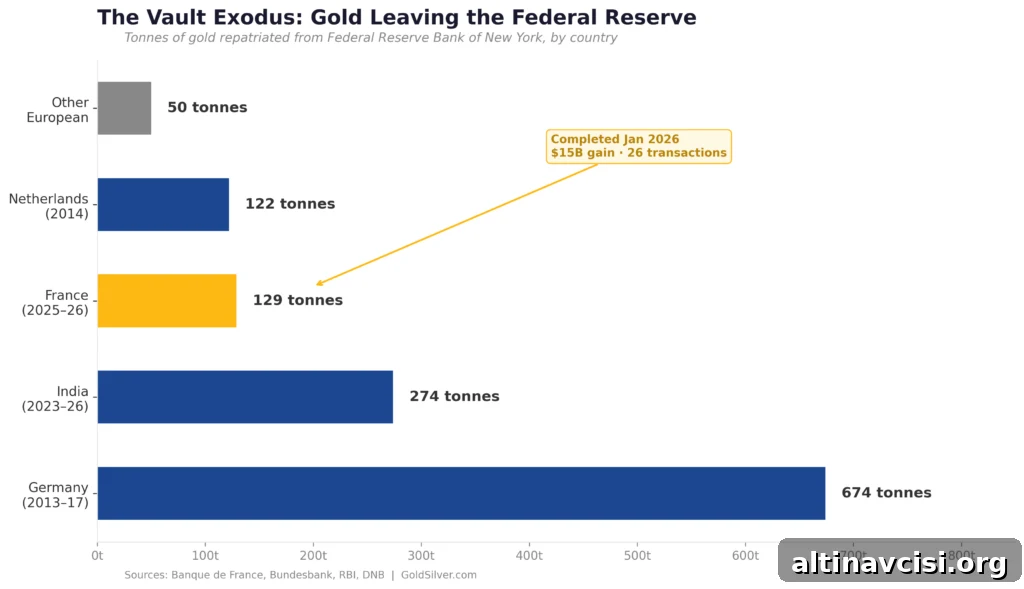
From July 2025 through January 2026, the Banque de France sold 129 tonnes of older, non-standard bars across 26 transactions and replaced them with higher-quality, LBMA-compliant European bullion. After those transactions, France’s total reserves of 2,437 tonnes are entirely on French soil. The central bank reported about €13 billion (roughly $15 billion) in capital gains from the operation. At the time of publication, gold traded near $4,820 per ounce.
Why Did France Move Its Gold Out of the US Federal Reserve?
The official reason is practical: many of the bars held in New York did not meet London Bullion Market Association (LBMA) standards, which define the market’s requirements for weight and purity. Refining older bars to meet those standards and shipping them back to Paris would have been costly. By selling the non-standard bars in New York while prices were strong and buying LBMA-compliant bars in Europe, France improved the quality of its holdings and realized a significant profit.
That explanation is accurate, but it sits alongside a broader context. France is not an outlier: other central banks have repatriated gold in recent years. Germany moved 674 tonnes from New York and Paris between 2013 and 2017. The Netherlands repatriated 122 tonnes in 2014. India has brought home 274 tonnes since March 2023. These moves reflect a wider reassessment of reserve storage practices.
A pivotal moment came in 2022, when Western countries froze roughly $300 billion in Russian central bank reserves held in Western institutions. That event prompted many central banks to reconsider the risks associated with holding reserves abroad.
When assets can be frozen remotely, countries reassess where and how they store strategic reserves. Repatriation reduces dependency on foreign custodians and increases direct control over access to physical bullion.
Is Germany’s “Our Gold Is Safe in New York” Position Sustainable?
Official institutions push back against the political interpretation. The Bundesbank has repeatedly described the Federal Reserve Bank of New York as a trustworthy partner and, as of April 2026, has made no public plan to repatriate the remainder of its holdings. France’s central bank governor, François Villeroy de Galhau, said the move was not politically motivated.
But central banks rarely announce geopolitical shifts by name. They act, and public debate often follows. In Germany, voices calling for repatriation have become more mainstream. That change in sentiment matters: Germany still holds 1,236 tonnes in New York, about 37% of its reserves, while Italy stores roughly 43% of its reserves in New York. Together, those holdings represent more than $350 billion in sovereign gold located in U.S. vaults.

The Edge Every Investor Needs
Smarter precious metals investing starts here. The Nuggets Newsletter brings essential market insights, Fed updates, global trends, educational videos, and concise analysis to help investors stay informed.
Why Are Central Banks Still Buying Gold at Record Prices?
Repatriation explains one trend; accumulation explains another. Central banks are buying gold even as prices reach new highs. The World Gold Council’s April 2026 update shows sustained Chinese buying: the People’s Bank of China recorded its 17th consecutive monthly purchase in March 2026, adding 5 tonnes and bringing official reserves to 2,313 tonnes. Withdrawals from the Shanghai Gold Exchange surged, signaling strong physical demand despite elevated prices.
Other countries that paused purchases for years, including Malaysia and South Korea, have resumed buying. The consistent driver is not the price level but a strategic preference for assets that cannot be frozen or restricted by foreign custodians. Gold remains a reliable hedge in environments where access to foreign-held reserves may be uncertain.
What Are the Dollar and the IMF Signaling for Gold?
Market signals also favor precious metals. The U.S. Dollar Index fell for several sessions through mid-April 2026, reaching a near six-week low and relinquishing gains accumulated earlier in the year. A weaker dollar typically supports dollar-priced commodities like gold.
On April 14, the International Monetary Fund lowered its global growth forecast to 3.1% while raising its inflation outlook to 4.4%. That combination raises the risk of stagflation, a scenario where both stocks and bonds can struggle. Gold often performs well in such environments because it is not subject to credit risk and can serve as an inflation hedge.
At current levels around $4,820 per ounce, gold sits near one-month highs. Silver has moved toward $80 per ounce, compressing the gold-silver ratio to about 61.1. When silver outperforms gold, it suggests the rally is broadening beyond a narrow “flight to safety” into wider industrial and investment demand.
What Did France Just Prove About Gold Ownership?
France’s operation was deliberate and measured, not panicked. Over seven months and 26 transactions, it upgraded the quality of its reserves and realized a substantial gain. The broader message is about control: when countries that design and operate the global monetary system choose to keep physical reserves close, it signals a reassessment of counterparty risk.
For individual savers, the implication is practical: owning gold is one consideration, but access and control matter. Ensuring physical holdings are obtainable when needed — rather than being subject to foreign custody risks — is part of the same calculation that guided France’s approach.
What Should You Watch in the Coming Weeks?
Germany is the next focal point. While the Bundesbank’s official stance remains unchanged, public pressure and parliamentary debate ahead of the May 2026 federal budget may prompt a formal review of repatriation. Any official decision, pro or con, would influence market expectations.
Monetary policy and macro data will also matter. If central banks hold rates and inflation remains elevated, real yields could compress further — a clear tailwind for gold. Technical support for gold sits near $4,750; silver’s behavior is worth watching independently, since a sustained gold-silver ratio below 62 has historically preceded the stronger phase of precious metals rallies.
Stay On Top of Gold & Silver Prices
Get important market alerts sent straight to your inbox.
SOURCES
1. Banque de France — 2025 Annual Results
2. London Bullion Market Association — Good Delivery Rules
3. Deutsche Bundesbank — Bundesbank Completes Gold Transfer Ahead of Schedule
4. Deutsche Bundesbank — Gold Reserves
5. De Nederlandsche Bank — DNB Has Adjusted Its Gold Stock to the Netherlands
6. Reserve Bank of India — Report on Foreign Exchange Reserves
7. US Department of the Treasury — Russia-Related Sanctions
8. World Gold Council — China Gold Market Update, April 2026
9. International Monetary Fund — World Economic Outlook, April 2026
10. ICE Futures U.S. — US Dollar Index
By the GoldSilver Editorial Team — helping investors understand sound money since 2005. This article is informational and does not constitute financial, investment, or tax advice. Consult a qualified advisor before making investment decisions.
You May Also Like
- Gold/Silver Ratio Hits 61.1 — Silver’s Turn to Run
- Silver Holds Near $80 as Iran Ceasefire Revives Rate-Cut Bets
- The Fed Goes Silent in 3 Days – What Does That Mean For Gold?
- Gold Is Down 10% From Its War-Peak — and Still Up 46% in a Year
- Gold Outranks the Dollar at Central Banks — What It Means for Your Savings
- Hormuz Blockade Sent Gold Down 2%. Here’s Why That’s Bullish
- Gold Jumps 2% as Trump Plans Iran War Address Tonight
- $88 Billion a Month: Why U.S. Debt Is Driving Gold Prices