

A Nomura strategist recently told Bloomberg that the U.S. economy can likely absorb more Federal Reserve rate hikes than markets currently expect. That statement is not a Fed announcement—it’s an investment house’s view about where real interest rates might head next. For gold, the most reliable driver of price action is the path of real yields. This week provided a clear example: the real 10-year Treasury yield rose from about 2.62% to roughly 2.83% over four trading sessions.
Below I explain what that move implies for gold’s near-term ceiling, and what it does not imply for the metal’s longer-term case.
Key Takeaways:
- Nomura’s North Asia CIO told Bloomberg (Sept 28, 2026) the U.S. economy can likely absorb additional Fed rate hikes without tipping into recession, pointing to resilient consumer spending, AI-driven capital expenditure, and expansionary fiscal policy.
- The real 10-year Treasury yield climbed from about 2.62% to 2.83% between September 21 and 25, 2026. A longer hiking cycle would tend to push real yields higher still.
- CFTC data for the week ending September 22, 2026 showed COMEX gold speculative positioning heavily skewed to the long side at roughly 61.5% of open interest. Crowded longs can magnify a pullback if hawkish surprises arrive.
- Major bank targets for year-end 2026 remain above spot: Goldman Sachs published $4,900 and J.P. Morgan’s target sits near $6,000. Those targets are materially above the spot price noted in this article.
- A hawkish Fed is a mechanical near-term headwind for gold through the real-yield channel. It does not by itself overturn the multi-year structural arguments for owning the metal.
Why Does the Bank Call Matter More Than the Headline?
The Nomura comment is a forward-looking house view about how far the Fed might push policy, not a policy decision. For anyone holding gold, the important point is the projected path of real interest rates—not the headline itself. Real rates are the single most consistent determinant of gold’s price. When real yields rise, gold tends to fall; when real yields fall, gold tends to rise. The Nomura call matters because it implies a direction for that key lever.
This article does not adjudicate whether Nomura is correct. Instead, it shows what a longer hiking cycle would do to gold’s near-term price ceiling if the bank’s view is right. Even if real yields move higher for a while, that outcome does not erase the structural, multi-year reasons investors hold gold.
What Is a Real Yield, and Why Does Gold Care?
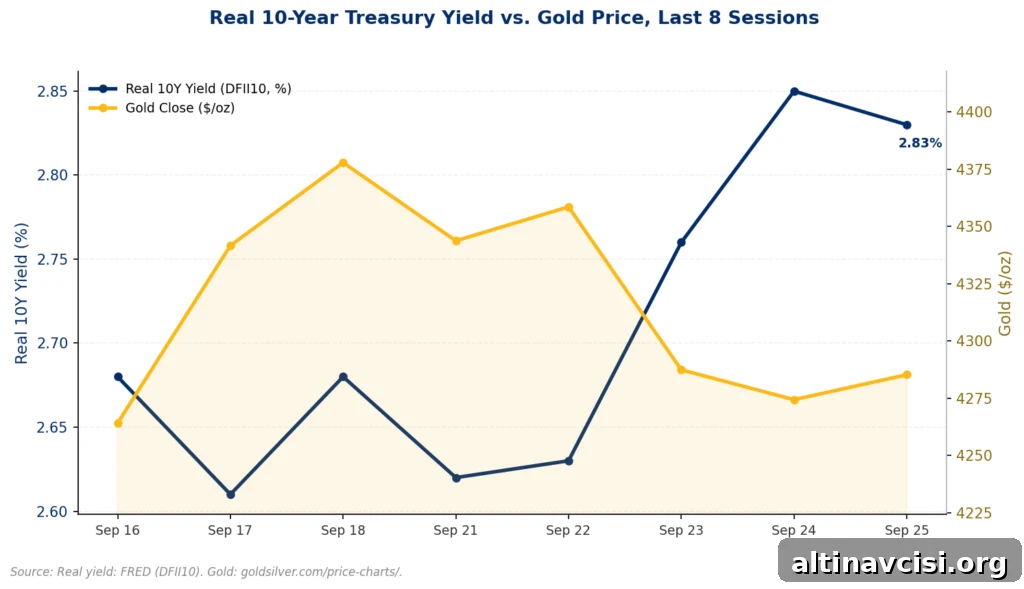
Gold does not pay interest or dividends. Owning an ounce today leaves you with an ounce years from now, so investors compare gold to the inflation-adjusted return on a long-term safe asset—typically the 10-year Treasury. That inflation-adjusted return is the real yield, and the market prices it daily via Treasury Inflation-Protected Securities. Changes in that number directly affect gold’s opportunity cost.
Between September 21 and 25, 2026, the real 10-year yield moved roughly 21 basis points—from 2.62% to 2.83%—which is sizable for just a few trading days. Historically, a roughly 25-basis-point move in real yields can correspond to a $40–$60 per ounce movement in the opposite direction for gold. In other words, rising real yields are a mechanical headwind for gold.
Most coverage focuses on the Fed meeting, the dot plot and the press conference. Those are important, but the real determinant of gold’s reaction is how real yields behave after the meeting. If Nomura’s thesis is correct and the Fed has room to hike further, real yields could keep trending up for days or weeks, and that persistent trend would weigh on gold more than a single policy announcement.
Is Gold’s Long Positioning a Risk Right Now?
Beyond macro mechanics, market positioning matters. The Commitment of Traders report for the week ending September 22, 2026 showed managed-money traders holding roughly 253,982 long contracts versus about 28,129 short contracts in COMEX gold. That concentration implies roughly 61.5% of open interest sitting long. It is a distinctly one-sided book.
A large speculative long is not inherently bearish—it reflects conviction accumulated over a rally—but it reduces the market’s ability to absorb negative news without a sharp price correction. If the Fed surprises on the hawkish side and real yields continue to climb, crowded longs may be forced to unwind quickly, producing an amplified pullback that is larger and faster than the underlying macro shift alone would cause.
Expect increased volatility around upcoming Fed-related data points. Positioning raises the odds of a sharper short-term correction, though it does not by itself prove that the long-term trend has reversed.
The Knowledge That Changes Everything

Two essential guides — yours free. Learn why gold matters and why fiat currencies repeatedly face pressure.
What the Street’s Own Money Says
If banks arguing for a longer hiking cycle were also turning uniformly bearish on gold, that would be a different signal. They are not. Major banks continue to publish year-end targets for gold that sit well above the spot price referenced in this article. These forecasts come from the same institutions where economists debate interest-rate paths, while commodities desks and strategists weigh medium-term demand, central bank purchases, and institutional underallocation to the metal.
Put differently: a bank’s macro team can reasonably expect a longer hiking cycle, while the same bank’s commodities team can reasonably expect gold to finish the year higher. Those perspectives address different time horizons and drivers—near-term interest-rate mechanics versus a multi-year reallocation into gold—and they can coexist.
What’s the Debt-Service Argument Nomura’s Wang Isn’t Making?
A related but distinct public argument concerns the government’s debt-service burden. Long-term Treasury yields at current levels last occurred roughly two decades ago, when federal debt was a much smaller share of GDP. As the absolute stock of debt has grown—passing notable milestones in recent years—each percentage-point increase in borrowing costs generates a larger dollar burden for the Treasury.
That argument differs from the question Nomura’s strategist raised. Wang focused on whether consumers and businesses can absorb higher rates without tipping the economy into recession. The debt-service argument asks whether the government’s finances can tolerate a prolonged period of elevated rates without triggering fiscal stress. An economy can pass one test while failing the other, and that tension matters for medium- to long-term asset allocation decisions.
What’s the Takeaway for Gold Investors?
You do not need to pick a side in the debate about how many more hikes the Fed will deliver. You do need to understand the mechanism by which those hikes affect gold. A longer hiking cycle mechanically pushes real yields higher, which is a genuine headwind for a non-yielding asset like gold. Heavy speculative long positioning can magnify any downside in the near term, producing sharper corrections.
Neither of those facts undermines the structural reasons to own gold. The long-term case rests on different forces—central bank purchases, portfolio reallocation by institutions and pensions that remain underallocated to precious metals, and fiscal strains that can increase the appeal of non-sovereign stores of value. Investors should be prepared for short-term volatility while keeping sight of the multi-year drivers.
Stay On Top of Gold & Silver Prices
Get important market alerts sent straight to your inbox.
People Also Asked
What did Nomura say about the Fed and interest rates?
Nomura’s North Asia Chief Investment Officer said the U.S. economy appears resilient enough to absorb additional Fed rate hikes without tipping into recession, citing robust consumer spending, AI-related capital expenditure, and loose fiscal policy. This is a firm’s house view rather than a policy statement from the Fed, and it implies a longer hiking cycle than some market participants expect.
Why do rising interest rates hurt gold prices?
Gold pays no yield, so its primary competitor is the inflation-adjusted return on safe government bonds. When real yields rise, the opportunity cost of holding gold increases, and gold prices tend to soften. When real yields fall, that opportunity cost diminishes and gold generally strengthens. This is a mechanical relationship rather than a sentiment-based one.
What is a real yield?
A real yield reflects the return on a bond after subtracting expected inflation. Markets price this outcome through Treasury Inflation-Protected Securities. For the period discussed above, the real 10-year yield rose from about 2.62% to 2.83% in four trading sessions, illustrating how quickly that lever can change.
Is gold overbought right now?
Current positioning appears one-sided rather than simply “overbought” by technical measures. The Commitment of Traders report showed speculative longs at roughly 61.5% of open interest, which increases vulnerability to a sharper correction if real yields move higher. That positioning is a risk for near-term volatility but not a definitive signal that the multi-year bullish case has ended.
What are Wall Street’s gold price targets for the end of 2026?
Major banks have published year-end targets above the spot price cited here, with notable examples including a $4,900 target from one large house and roughly $6,000 from another. These targets are forecasts based on their models and assumptions and can change as conditions evolve.
Does a hawkish Fed mean it’s a bad time to own gold?
A hawkish Fed creates a near-term headwind via higher real yields, and positioning can amplify short-term downside. But that is distinct from the structural, multi-year rationale for holding gold. Investors should be prepared for volatility while considering the longer-term forces that support allocation to the metal.
What is fiscal dominance, and how does it relate to this story?
Fiscal dominance occurs when the government’s debt-service burden constrains central bank policy. If rates rise enough to sharply increase the government’s interest expense, fiscal constraints can limit how long higher rates are sustainable. That is a different concern than whether consumers and businesses can absorb higher rates; both dynamics are worth watching because they affect medium-term inflation, rates and the appeal of gold.
SOURCES
1. Bloomberg – Nomura’s Wang: US Can Absorb More Rate Hikes – September 28, 2026 (news report).
2. FRED – 10-Year Treasury Inflation-Indexed Security (DFII10) – data series referenced for real yields (September 25, 2026).
3. CFTC – Commitment of Traders Report – week ending September 22, 2026 (positioning data).
4. Industry forecasts and bank reports compiled in recent market round-ups (consult major bank publications for their full notes).
Disclaimer: This article is for informational purposes only and does not constitute investment advice. Past performance is not indicative of future results. Consult a qualified financial advisor before making investment decisions.
You May Also Like:
- Gold Fell 23% This Year. One Number Explains Why.
- What Is the Debt-to-GDP Ratio, and What the U.S. Number Tells You About Gold
- The World’s Last Zero-Rate Anchor Is Rising, and Gold Should Care
- What Is a FOMC Meeting? What the Fed Decides and How Gold Reacts
- Gold in Your Phone: How Much Gold Is in Electronics and What It Means for Demand
- Real Yields vs. Nominal Rates: The Number That Actually Moves Gold
- How to Read a Gold Spot Price Chart: The 4 Things That Actually Matter
- Central Banks Hold 80% of Reserves in Gold. Sovereign Wealth Funds Hold Under 1%.