KEY TAKEAWAYS
- April JOLTS reported 7.62 million job openings, well above the 6.88 million consensus by nearly 750,000.
- Gold is up about $43 today, trading near $4,477/oz — a response that runs counter to the textbook reaction to higher rate odds.
- The CME FedWatch Tool now shows an 85% probability of a Fed hike by December 2026, up from 60% a week earlier.
- In stagflationary settings, rising nominal rates can signal policy failure rather than success — a dynamic that tends to support gold.
- History shows a similar pattern in the 1970s: gold climbed dramatically while the Fed raised rates from about 4.7% to nearly 20%.
- Only when Volcker pushed real rates substantially positive did the gold bull market end — a policy move that appears infeasible given today’s fiscal position.
- Monthly jobs data can be read both ways, but under the real-yield mechanism, strong or weak prints can each reinforce a long-term bullish case for gold.
Why Is Gold Rising When Rate Hike Odds Are This High?
This morning’s JOLTS report showed 7.62 million job openings in April, beating the consensus of 6.88 million by nearly three-quarters of a million. Together with a stronger ADP private payrolls print, the labor market message is straightforward: the economy isn’t collapsing.
Under the conventional narrative, that should be bearish for gold. Strong labor → Fed can tighten → nominal rates rise → dollar strengthens → non‑yielding gold underperforms. It’s the simple cause-and-effect taught in classrooms and repeated in headlines.
Yet gold is higher today, gaining roughly $43 and trading around $4,477/oz as of this afternoon. At the same time, markets have ramped up the odds of a December 2026 Fed hike to about 85%, effectively pricing out rate cuts for the year and making a year‑end hike the base case.
So why didn’t gold fall? The answer requires shifting focus from nominal rates to real yields — and recognizing the dynamics of a stagflationary environment.
The Knowledge That Changes Everything
Two essential guides — yours free. Understand why gold matters and why fiat currencies repeatedly fail.
Why Does Gold Rise When Rate Hike Odds Rise?
The usual model is not wrong; it’s incomplete. When central banks raise rates in a healthy economy where inflation is under control and growth is robust, the opportunity cost of holding gold rises. Bonds yield more, the dollar strengthens, and gold often softens. That dynamic was visible between 2022 and early 2024, when the Fed hiked repeatedly and real yields moved from deeply negative toward positive, pressuring gold at times.
But the critical variable for gold is the real yield — nominal yield minus inflation — not the nominal fed funds rate itself. In a stagflationary scenario, nominal rates can rise while inflation accelerates or remains elevated, leaving real yields flat or even negative. For example, with headline PCE near 3.8% and 10-year Treasuries around 4.3–4.6%, real yields are only marginally positive. A 25 basis point hike barely changes that picture. If savers still lose purchasing power in real terms, gold remains competitive despite higher nominal rates.
Did Gold Actually Rise During Rate Hikes in the 1970s?
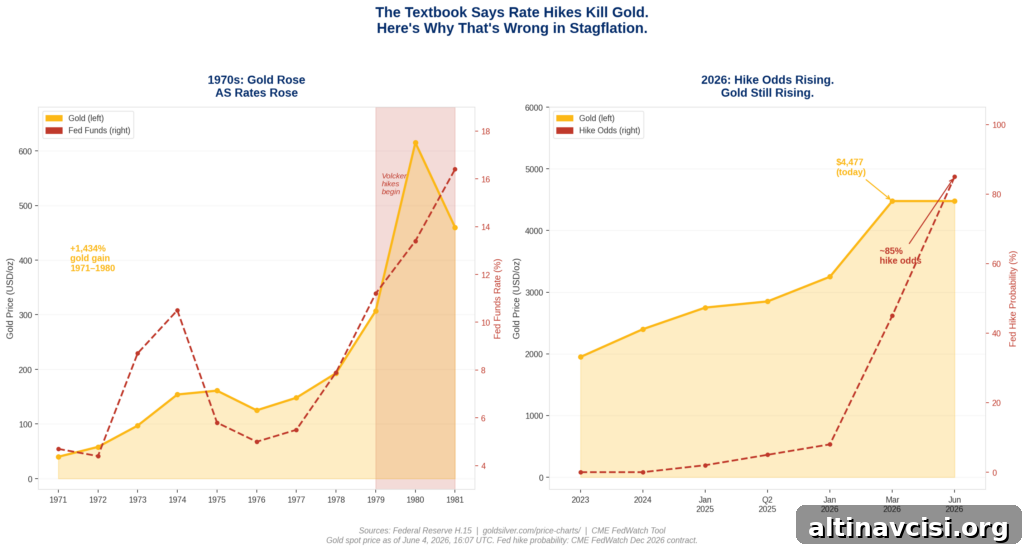
The 1970s offer a clear precedent. From 1971, when the U.S. left the gold standard, through 1980 the Fed raised rates dramatically — from around 4.7% to nearly 20%. Conventional logic would have expected gold to fall, but gold instead soared from roughly $40/oz to about $615/oz by year‑end 1980 and peaked near $850 in January 1980. That surge happened while the Fed was hiking because investors were focused on real yields and inflation expectations rather than nominal policy rates.
Paul Volcker’s actions illustrate the exception. By driving real rates sharply positive and accepting a deep recession, he eventually broke inflation expectations and ended gold’s bull run. Replicating that outcome today would require sustained real yields far above current levels — a path that appears politically and fiscally challenging given today’s debt load.
Why Can’t the Fed Run the Volcker Playbook Today?
The Fed funds rate currently sits around 3.50–3.75%, with markets pricing in a high likelihood of one more 25bp hike by year‑end. Given headline PCE near 3.8% and 10‑year yields around 4.48–4.49%, real 10‑year yields are only modestly positive — well short of the 4–6% real yields Volcker achieved. More importantly, federal debt is approaching $39 trillion and interest costs exceed $1 trillion annually. A Volcker‑style rate path would drastically increase interest expenses, risking a sovereign fiscal crisis. Those constraints limit the Fed’s ability to force real yields much higher, which in turn supports gold’s structural case.
Central banks are also adding to the backdrop: many remain net buyers of physical gold, accumulating reserves as a hedge. That demand reinforces the idea that higher nominal rates do not automatically mean weaker gold.
What Does “Trapped” Mean for Physical Gold Owners?
In a normal tightening cycle, higher real yields and a stronger dollar create headwinds for gold. In stagflation, however, rising nominal rates often reflect a central bank trying to catch up to pervasive inflation rather than successfully reining it in. Bonds with fixed coupons lose purchasing power if inflation outpaces yields; gold has no coupon to erode. That makes physical gold a durable store of purchasing power when real yields remain low or negative.
The modern twist is central banks themselves buying gold, adding another structural buyer to the market and reinforcing the asset’s hedge qualities.
Why Does the Monthly Jobs Report Cut Both Ways for Gold?
Monthly employment prints are high-frequency events that can move gold intraday or for a few sessions. A strong jobs number typically increases the chance of Fed tightening, strengthening the dollar and pressuring gold short term. But unless those moves produce materially higher real yields, the structural store-of-value case for gold stays intact. Conversely, weak jobs reinforce stagflation concerns — slow growth plus persistent inflation — a classic environment where gold tends to outperform. In short, the monthly report is noise; the real‑yield dynamic is the signal.
What Would Actually Break the Gold Thesis?
The thesis breaks only if policymakers can sustainably push real yields decisively above +4% and keep them there long enough to reset inflation expectations — effectively repeating Volcker’s outcome. That would require policy rates materially higher for an extended period, a scenario that looks unlikely given today’s fiscal constraints and political realities. Until real yields move meaningfully and persistently higher, the mechanism supporting gold remains intact.
Understanding this distinction — nominal rates versus real yields, and the importance of the macro backdrop — explains why gold can rise even as markets price higher odds of future Fed hikes. It’s not a contradiction so much as a different economic regime than the one assumed by the textbook case.
Stay On Top of Gold & Silver Prices
Get important market alerts sent straight to your inbox.
SOURCES
1. Gold & silver price charts and market data.
2. Bureau of Economic Analysis — Personal Consumption Expenditures Price Index, April 2026.
3. Bureau of Labor Statistics — Job Openings and Labor Turnover Summary, April 2026.
4. World Gold Council — Gold Demand Trends Q1 2026.
5. Data on national interest costs and debt levels.
6. CME Group — FedWatch Tool.
7. Market commentary on inflation, yields, and gold demand.
Disclaimer: This article is for informational purposes only and does not constitute financial or investment advice. Consult a qualified financial adviser before making investment decisions.
You may also like:
- Gold Confiscation: Could the Government Take Your Gold Again?
- Gold Price History: From $35 to $4,500 in 100 Years
- The Debasement Trade Explained: Mechanism, History, and What It Means for Gold
- Gold or Silver First? A First-Time Buyer’s Framework
- Gold Reserves by Country: The 2026 Rankings
- Gold Portfolio Allocation: Why Wall Street Is Rewriting the 60/40
- What Does the SILVER Act Mean for Precious Metals Investors?
- What Backs the US Dollar? Not Gold. Not Silver.
- Why Is Gold Valuable? The 5,000-Year Answer Most Investors Get Wrong
- 72% of Family Offices Hold No Gold. What They’re Missing.