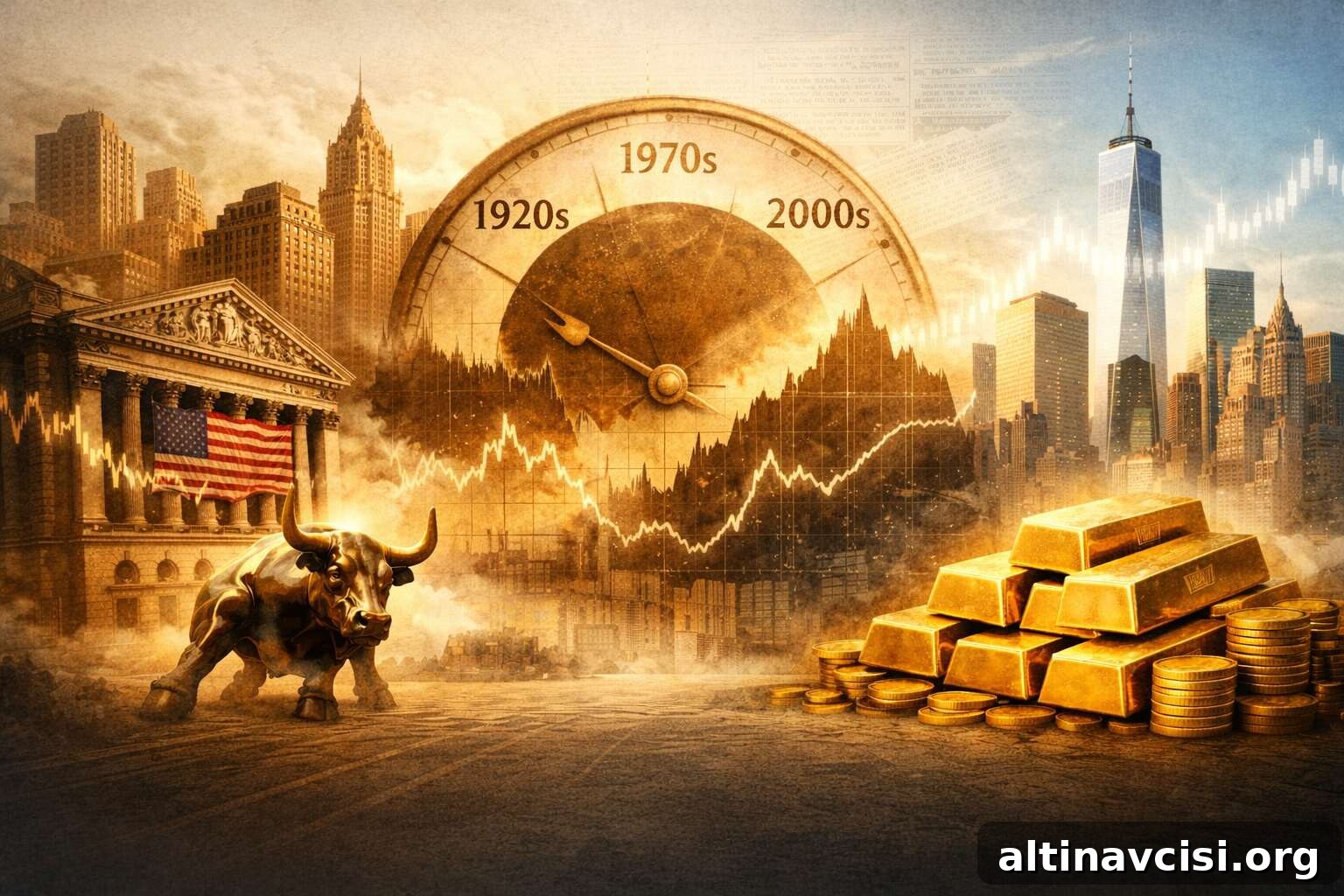
The Dow–gold ratio divides the Dow Jones Industrial Average by the spot price of one ounce of gold, showing how many ounces of gold equal one unit of the Dow. Today that ratio is roughly 10 — meaning it takes about 10 ounces of gold to equal one Dow unit — which is well below its 50‑year average near 15 and far beneath the all‑time peak around 43 at the 1999 dot‑com height. That compression reflects a sustained gold bull market: in real terms, gold has outpaced stocks and the structural forces behind the trend — currency debasement, persistent inflation, and heavy central bank buying — remain in place.
Gold has risen roughly 15.6% since January 1, 2026, while the Dow gained only about 2.7% over the same interval. That divergence is easy to miss in daily headlines but the Dow–gold ratio captures it directly. At a ratio near 10, gold has already done significant work repricing equities in terms of real money. Historically, large swings in this ratio have coincided with major shifts in the monetary and market cycle.
What Is the Dow to Gold Ratio?
The Dow–gold ratio is calculated by dividing the current level of the Dow Jones Industrial Average by the spot price of a troy ounce of gold. For example, if the Dow is roughly 47,917 and gold trades near $4,780 per ounce, the ratio is about 10. That figure expresses the number of ounces of gold needed to equal one unit of the Dow index — the same exposure you get through a Dow ETF or futures contract.
This ratio is not a short‑term price forecast. Instead, with a history extending more than a century, it serves as a long‑term gauge of relative valuation between equities and hard money. High readings indicate stocks are expensive in gold terms; low readings indicate gold has appreciated relative to stocks. Over long cycles the ratio has tended to revert toward its mean, making it a useful barometer of the monetary environment rather than a timing device for weekly moves.
Why Has the Dow Gold Ratio Predicted Major Market Turns?
The Dow–gold ratio has a consistent record of signaling turning points in monetary cycles. In 1929 the ratio peaked near 19 before the stock market collapse that followed; by 1933 it had fallen sharply as stocks lost value while gold held its purchasing power. In the late 1960s the ratio rose again and after a stagflationary decade it plunged, culminating around 1980 when one ounce of gold was roughly equivalent to one unit of the Dow.
The credit expansion of the 1980s and 1990s pushed the ratio to its all‑time high near 43 by 1999, when gold traded in the low $200s. The dot‑com bust initiated a cycle in which gold surged and the ratio compressed: from about 2000 to 2011 gold climbed from near $250 to over $1,900 per ounce and the ratio fell to cycle lows around 6.7. Those historical patterns show the ratio’s value as a long‑term indicator: extreme highs have tended to precede gold bull markets, and extreme lows have eventually given way to stock recoveries.
What Does a Ratio of 10 Signal Right Now?
A ratio near 10 confirms that a gold bull market is well underway rather than serving as an early warning. Recent price action — gold reaching record highs then settling back while the Dow has lagged — has driven the ratio into this territory. Compared with past cycles, a reading of 10 is higher than the extreme lows of 1.3 (1980) and 6.7 (2011), so it does not yet show the kind of extreme compression that historically signals the end of a gold cycle.
That said, current macro conditions — inflation above historical norms and strong central bank gold purchases — support continued gold demand. For the ratio to revert up toward its 50‑year average of 15, the Dow would need to substantially outperform gold, which likely requires a notable change in the monetary backdrop: disinflation, falling central bank demand, or a sustained dollar rebound.
How Investors Use the Dow Gold Ratio in Practice
A common practical framework, popularized by investor Bill Bonner, uses two thresholds: when the ratio rises above about 15, gold is relatively cheap versus stocks and investors may increase gold exposure; when it falls below about 5, stocks are deeply undervalued in gold terms and rotation into equities becomes attractive. This approach treats the ratio as a slow‑moving rebalancing compass rather than a trade trigger.
Investors applying the ratio today typically use it to manage asset allocations and monitor where the long‑term value balance sits between equities and hard money. At a ratio near 10, the focus is on positioning and readiness for eventual mean reversion rather than entering a fresh trade based solely on the number.
What Are the Limits of the Dow Gold Ratio?
The Dow–gold ratio is a powerful long‑term indicator but a poor short‑term timing tool. For nearly two decades in the 1980s and 1990s, the ratio rose while equities delivered one of the largest bull markets in history; anyone who abandoned stocks early because the ratio crossed a threshold missed substantial gains. The ratio also omits dividends, which are an important component of stock returns, and it measures just 30 large U.S. companies rather than the full global market. In short, it’s a useful instrument on the valuation dashboard, but not the only one investors should consult.
Your Gold Buying Guide Most investors overpay when they buy gold and again when they sell. This guide explains what to own and why.
Stay On Top of Gold & Silver Prices
Get important market alerts sent straight to your inbox.
People Also Ask
What is the Dow to gold ratio right now?
As of April 2026 the ratio is approximately 10, calculated by dividing the Dow Jones Industrial Average (near 47,917) by the gold spot price (near $4,780 per ounce). That implies about 10 ounces of gold equal one Dow unit, a level below the 50‑year average and indicative of a mature gold bull market.
How is the Dow to gold ratio calculated?
Divide the current Dow level by the current spot price of one ounce of gold. For instance, a 47,000 Dow divided by $4,700 gold yields a ratio of 10, showing how many ounces of gold equal one unit of the Dow index.
What does a low Dow to gold ratio mean?
A low ratio means gold has gained significantly relative to the Dow, so fewer ounces are needed to match the index. Historically, low readings have coincided with gold bull markets, monetary stress, and sustained inflation; the 1980 low of about 1.3 occurred at a peak in gold’s purchasing‑power run.
What was the Dow gold ratio at its highest?
The ratio reached roughly 43 in 1999 during the dot‑com bubble, when equities were richly priced against gold, which traded in the low $200s per ounce. That extreme reflected a historic undervaluation of gold relative to stocks.
Is the Dow gold ratio a good investment signal?
It’s a robust long‑term valuation tool rather than a short‑term trading signal. Historically, readings above 15 have preceded prolonged gold outperformance, and readings below 5 have signaled eventual equity outperformance. Use it to inform rebalancing and long‑term allocation decisions, not as a single trade trigger.
What does the Dow gold ratio tell us about inflation?
A falling ratio often reflects inflationary pressure and monetary debasement: gold preserves purchasing power while stocks can struggle in real terms. Measuring portfolios in ounces of gold strips out the distortion of a depreciating currency and highlights real, lasting value.
What ratio level should trigger buying gold?
One practical rule of thumb identifies a ratio above about 15 as a signal to increase gold exposure, and readings below about 5 as a point to rotate back toward equities. At roughly 10 today, the buy‑gold signal has already been playing out and the ratio is now tracking toward the eventual rotation zone rather than away from it.
The Bottom Line
The Dow–gold ratio is one of the clearest long‑run valuation gauges available. It doesn’t forecast next‑week moves, but it removes the dollar illusion and shows how stocks and gold compare in real money terms. At around 10 today, the ratio sits below its 50‑year average and far below the dot‑com peak, signaling that gold has already materially repriced equities this cycle. Structural drivers such as ongoing central bank purchases and above‑trend inflation support the case that the current gold cycle may have further room to run.
This article is informational and not financial advice. Past performance does not guarantee future results. Consult a qualified financial advisor before making investment decisions.