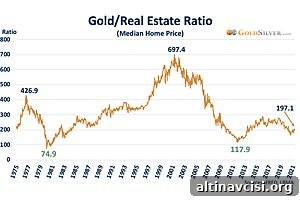
We update our charts every year to show how many ounces of gold and silver it takes to buy a house in the United States. The idea of purchasing a home with bullion is compelling, especially given how stretched housing prices are relative to gold and silver. This year we reviewed our figures and discovered an important distinction that changes the picture: using median home prices instead of average prices provides a clearer, more representative comparison.
Why does this matter? Average (mean) home prices can be skewed by a small number of very expensive sales. For example, if nine homes sell for $100,000 and one sells for $1,000,000, the average sale price becomes $190,000 even though most buyers paid much less. Median price—the middle value in a list of sales—better reflects what a typical buyer pays, because half the sales fall above it and half below.
Housing markets contain many high-end sales that push averages upward. For middle-class buyers interested in how their bullion holdings translate into real estate purchasing power, median pricing is the more useful metric. Switching to median values reduces potential distortion from a handful of high-priced transactions.
Gold and Silver Ratios to Median Home Prices
Using average prices, our earlier chart showed it took 85.1 ounces of gold to buy the average-priced U.S. home at the peak of the gold market in January 1980. When we recalculate using median home prices, that 1980 low actually equates to 74.9 ounces of gold.
That difference may seem modest, but at today’s gold prices it represents a meaningful amount of money—more than $18,000 in purchasing power. In practical terms, if the ratio returned to its 1980 low you would need to spend over $18,000 less in gold than our original average-based chart suggested.
Across the board, values measured against median home prices are lower. Last month it took roughly 231 ounces of gold to buy the average-priced home, versus about 197.1 ounces for a median-priced home.
Silver shows an even larger gap. In January 1980 it took 1,464 ounces of silver to buy the average-priced home, but only 1,288 ounces to buy a median-priced home.
If that ratio returned to the 1980 low, your required investment in silver today would be lower by roughly $4,720 versus the average-based estimate. In the most recent month we tracked, buying the average-priced home would demand about 16,056 ounces of silver, while a median-priced home required about 13,220 ounces—a difference of 2,836 ounces, or nearly six retail mint cases.
In short, purchasing a home with gold or silver may be more attainable than prior charts implied. If your plan is to trade bullion for real estate, median-based ratios suggest it could take fewer ounces than previously reported—especially in silver.
For some readers the median-versus-average distinction may be minor. For others, particularly long-term precious metals investors anticipating a significant rise in purchasing power for gold and silver, it’s an important clarification. Analyst Mike Maloney and others have suggested the silver-to-home ratio could drop even further, possibly approaching 1,000 ounces of silver for a typical home.
Picture buying a house outright with roughly two mint cases of silver Eagles or Maple Leafs (pre-tax), or converting a larger hoard into extensive real estate holdings: a city block, a beachfront property, or a working farm. These scenarios are speculative, but they illustrate how sensitive bullion-to-home ratios are to whether you use median or average price measures.
We made this correction to provide a clearer, more practical comparison for readers who want to understand real-world buying power in bullion. If you’re considering silver or gold as part of a plan to acquire property someday, the median-based charts are likely the better reference.
About Jeff Clark
Jeff Clark is an active investor and a recognized authority on precious metals. Growing up in a family with gold panning and mining claims across California, Arizona, and Nevada, he has deep roots in the industry. Jeff speaks at precious metals conferences, serves on the board of Strategic Wealth Preservation in Grand Cayman, and provides market analysis and commentary to GoldSilver customers. Follow Jeff on Twitter @TheGoldAdvisor