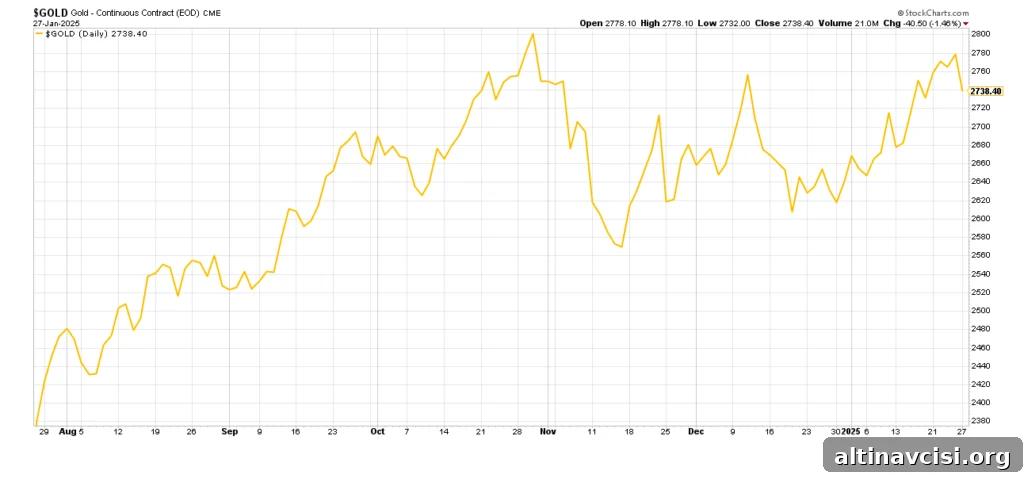
Gold looks poised for a strong 2025 after an impressive 27% rally in 2024 — its best annual performance since 2010. That momentum has carried into forecasts for next year, with a recent poll of 36 market experts projecting an average gold price near $2,756 per ounce for 2025. The consensus reflects growing confidence in the metal’s role as a safe-haven asset amid heightened political and economic uncertainty.
The market has not moved in a straight line. Gold briefly pulled back after the U.S. election and the Federal Reserve’s December meeting, where policymakers signaled fewer rate cuts in 2025 than some had expected. Even so, the dip was shallow and short-lived as fresh drivers emerged to support prices. Statements from the White House about tariffs and the prospect of renewed trade tensions helped rekindle safe-haven flows, while ongoing geopolitical risks bolstered demand from investors seeking protection against volatility.
Demand patterns are evolving beneath the headline price movements. High prices tend to weigh on jewelry buying in price-sensitive Asian markets, where consumers often reduce purchases when the metal becomes noticeably more expensive. Yet that drop in jewelry demand has been offset to a meaningful degree by stronger flows elsewhere: central bank acquisitions remain a steady source of demand as many monetary authorities diversify reserves away from fiat currencies, and speculative interest among hedge funds and other institutional investors continues to provide liquidity and price support.
Analysts also point to inflation dynamics as a fundamental underpinning for gold. Even with central banks signaling more cautious easing paths, persistent inflationary pressures — or the risk that inflation proves stickier than currently expected — make gold an attractive hedge. Political uncertainty, trade policy shifts and the potential for new geopolitical flashpoints add to the array of risks that typically favor precious metals.
The combination of central bank buying, speculative positioning and safe-haven flows alongside still-elevated global uncertainty helps explain why many forecasters see upside potential despite periodic corrections. Investors and policymakers alike will be watching several key indicators that could influence the path of prices in 2025: Fed communications and actual interest-rate decisions, developments in U.S.-China and other trade relationships, the pace of global economic growth, and any escalation in geopolitical tensions.
Market participants should also consider seasonal and regional demand cycles. Traditionally, physical demand spikes during festivals and wedding seasons in major consuming countries; those seasonal trends can amplify price moves when combined with large-scale investment flows or sudden shifts in macro expectations. Meanwhile, supply-side considerations — including mining output and recycling rates — tend to change only gradually, which can make gold prices sensitive to changes in demand sentiment.
Risk management remains essential for investors considering exposure to gold. While the consensus forecast points to a stronger 2025, volatility is a constant in commodity markets. Diversification, position sizing and a clear view of investment horizons can help manage the range of outcomes that gold might produce. For those seeking lower-volatility exposure to the metal, incremental purchase strategies or allocation through diversified funds can smooth entry points compared with trying to time short-term swings.
Overall, the outlook for gold in 2025 is shaped by a mix of supportive structural factors and near-term catalysts. Central bank reserve diversification, investor appetite for safe havens, inflation concerns and geopolitical risks form the foundation of the bullish case, while higher prices may restrain discretionary jewelry demand in Asia. With a consensus forecast around $2,756 per ounce, market watchers see continued relevance for gold as a portfolio diversifier and risk hedge through the coming year.