Why Central Banks’ Purchase of 39 Tonnes of Gold Matters

Central banks reported 39 tonnes of net gold buying in August 2026, according to data published by the World Gold Council on October 6, 2026. While the monthly total is noteworthy, the larger takeaway is that long-term reserve strategies—and not short-term price moves—largely determine central-bank buying patterns.
Key Takeaways:
- Central banks reported 39 tonnes of net purchases in August and 170 tonnes of net purchases through August 2026, based on World Gold Council disclosures on October 6, 2026.
- China was the largest reported buyer in August with 20 tonnes, marking continued accumulation. Poland and Uzbekistan each added eight tonnes. Some institutions adjusted in the other direction: Russia reported selling six tonnes and Jordan sold three tonnes.
- Long-term physical gold ownership requires a clear purpose, secure custody, and realistic liquidity planning for it to work as part of a broader financial strategy.
How Much Gold Did Central Banks Buy through August 2026?
The World Gold Council reported net central-bank purchases of 39 tonnes in August 2026, bringing reported buying to 170 tonnes through the first eight months of the year. These monthly figures are drawn from official disclosures and reflect reported transactions; they are not estimates of any unreported purchases.
China led the reported buying in August with 20 tonnes, continuing a multi-month accumulation trend. Poland and Uzbekistan also added to official reserves, each reporting eight tonnes. At the same time, a small number of central banks reduced holdings: Russia reported selling six tonnes and Jordan sold three tonnes in August.
These mixed actions underscore that central banks do not act as a single, homogeneous group responding only to short-term price signals. Instead, many follow multi-year reserve plans that guide purchases and sales. When institutions are executing long-dated accumulation programs, monthly activity often reflects an ongoing policy rather than a sudden market view.
Looking at recent years for context, reported annual net central-bank demand rose substantially after 2021. Annual demand exceeded 1,000 tonnes from 2022 through 2024 and then stood at 863 tonnes in 2025—still well above the 2010–2021 average of 473 tonnes. That backdrop helps explain why many central banks continue to treat gold as a core reserve asset despite the absence of interest income.
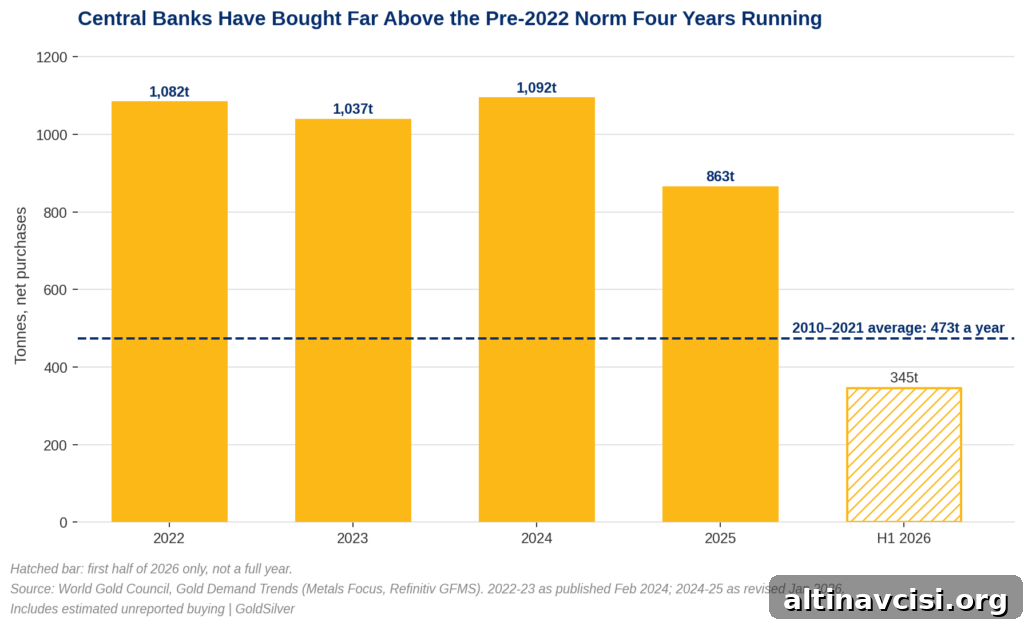
Note: the chart above uses estimated annual totals, while the monthly World Gold Council releases are based on reported transactions. These two measures are useful together but are not directly interchangeable.
Why Do Central Banks Hold Gold for Years?
Central-bank reserve managers balance several objectives: liquidity, diversification, and resilience against financial stress. Gold occupies a unique place among reserve assets because it is a physical, non‑issuer asset that does not represent someone else’s promise to pay. In other words, gold is not another country’s debt and does not carry counterparty credit risk in the same way bonds or deposits do.
That said, gold does not pay interest and its market value fluctuates. Custody, storage and insurance have costs. For those reasons, central banks periodically review and rebalance holdings to ensure reserves remain aligned with broader policy goals. Many recent purchases reflect deliberate, multiyear accumulation programs rather than tactical moves based purely on near-term price expectations.
Reserve strategy is about trade-offs: the security and diversification gold may offer versus the opportunity cost of holding a non-yielding asset. In practice, central banks integrate gold into a broader mix of currencies, bonds and liquid assets to meet liquidity needs while managing risk exposures over time.
What Does This Mean for Long-Term Physical Gold Owners?
Although central banks and private investors have different mandates, one principle applies to both: ownership should be driven by purpose. Before buying gold, decide why you want exposure—portfolio diversification, insurance against systemic risk, or a store of value—and how it fits alongside other assets.
Physical gold can diversify a portfolio, but it does not guarantee protection in every market environment. Prices can be volatile over the short and medium term. For individuals, holding physical metal also raises practical decisions about custody and liquidity: where to store it, how accessible it should be, and how to document ownership.
Home storage gives immediate access but requires robust security and insurance. Professional vaulting reduces personal security responsibilities and can offer allocated or unallocated options; terms, storage fees, insurance arrangements and withdrawal rules differ across providers and matter for long-term planning. Separately, gold-backed ETFs and other financial instruments provide price exposure without the logistical issues of holding metal, but they introduce counterparty or custodian considerations that differ from owning physical bars or coins.
Does Long-Term Gold Ownership Mean Never Selling?
No. Long-term ownership does not imply an absolute ban on selling. Central banks sell when their reserve needs change; households sell when liquidity is required or when rebalancing makes sense. A practical long-term approach includes planning for liquidity events and scheduling periodic reviews of storage arrangements, insurance, and ownership documentation.
Ultimately, the value of a gold ownership plan lies in clarity of purpose and realistic expectations. Rather than trying to predict the next price swing, a well-defined plan identifies the role gold plays in the overall portfolio, how it will be stored, and under what conditions it would be sold or increased.
SOURCES
1. World Gold Council – Central Bank Gold Statistics: Central Banks Continue Summer Spree in August – October 6, 2026.
2. World Gold Council – Gold Demand Trends: Full Year 2025, Central Banks – January 29, 2026.
3. World Gold Council Research – Gold Demand Trends: Full Year 2023, Central Banks – January 31, 2024.
4. World Gold Council – Q2 2026 Central Bank Gold Demand, Gold Demand Trends – July 30, 2026.
Disclaimer: This article is for informational purposes only and does not constitute investment advice. Past performance is not indicative of future results. Always consult a qualified financial advisor before making investment decisions.
You May Also Like:
- Investors Turn to Treasuries as AI Stocks Slide
- London Gold Vault Holdings Rose 3.78% in Q3. What Changed?
- Gold Rebounds Above $4,130: What Changed for Owners?
- How 3.7% Inflation Impacts Wealth Preservation
- Gold and Silver Dip on a Hot CPI Report
- Currency Swing Erases Gold’s Brief Dip
- Short-Term Pressure Pushes Gold Down
- Squeezed at the Pump, Steady in the Vault
- Fed Governor Blames AI Chips for Inflation, Silver Falls
- Oil Jumps 4% on Hurricane and Tanker Squeeze. Why Didn’t Gold Follow?
Popular Topics
Picked from the archive
-
01
 Topics
Weaker Dollar, Falling Gold: A Bullish Signal
-
02
Topics
Gold Drops 22% Like 2022: Why the Floor Is Different
-
03
Topics
Municipal Bonds Reach 15-Year Record: Why Gold Is Unaffected
-
04
Topics
Gold, Silver Steady as Bessent Seeks Hormuz Deal; JOLTS Falls
-
05
Topics
Gold Prices Pull Back Ahead of Fed Meeting
-
06
Topics
Will Policy Reversal Move Gold? Conflict Pressure Index Insight
-
07
Topics
Gold Falls to Two-Month Low as Yields Rise, Not Iran
-
08
Topics
Silver Price Outlook Sep 2026: Hike Priced In, Positioning Lags