How AI Data Centers Are Driving Silver Demand
Last verified September 2026
Industrial silver demand refers to the portion of annual silver consumption used in manufacturing and electronics, excluding jewelry, coins, and investment bars. A rapidly growing subset of that demand is coming from AI data centers. This emerging category now deserves distinct attention when assessing silver’s market fundamentals.
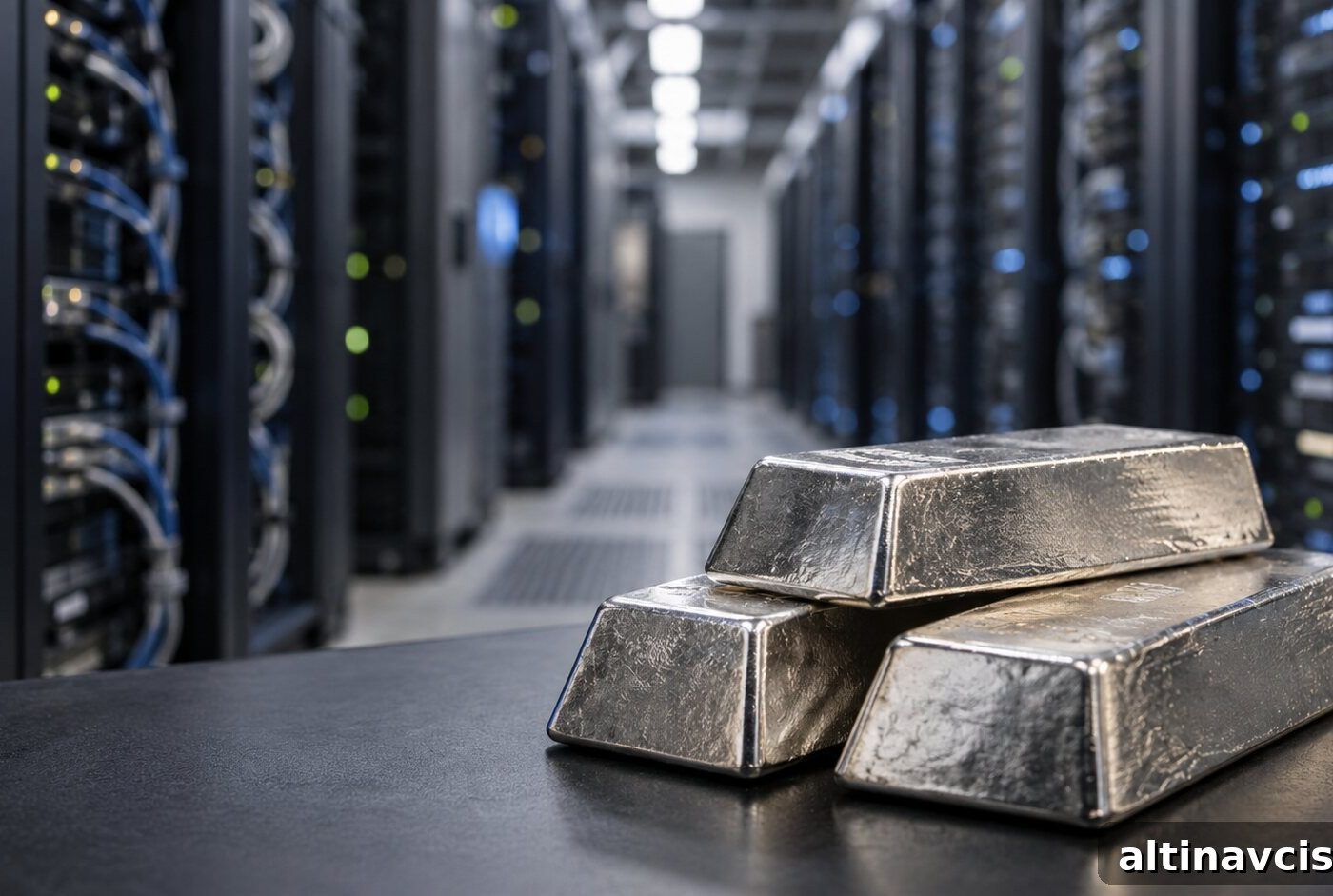
The short answer: AI data centers are becoming a meaningful new source of industrial silver demand. Silver is the best conductor of electricity and heat among commonly used metals, making it the preferred choice for high-current contacts, switchgear, busbars, and other power components inside large data facilities. This development adds a third structural demand pillar for silver—alongside solar and electric vehicles—on top of a market that has run a supply deficit for several years.
The Silver Institute’s World Silver Survey 2026 estimates that industrial uses account for roughly half of annual silver demand. That market has seen a supply deficit for six consecutive years. Meanwhile, the International Energy Agency’s 2026 reporting projects global data center electricity demand to roughly double between 2025 and 2030, with demand already up 17% in 2025. That growth outpaced overall electricity demand and was strongest among AI-focused facilities. Because this buildout requires substantial physical hardware, the resulting demand for silver contacts and connectors is tangible and immediate. Recent price moves also reflect these industrial dynamics, not only macro-driven flows.
Key takeaways:
- The Silver Institute reports a sixth straight year of a global silver supply deficit, with industrial applications representing about half of annual demand.
- The IEA projects global data center electricity demand will roughly double between 2025 and 2030; electricity use in data centers rose 17% in 2025, faster than overall demand.
- Silver is the default material for many high-power data center components because it conducts electricity and heat better than other common metals; its thermal conductivity exceeds copper by roughly 7%.
- Major tech companies invested heavily in 2025: capital spending by five leading hyperscalers topped $400 billion and is expected to rise further, focused on data centers and power infrastructure. Broader estimates place AI-related buildout spending in the trillions over the coming years.
- In November 2025 the U.S. Department of the Interior added silver to the List of Critical Minerals, recognizing its strategic importance in supply chains for industrial technology.
As of this week, silver traded near $64 an ounce and showed intraday gains as markets awaited major policy announcements. Much coverage of silver’s performance emphasizes macro factors—currency moves, real yields, and central bank policy. Those drivers are real, but they do not tell the whole story. Beneath monetary narratives, a structural demand shift driven by the physical expansion of AI infrastructure is taking shape and reinforcing silver’s longer-term bullish thesis.
Why Is Silver Demand From AI Data Centers Growing?
Data centers are essentially very large, continuous electrical loads. Hyperscale facilities commonly draw tens to hundreds of megawatts of power. That electricity passes through switchgear, power distribution units, busways, and connectors—components that require reliable, low-resistance metal contacts. Silver has the highest electrical and thermal conductivity among commonly used metals, which reduces resistive losses and helps dissipate heat from GPUs and other critical components. Those performance advantages make silver the preferred material at the highest-current contact points, where reliability and thermal performance are paramount.
While the quantity of silver used in a single facility may be small, the cumulative effect across thousands of new and upgraded data centers becomes significant. The Silver Institute’s 2026 analysis highlights that industrial silver demand is broadening beyond solar and EVs to include AI infrastructure and other electrification trends.
The Knowledge That Changes Everything

Two essential guides—yours free. Learn why gold matters and why fiat currencies can lose purchasing power over time.
How Fast Is the AI Buildout Moving?
The scale of investment helps explain the significance of AI-driven silver demand. Industry estimates indicate trillions of dollars in AI-related buildout spending across the coming years, covering chips, data centers, and power systems. Major hyperscalers account for a large share of that spending. In 2025, five of the largest tech companies together spent more than $400 billion on capital expenditures, and that figure was expected to rise substantially in 2026, primarily on data centers and supporting power infrastructure. These are committed, utility-scale investments that already appear in electricity usage and construction data, not just speculative forecasts.
This is a funded, ongoing buildout: racks are being installed, power systems are being upgraded, and supply chains for critical components are operating now. As a result, the incremental silver demand tied to AI infrastructure is immediate, measurable, and likely to continue as long as AI compute growth persists.
Why Is This Different From the Solar Story Investors Already Know?
Solar power has been the most visible industrial driver of silver demand for over a decade because photovoltaic cells use silver paste in their contacts. However, solar manufacturers have systematically reduced silver content per panel—a process called thrifting—to lower costs. That means solar’s demand growth for silver faces some offset from efficiency gains and design changes.
AI data center demand differs in two key ways. First, it is a newer and rapidly expanding category that barely existed at scale five years ago. Second, there is far less room to substitute or “thrift” silver in the highest-current power components without compromising reliability. Minimizing resistive loss and thermal risk in facilities that cannot tolerate downtime is a stricter engineering constraint than the cost-driven changes in solar panels. For investors, that makes the AI demand pillar more additive and less likely to be eroded quickly by technology substitutions.
What Happens If the AI Investment Cycle Slows Down?
A reasonable counterargument is concentration risk: a large portion of AI spending is driven by a handful of hyperscalers. If those companies sharply reduce capital expenditures, incremental silver demand from new construction would slow. That risk is real.
However, much of current AI infrastructure spending is already committed under multi-year build plans, and facilities already built will continue consuming power and using silver-equipped hardware. Even if new construction slows, the structural trend toward more computing and higher electricity use globally supports ongoing industrial demand for silver.
What Does the Critical Minerals Listing Change?
In November 2025, the U.S. Department of the Interior added silver to its List of Critical Minerals. This designation does not directly create new industrial demand, but it signals that silver’s supply chain is strategically important. The listing can influence policy, approvals, and monitoring, and may affect efforts to secure supply, manage inventories, or prioritize domestic processing. Given that much of the global silver supply is produced as a byproduct of mining other metals, this federal recognition underscores that supply-side responsiveness is limited.
The Second Corner: What the Surface Story Misses
The headline story about silver’s recent rally often emphasizes macro drivers: a softer dollar, falling real yields, and central bank policy uncertainty. Those factors drive investment demand for silver as a monetary hedge, similarly to gold. But that view is incomplete.
Silver is unique among major precious metals because it combines monetary appeal with a significant industrial use case. Roughly half of silver’s annual demand is industrial and tied to real manufacturing activity—solar panels, EVs, electronics, and increasingly, AI data centers. At the same time, much of silver supply is a byproduct of mining other metals and cannot easily scale up to meet a sudden rise in demand. The monetary and industrial demand engines can therefore reinforce each other, strengthening price support when both run in the same direction.
What This Means for Gold and Silver Investors
This analysis does not replace macro-driven considerations like central bank decisions or currency moves. It does, however, add a durable, physical-market dimension to silver’s case. A market already running a multi-year supply gap is now absorbing a new, largely inelastic source of demand from AI infrastructure. Many retail investors may not yet connect these industrial dynamics to the spot price they see, but the combination of constrained supply and rising industrial needs can support a multi-year structural bull case. For investors focused on fundamentals, that argues for considering the metal’s physical demand drivers alongside short-term macro headlines.
Stay On Top of Gold & Silver Prices
Get important market alerts sent straight to your inbox.
People Also Asked
What is industrial silver demand?
Industrial silver demand is the portion of annual silver use that goes into manufacturing and electronic applications, distinct from jewelry and investment purchases. As of 2026, industrial uses represent roughly half of total silver demand and include solar, EVs, electronics, and growing demand from AI data centers.
How is industrial silver demand different from monetary or investment demand for silver?
Investment demand (coins, bars, ETFs) tends to follow macro factors such as currency movements, real interest rates, and inflation expectations. Industrial demand follows physical production: how many panels, vehicles, and data centers are built. Silver is unusual because it is driven by both investment and industrial demand, unlike gold, which has minimal industrial use.
How much silver does a typical data center use?
Silver is used in switchgear, power units, busways, and high-current contacts throughout a data center’s power infrastructure. Per-facility tonnage varies and is not yet standardized the way solar panel silver content is tracked. Nonetheless, industry surveys and energy data confirm the category is growing and materially relevant.
What is the risk to the silver-AI demand story if AI investment slows?
Hyperscaler capex is concentrated and could slow if returns disappoint or credit tightens. Such a slowdown would reduce incremental silver demand from new construction. However, significant spending is already committed under multi-year plans, and already-operational facilities continue to draw power and use silver-based hardware.
Does GoldSilver track industrial demand data like this for silver?
Research for this coverage draws on institutional sources including the Silver Institute’s World Silver Survey, IEA energy reports, and government designations for critical minerals. The intent is to ground discussion of silver’s supply-demand balance in documented industry and energy data rather than short-term market sentiment.
What happens if silver-thrifting reduces silver use in data centers the way it did in solar?
Solar manufacturers have reduced silver per panel through thrifting. Similar efficiencies could emerge in data center components over time, but engineering constraints around resistive loss and thermal management in mission-critical systems make straightforward substitution or dramatic reductions more difficult. Silver’s physical advantages make it hard to replace at the highest reliability levels.
SOURCES
1. Silver Institute – World Silver Survey 2026
2. International Energy Agency – Key Questions on Energy and AI (2026 reporting)
3. Goldman Sachs Global Institute – Tracking Trillions: assumptions shaping AI buildout
4. U.S. Department of the Interior – Final 2025 List of Critical Minerals
Disclaimer: This article is for informational purposes only and does not constitute investment advice. Past performance is not indicative of future results. Always consult a qualified financial advisor before making investment decisions.
You May Also Like:
- The Copper Mine That Isn’t Trying to Mine Silver Just Explained the Whole Deficit
- Inherited Gold IRA: Beneficiary Rules & the Step-Up Basis Gap
- The Cantillon Effect: Why Money Printing Makes Some People Rich First
- Silver Price Outlook September 2026: The Hike Is Priced In. The Positioning Isn’t.
- Gold Is About to Face Its First Rate Hike of the Cycle. Here’s Why It Isn’t Scared.
- How Much Gold Should You Own at 25, 45, or 65?
- Gold Price Outlook September 2026: What the Fed’s Meeting Means for Your Metals
Popular Topics
Picked from the archive
-
01
 Topics
Warsh Skips Fed Dot Plot, FOMC Minutes Release Wednesday
-
02
Topics
Gold Coins vs Gold Bars: Compare Value, Liquidity and Costs
-
03
Topics
Why Gold Prices Held Steady After Iran Peace News
-
04
Topics
Iran’s War Deadline Sparks Gold and Silver Price Volatility
-
05
Topics
Oil Up 7% Yesterday, Silver Down: Physical Buyers Pivot
-
06
Topics
War Sends Gold Prices to Worst Quarter Since 2013
-
07
Topics
Should You Buy Gold Now During a Dip? Timing and Risks
-
08
Topics
August 2026 Gold Outlook: How Three Data Prints Move Prices