Why 401(k) to Gold IRA Rollovers Lose 20% and How to Avoid It
Key Takeaways
- A direct rollover from a 401(k) to a gold IRA is tax-free when funds move directly between institutions — no withholding, no penalty, and no taxable distribution.
- An indirect (60-day) rollover causes mandatory 20% federal withholding. You have 60 days to replace the withheld amount or the difference becomes taxable income.
- Trustee-to-trustee transfers (IRA to IRA) are not subject to the one-rollover-per-year limit and avoid withholding risk because the funds never reach you.
- Converting traditional 401(k) funds to a Roth gold IRA is a taxable event; the full converted amount is included in your taxable income for that year.
- IRA-eligible gold must meet IRS purity standards (99.5% fineness), with American Gold Eagles an explicit legislative exception.
A 401(k)-to-gold-IRA rollover can be completed without incurring taxes if you execute a direct transfer. The IRS does not treat a direct rollover as a distribution, so there is no tax withholding, no early withdrawal penalty, and no addition to your gross income. The deciding factor is simple: make sure the funds are sent directly to the new custodian rather than to you personally.
Below is a clear, practical guide to how IRS rules apply, which transfer methods remove withholding risk, and the common errors that convert a tax-free rollover into a taxable event.
Why Are More Retirement Savers Moving Into Physical Gold?
Many investors allocate to physical gold to protect purchasing power. Unlike currency, gold does not lose its physical quantity and it often reflects changes in the value of the currency in which it’s priced. Recent research and market commentary argue that traditional portfolios can be vulnerable in inflationary regimes, and some investors include gold as a diversification strategy. Moving retirement savings into a gold IRA preserves tax-deferred status when performed correctly.
The Knowledge That Changes Everything

Two essential guides — yours free. Learn why gold matters and the risks that fiat currencies can present.
What Is the Difference Between a Direct Rollover, a Transfer, and an Indirect Rollover?
These terms are distinct under IRS rules, and the difference determines whether taxes are triggered or avoided.
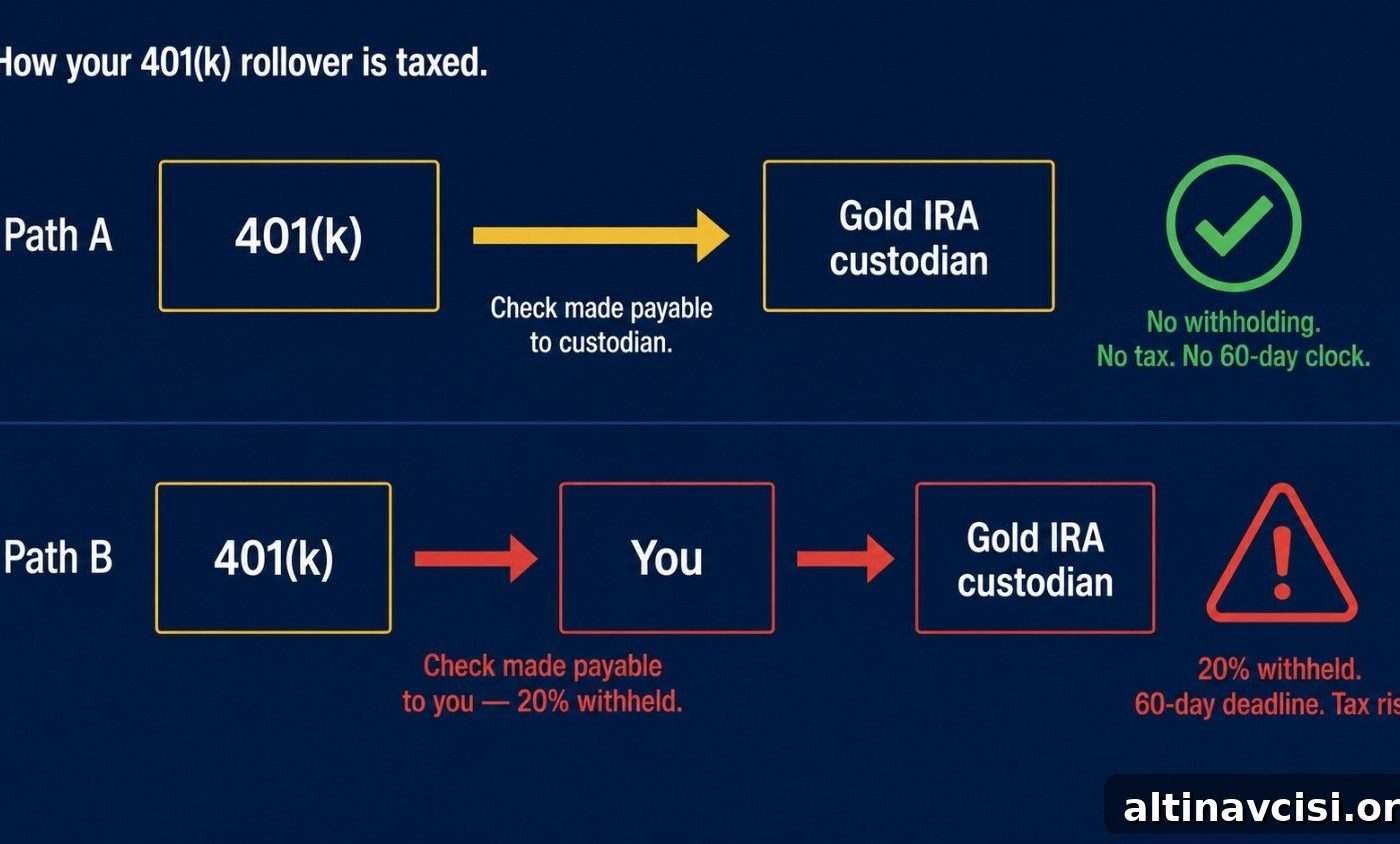
Direct rollover: Your 401(k) administrator sends funds directly to your new gold IRA custodian. The check or electronic transfer is payable to the receiving institution, not to you. Because the funds move institution-to-institution, the IRS does not treat this as a taxable distribution.
Trustee-to-trustee transfer: This applies when you already have an IRA and move it to a self-directed IRA that holds gold. The custodians transfer the assets directly; the funds never pass through your hands. The IRS treats this as a transfer rather than a rollover, so the one-rollover-per-year limit for IRA-to-IRA indirect rollovers does not apply.
60-day (indirect) rollover: The plan sends the distribution to you, and you have 60 days to redeposit the full amount into an IRA. This method carries the greatest tax risk because plan administrators must withhold 20% for federal taxes on distributions paid directly to the participant.
What Triggers the 20% Withholding Problem — and How Do You Avoid It?
If a 401(k) distribution is paid directly to you, the employer or plan administrator is required to withhold 20% for federal income tax. You cannot opt out of that withholding. To avoid this, arrange for a direct rollover so the payment goes straight to your new IRA custodian. When the check or transfer is payable to the receiving custodian, no withholding applies and no 60-day clock begins.
Example: If you receive a $10,000 distribution paid to you and the administrator withholds $2,000, you would need to make up that $2,000 from other funds to roll over the full $10,000 within 60 days. Otherwise, the withheld amount (or any shortfall) is treated as taxable income and may be subject to early withdrawal penalties if applicable.
How Many Rollovers Can You Do Per Year?
The IRS limits IRA-to-IRA indirect rollovers to one per 12-month period across all IRAs you own. This rule does not apply to direct rollovers from employer plans to IRAs, trustee-to-trustee transfers between IRA custodians, or Roth conversions. If you move a 401(k) directly into an IRA via a direct rollover, the one-per-year limitation is not relevant.
Does a Rollover to a Roth Gold IRA Trigger Taxes?
Yes. Converting pre-tax 401(k) funds to a Roth gold IRA is a taxable conversion: the full converted amount is added to your gross income for the year and taxed at ordinary income rates. The appeal of a Roth conversion is long-term tax-free withdrawals in retirement; whether it makes sense depends on your current tax bracket, expected retirement bracket, and personal outlook.
If you move pre-tax funds from a 401(k) into a traditional gold IRA without converting to a Roth, there is no immediate taxable event and taxes remain deferred until you take distributions.
What Gold Can You Actually Hold in an IRA?
Not all precious metals qualify for IRA ownership. IRA-eligible gold must meet IRS fineness standards; specifically, gold typically must be at least 99.5% pure. Silver, platinum, and palladium have their own purity requirements. Certain coins, such as American Gold Eagles, are specifically approved despite lower karat ratings. IRA-held metals must be purchased by the custodian and stored in an IRS-approved depository; taking personal possession of IRA metals is treated as a distribution and triggers taxes and potential penalties.
What Are the Required Minimum Distribution Rules for a Gold IRA?
Required Minimum Distributions (RMDs) apply to traditional IRAs, including gold IRAs. RMD rules and starting ages have changed in recent legislation; RMDs cannot be rolled over. If you are subject to an RMD in a given year, that RMD must be taken before any rollover of remaining funds.
How Do You Execute a Tax-Free 401(k)-to-Gold-IRA Rollover?
Follow these straightforward steps for a tax-free direct rollover:
- Open a self-directed IRA: Only a self-directed IRA permits ownership of physical precious metals under IRS rules. Select an IRS-approved custodian experienced with precious metals IRAs.
- Request a direct rollover: Instruct your 401(k) plan administrator to send the funds directly to your self-directed IRA custodian. Provide the custodian’s details and specify a direct rollover, not a distribution to you.
- Purchase qualifying metals: Once the IRA is funded, the custodian purchases IRS-eligible metals and places them in an approved depository. You never take physical possession.
A properly executed trustee-to-trustee transfer or direct rollover typically completes within one to three weeks, depending on processing times.
Stay On Top of Gold & Silver Prices
Receive timely market alerts delivered to your inbox.
People Also Ask
Is a 401(k) to gold IRA rollover taxable?
A direct rollover from a 401(k) to a gold IRA is not taxable. When funds move directly between institutions, the IRS does not treat the transfer as a distribution. An indirect rollover — where the funds are paid to you first — triggers mandatory 20% withholding and creates a 60-day deadline to redeposit the full amount to avoid taxation on the shortfall.
How long does a 401(k) to gold IRA rollover take?
Direct rollovers and trustee-to-trustee transfers typically take one to three weeks from submission of paperwork, depending on how quickly the releasing plan processes the request.
Can you roll a 401(k) into a gold IRA without a penalty?
Yes. A direct rollover avoids both mandatory withholding and early withdrawal penalties because the transaction is not treated as a distribution.
What is the one-rollover-per-year rule, and does it apply to 401(k) rollovers?
The one-rollover-per-year rule limits IRA-to-IRA indirect rollovers to one per 12 months across all your IRAs. It does not apply to direct rollovers from employer plans to IRAs or to trustee-to-trustee transfers.
Can I store my gold IRA metals at home?
No. IRA-held metals must be held by an approved custodian and stored at an IRS-approved depository. Personal possession of IRA metals is treated as a distribution and triggers taxation and potential penalties.
Sources
Official IRS guidance on rollovers, IRA rules, required minimum distributions, and tax treatment of conversions; published guidance on IRA-eligible precious metals; and industry research on portfolio diversification and precious metals were consulted in preparing this article. For personalized tax or investment advice, consult a qualified tax professional or financial advisor.
Disclaimer: This article is educational and does not constitute investment advice. Past performance is not indicative of future results. Consult a qualified financial advisor before making investment decisions.
You May Also Like:
- Gold Just Climbed to a 7-Week High: One Number Changed Everything
- The Jobs Report and Market Reaction: How Gold and Policy Move Together
- China’s Recent Gold Activity and Market Implications
- Industrial Demand Shocks and Silver’s Role
- Short-Term Gold Rallies and Key Indicators to Watch
Popular Topics
Picked from the archive
-
01
 Topics
Gold Remonetization: 6 Forces Reviving Gold as Money
-
02
Topics
CPI 3.3% and GDP Stalling: Is 2026 Stagflation Coming?
-
03
Topics
Why Is Gold Falling While War Rages?
-
04
Topics
Can Silver Outpace Gold in a Bull Market?
-
05
Topics
Gold Radar: 5 Hidden Signals Your Price Chart Misses
-
06
Topics
Gold Pullback Driven by Treasury Buyback, Not ETFs
-
07
Topics
Hong Kong Completes First Gold Settlement; Banks Also Run London
-
08
Topics
How a Falling Gold/Silver Ratio Impacts Investor Portfolios