How Government Debt Drives Gold and Silver Prices
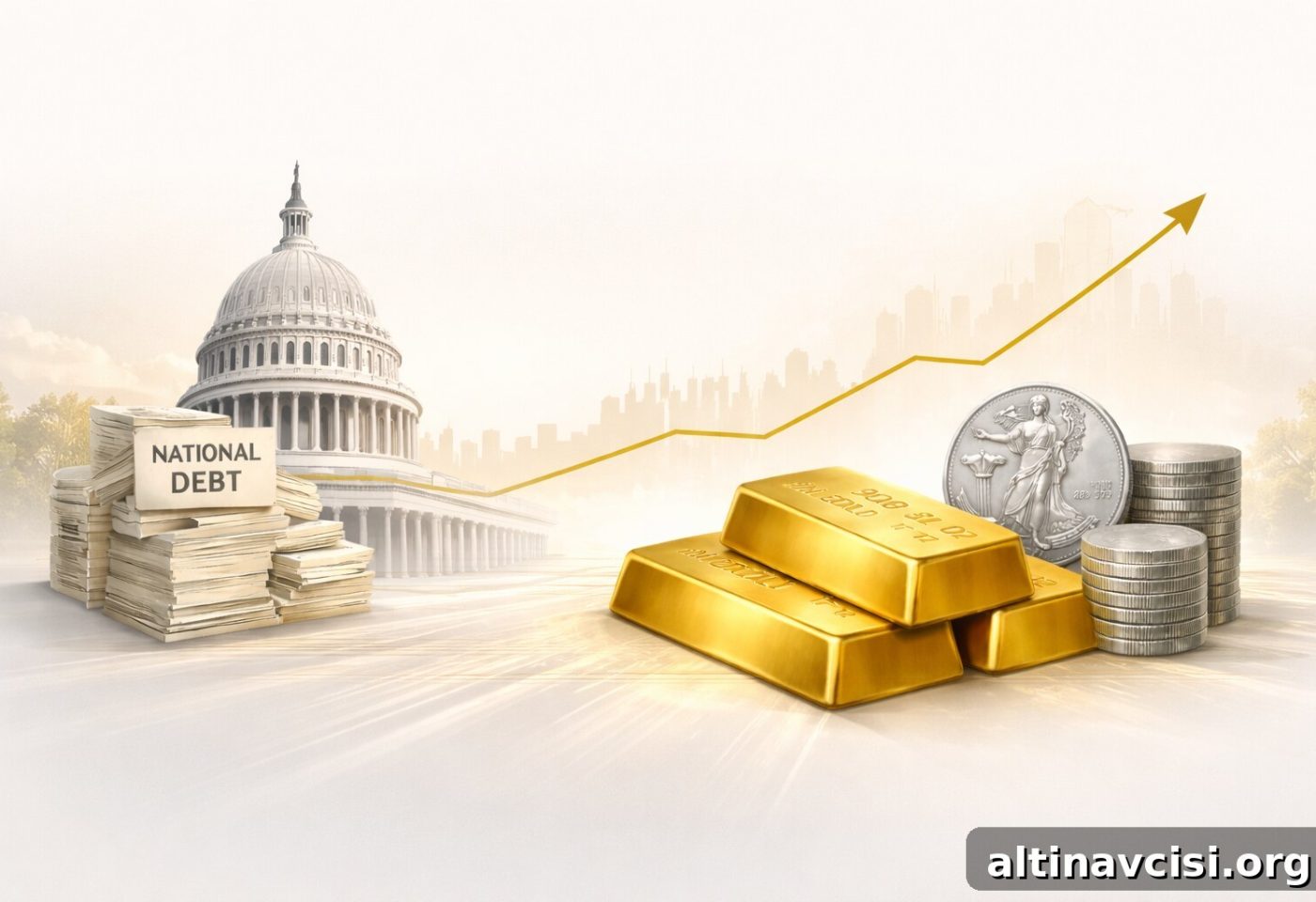
Government debt has emerged as a defining financial theme of our time. The U.S. federal debt recently exceeded $36 trillion, and many other major economies are facing similar fiscal pressure. For investors, the key question is clear: how does rising government debt affect the price and performance of gold and silver?
In short, rising sovereign debt is typically bullish for precious metals, but the connection is complex. Understanding the main drivers—monetary policy, inflation, real yields, and confidence—helps investors decide if, when, and how to add gold and silver to a diversified portfolio.
What Is the Relationship Between Government Debt and Precious Metals?
The link between government debt and precious metals rests on one idea: confidence. When investors trust a government’s fiscal management and the stability of its currency, paper assets such as bonds, cash, and equities generally do well. When that trust erodes, capital often shifts toward assets outside the financial system—most notably gold and silver.
Unlike government bonds or fiat currency, precious metals are not someone else’s liability. They do not depend on tax receipts, political choices, or central bank balance-sheet policies to retain value. That distinction becomes particularly important when sovereign debt grows to historic levels.
How Rising Government Debt Affects the Economy
When government debt grows faster than economic output, policymakers face limited choices: raise taxes, cut spending, restructure debt, or erode the debt burden through inflation. Historically, inflationary paths driven by monetary expansion have been common.
Monetary expansion—whether through quantitative easing, prolonged low interest rates, or large fiscal stimulus—increases the money supply and, over time, reduces purchasing power. Currency units remain functional but buy less than before.
Gold’s supply cannot be expanded by a policy decision; mine production typically grows only 1–2% per year. When the supply of fiat currency rises much faster than the physical supply of gold, gold’s price measured in that currency tends to rise. This is an empirical pattern observed across several historical episodes.
The Financial System Isn’t Safer — And You Know It
As risks mount, see why gold and silver are projected to remain important in 2026 and beyond.
Historical Evidence: Debt, Inflation, and Gold
The 1970s: Debt, Monetary Change, and Gold
After the U.S. left the gold standard in 1971 and government spending expanded, inflation accelerated through the decade. Gold rose dramatically—from the fixed $35-per-ounce era into the hundreds—reflecting a repricing of a scarce asset against an expanding money supply.
The 2020 Stimulus Era
In response to the pandemic, global governments and central banks injected trillions into the financial system in 2020. U.S. federal debt jumped by several trillion dollars, and precious metals responded: gold posted notable gains and silver rose even more sharply. Capital flows reacted to the scale of monetary expansion and heightened uncertainty.
Debt-to-GDP: The Key Metric
Analysts often use the debt-to-GDP ratio—the level of government debt relative to national output—to gauge fiscal sustainability. When debt climbs faster than GDP, pressure builds: interest payments take a larger share of revenue, governments borrow to service existing obligations, and central banks may feel compelled to keep rates low.
The United States now carries debt exceeding 120% of GDP, and global debt across public and private sectors has climbed to levels well above those seen two decades ago. At historically high debt-to-GDP ratios, policymakers more often rely on financial repression and low real interest rates to manage obligations rather than outright default.
Global Debt-to-GDP Has Nearly Doubled Since 2000
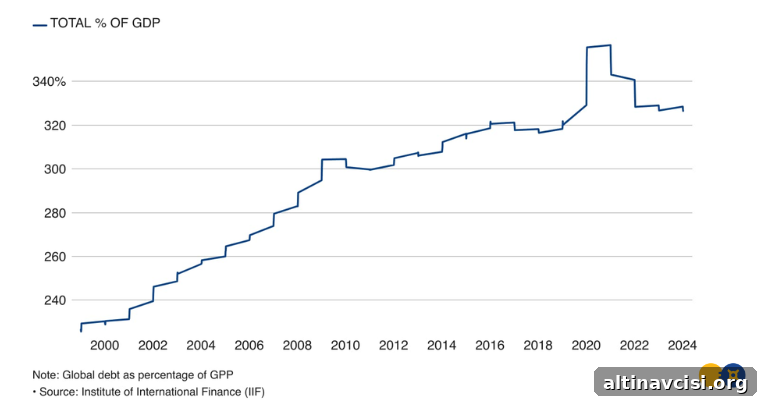
Source: Institute of International Finance (IIF), via media reports
Rather than widespread defaults, governments typically use policies that keep real interest rates low and allow inflation to reduce the real value of outstanding debt. In such environments, gold has historically outperformed many traditional fixed-income assets.
Real Yields and the Gold-Bond Relationship
Gold does not pay interest, which at first glance is a disadvantage. The relevant comparison is real yield—bond returns after inflation. When real yields are negative, bondholders lose purchasing power. In those periods, gold’s lack of yield becomes less important because paper assets are delivering negative real returns and capital seeks alternatives that preserve value.
Over the past decade, real yields have often been near zero or negative, and gold has performed well during those stretches. If debt expansion keeps real yields suppressed over the long term, gold’s appeal as a store of value is structurally enhanced.
The Safe-Haven Effect: Confidence and Counterparty Risk
Debt affects precious metals not only through inflation but also by undermining confidence. When investors doubt a government’s fiscal discipline or a currency’s long-term stability, they prefer assets with no counterparty risk.
Gold is unique in this respect: it is not issued by a government, carries no default risk, and does not depend on a financial institution’s solvency. This is one reason central banks have increased gold holdings as part of reserve diversification. Central bank demand signals a broader institutional preference for assets outside the bond system when sovereign balance sheets weaken.
Silver’s Dual Role: Monetary and Industrial
Silver often tracks gold during monetary stress but tends to be more volatile. In addition to its monetary role, silver enjoys substantial industrial demand from sectors such as solar energy, electronics, electric vehicles, and grid infrastructure. Large-scale government spending on energy transition and technology can raise structural demand for silver.
That gives silver two demand drivers: a monetary hedge in inflationary periods and an industrial component during expansionary fiscal cycles. Investors comfortable with higher volatility can use silver to amplify exposure to precious metals beyond what gold alone offers.
Has Gold Already Priced In the Debt Risk?
A reasonable question is whether current gold prices already reflect fiscal risks. Major precious metals bull markets have historically aligned with sustained negative real rates, rising debt-to-GDP ratios, weakening currency confidence, and geopolitical stress. Many of these conditions exist today to varying degrees.
That doesn’t guarantee immediate price gains—markets are complex and timing is uncertain. However, the long-term macro backdrop mirrors prior multi-year periods of strong precious metals performance, suggesting the structural case for metals remains relevant.
Putting It in Context
Rising government debt does not automatically drive gold and silver higher, but it increases the likelihood of dynamics that historically favor precious metals: monetary expansion, persistent inflation, currency depreciation, financial repression, declining real yields, and diminished confidence in sovereign balance sheets.
Gold and silver are among the few asset classes that sit outside sovereign liabilities while remaining integrated into global finance. For long-term investors focused on preserving purchasing power, that structural position is important—regardless of short-term price movements.
Stay On Top of Gold & Silver Prices
Get important market alerts sent straight to your inbox.
People Also Ask
Does rising government debt increase gold prices?
Generally, yes. Higher government debt often leads to monetary expansion and inflation, which erode the purchasing power of fiat currency. Investors commonly turn to gold as a finite, tangible asset that can preserve value when paper currency is weakening, which tends to push gold prices higher.
Why are gold and silver considered safe-haven assets during debt crises?
Gold and silver have no counterparty risk and are not dependent on a government’s promise to repay. When confidence in sovereign debt declines and real bond yields turn negative, investors often rotate into precious metals as a reliable store of value outside the traditional financial system.
How does inflation caused by government borrowing affect silver prices?
Inflation driven by government borrowing and monetary expansion benefits silver as a monetary hedge. Because silver also has important industrial uses, it can outperform gold during inflationary cycles that coincide with increased industrial demand, amplifying gains in certain periods.
What historical trends show the link between national debt and precious metals?
Periods of heavy deficit spending and fiscal stress—such as the 1970s and the major stimulus years of the 21st century—have often coincided with strong precious metals performance. These historical episodes illustrate how monetary expansion, inflation, and loss of confidence can drive demand for gold and silver.
What percentage of my portfolio should be in gold or silver given high debt levels?
Common guidance recommends allocating 5–15% of a portfolio to precious metals depending on risk tolerance. Conservative allocations often favor 8–10% in gold and 2–3% in silver. More aggressive investors may increase silver exposure to capture higher upside potential, while maintaining a core gold position for stability.
Disclaimer: This article is informational only and is not investment advice. Past performance is not indicative of future results. Consult a qualified financial advisor before making investment decisions.
You May Also Like:
- Gold vs Silver: The liquidity differences that matter
- Silver price components: premiums, spot, and dealer markup explained
- Silver price forecasts revisited: lessons from past forecasts
- Gold’s purchasing power: what one ounce has bought over time
- Why metals performed strongly and what that means for future markets
Popular Topics
Picked from the archive
-
01
 Topics
Gold Price Tops $5,200, Silver $90 as Inflation Persists
-
02
Topics
Fed’s Logan: Rates May Stay High Amid Tariff Pressure
-
03
Topics
Why Physical Gold Outperforms ETFs and Digital Gold in 2025
-
04
Topics
Silver Prices Eye Record Highs as Fed Signals Rate Cuts
-
05
Topics
Treasury Secretary Urges Fed Rate Cut After Revised Jobs Report
-
06
Topics
Iran’s Nuclear Threat: Could It Cut the World’s Oil Supply?
-
07
Topics
Platinum Price Surges Past $1,400 Amid Global Supply Squeeze
-
08
Topics
Gold Rises Friday but Posts Weekly Loss After Inflation Shock