After January Jobs Surprise, Silver Dips as Gold Holds Firm

Daily News Nuggets | Today’s top stories for gold and silver investors
February 11th, 2026 | Brandon Sauerwein, Editor
Labor Market Surprises with 130,000 Jobs Added in January
The January jobs report delivered a mixed message: headline payrolls rose by 130,000 and the unemployment rate ticked down to 4.3%, a stronger-than-expected top-line result that initially reduced pressure on the Federal Reserve to move quickly toward rate cuts. Markets reacted by strengthening the dollar and nudging bond yields higher.
Beneath that headline, however, the details tell a different story. Annual revisions trimmed total job gains for 2025 to just 181,000 — a far lower pace than earlier estimates and one of the weakest annual tallies in recent years. That revision suggests the labor market’s momentum has eased more than the headline figure implies.
For precious metals investors, those mixed signals matter. A resilient headline can delay expectations for easing monetary policy, which tends to pressure non-yielding assets like gold. At the same time, weaker underlying job growth and downward revisions keep the possibility of future rate cuts alive, preserving a longer-term tailwind for bullion. In short, the labor data have pushed markets into a state of uncertainty: short-term strength versus a softer structural backdrop.
Investors will likely watch incoming data closely — payroll trends, wage growth, and inflation metrics — for clues about the Fed’s timing. Until a clearer narrative emerges, gold may trade within a range as traders weigh the competing signals from headline strength and underlying weakness.

The Edge Every Investor Needs
Smarter precious metals investing starts here. The Nuggets Newsletter delivers timely market analysis, Fed updates, global trends, and educational resources to help you make better-informed decisions.
No spam. Unsubscribe at any time.
ETF Inflows Signal Renewed Bullion Demand
Exchange-traded funds focused on gold and silver saw notable inflows after several U.S. economic reports softened expectations for the near-term path of interest rates. Large funds such as SPDR Gold Shares (GLD) and iShares Silver Trust (SLV) led the buying, reflecting a preference among investors to gain exposure to physical-backed bullion through ETF wrappers rather than futures or derivatives.
ETF flows are important because they typically represent longer-term allocation decisions. Unlike speculative futures trading, purchases of physically backed ETFs involve the accumulation of metal in custodial holdings. When inflows accelerate, they can exert steady upward pressure on spot prices by reducing available supply, especially in markets already operating with limited immediate liquidity.
This dynamic is especially relevant when market participants expect central banks to ease policy. Anticipated rate cuts weaken the opportunity cost of holding non-yielding assets like gold and silver, prompting portfolio reallocations into bullion. For investors, tracking ETF flow trends can provide an early signal of sustained demand and help contextualize price movements that might otherwise look short-lived.
Gold Steadies Above $5,000 as Silver Finds Its Footing
Gold has remained firm above the $5,000 mark as investors adopt a cautious stance, awaiting clearer direction on interest rates and broader economic momentum. The metal’s relative stability reflects its long-standing role as a defensive asset in periods of macroeconomic uncertainty.
Silver has experienced a much bumpier ride. At the end of January, the metal suffered its largest single-day drop on record, an episode that appeared driven more by forced liquidations and the unwinding of leveraged positions than by a sudden change in fundamentals. Liquidity can evaporate rapidly in tighter markets, causing exaggerated moves in silver compared with gold.
Silver’s Six-Month Surge vs. the S&P 500
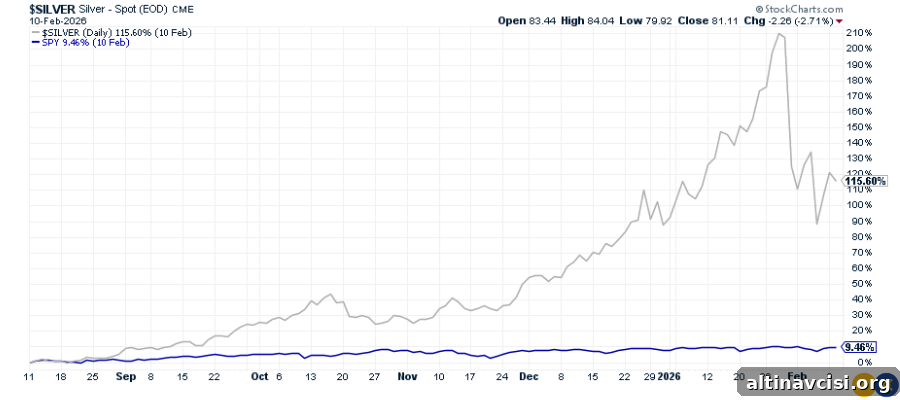
After the sharp sell-off, prices stabilized and partially recovered as selling pressure eased. Silver’s volatility means it often amplifies the directional moves of gold: deeper declines during stress and stronger rebounds when liquidity returns. For traders this can mean both higher short-term risk and greater potential upside if market conditions improve.
Choosing between gold and silver typically comes down to investment objectives and risk tolerance. Gold tends to offer steadier protection and lower volatility, while silver provides more pronounced price swings and higher potential returns for investors who can withstand the volatility. Both metals remain sensitive to rate expectations, inflation trends, and shifts in investor positioning.
Stay On Top of Gold & Silver Prices
Get market alerts and concise analysis sent straight to your inbox.
Governments Stockpile Commodities as Risk Rises
Policymakers in a growing number of countries are treating commodities as strategic assets rather than just market-traded inputs. Central banks and national authorities have expanded stockpiles of energy products, industrial metals, and precious metals amid heightened geopolitical tensions and a trend toward regionalized supply chains.
This shift away from tightly optimized, globally integrated supply systems reflects a preference for resilience over efficiency. Sanctions, trade disputes, and the prospect of regional conflict have encouraged governments to hold reserves as insurance against disruption. When state actors absorb material into strategic stockpiles, less product is available to private markets, which can tighten conditions and boost price volatility.
Gold, in particular, benefits from this structural demand as central banks continue to accumulate reserves for diversification and risk management. For investors, rising government demand represents another layer of fundamental support that can complement flows from private-sector buyers and ETFs.
Lebanon’s Gold Reserves Take Center Stage Amid Banking Collapse
Lebanon’s prolonged financial crisis has placed renewed attention on the country’s gold reserves. With bank withdrawals limited and the local currency significantly devalued, many residents and observers view the nation’s roughly 286 tons of official gold holdings as a cornerstone of potential stability.
Lawmakers have largely resisted calls to liquidate those reserves, treating them as a last line of defense given the fragile state of public finances and the erosion of trust in formal banking channels. The situation underscores gold’s historical role as an asset of last resort when monetary systems and local currencies face severe stress.
You May Also Like
- Silver’s 7% Bounce Sparks Bullish Calls
- Gold Holds Above $5,000 as Hedge Funds Brace for Turbulence
- Gold and Silver Rally Through Ongoing Market Volatility
- Gold Rebounds as Fed Risk, Weak Jobs, and Crypto Stress Collide
- Gold (+6%) and Silver (+10%) Stage Dramatic Comeback
- JP Morgan Sees $6,300 Gold After Historic Crash
Popular Topics
Picked from the archive
-
01
 Topics
Dollar Steadies After Jobs Data Shock Sends 90% Odds of Fed Cut
-
02
Topics
Silver Price Falls on Index Rebalancing Ahead of Jobs Report
-
03
Topics
CBO: Trump Tax Law Increases U.S. Deficit by 3.4 Trillion
-
04
Topics
Fed Rate Cut Sparks Silver Rally Above $62
-
05
Topics
Gold Price Rises as Trump Escalates Trade Tensions with Asia
-
06
Topics
Gold Price Could Surge to $3,800 by Mid-October
-
07
Topics
How to Open a Precious Metals IRA with GoldSilver
-
08
Topics
US Economy at a Crossroads: Jobs Stall as Inflation Persists