Gold Tops $4,000 as Shutdown Hits Jobs, Inflation and Airlines

Daily News Nuggets | Today’s top stories for gold and silver investors
November 7th, 2025
Gold at $4,000, Silver Near $49 — Momentum Holds
Gold reclaimed the $4,000-per-ounce threshold this morning as investors reacted to political gridlock, renewed inflation concerns, and a softer U.S. dollar. Silver climbed to $48.58, recovering from recent declines but remaining below last month’s spike near $54. Despite intermittent volatility, both metals have shown strong momentum: gold is up roughly 17% over the past three months, while silver has gained more than 25% over the same period.
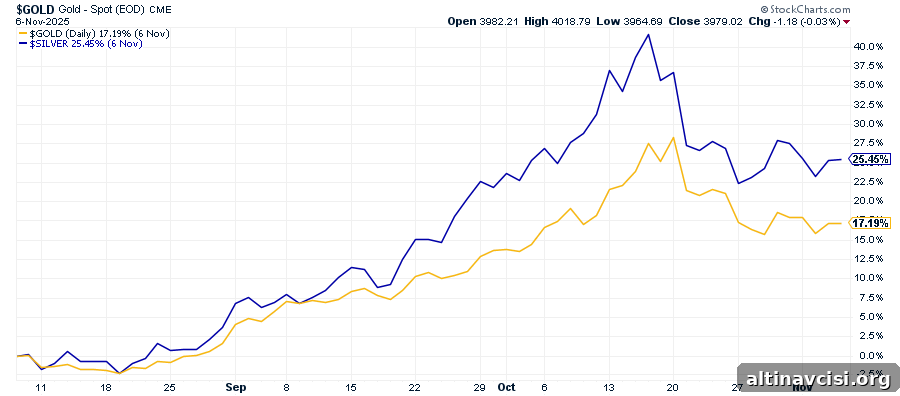
These gains are notable not just for their size, but for how quickly they materialized. In effect, the recent quarter produced returns that investors typically expect over a much longer span. The underlying drivers are familiar: sustained central-bank purchases, worries about U.S. fiscal stability, and a broad rotation into tangible assets. For silver, additional support comes from rising industrial demand tied to solar energy, electric vehicles, and expanding data-center infrastructure, which is tightening supply/demand balances.
What’s different now is that the trade is no longer positioned purely as an inflation hedge. With policy uncertainty and fiscal risks elevated, more investors are choosing assets that carry no counterparty exposure. One prominent source of that uncertainty is the ongoing government shutdown, which has disrupted the release of key economic data and raised questions about near-term policy decisions.
No Jobs Report, Big Speculation
The scheduled October jobs report was not released because of the shutdown, leaving markets to rely on estimates and partial indicators. Consensus estimates suggested roughly 125,000 new jobs and a modest uptick in the unemployment rate to about 4.2%, which would have signaled the weakest job growth since mid-2023. Even without official confirmation, these expectations are influencing market pricing.
Investors are already pricing in slower labor-market momentum, and that has implications for monetary policy. Weaker jobs growth typically reduces wage pressures and increases the likelihood that the Federal Reserve may be able to ease policy later than it would under stronger labor conditions. The market’s willingness to bid gold above $4,000 reflects a view that the economy is softer than previously thought and that safe-haven assets may offer protection if growth weakens further.
Fed’s Data Blind Spot Adds Risk to Inflation Outlook
Federal Reserve officials have signaled concern about the lack of fresh inflation data resulting from the shutdown. With official CPI and PCE releases delayed, central bankers are relying more heavily on private-sector indicators and internal surveys. That data gap increases uncertainty about the true pace of price changes and could lead the Fed to adopt a more cautious path on rate cuts or to postpone easing until better information is available.
For precious-metals investors, that uncertainty is meaningful. If the Fed delays easing because it lacks reliable inflation readings—or if inflation is actually higher than interim indicators suggest—then the market’s expectations for future monetary policy will remain unsettled. In such an environment, gold and silver often benefit as investors seek assets that preserve value against both inflationary surprises and policy missteps.
Airlines Cut Flights as Shutdown Drags On
The government shutdown is already affecting the real economy. Airlines have begun trimming schedules in anticipation of staffing shortages and delays in safety inspections, a disruption that may intensify as the holiday travel season approaches. Those reductions, particularly at major hubs, add to consumer frustration and add a tangible drag on services activity.
Prolonged shutdowns carry measurable costs. Analysts have suggested this one could shave around 0.3% off GDP growth for the quarter, a meaningful hit to an economy that was already showing signs of slowing. Market responses so far have followed a familiar pattern: lower Treasury yields and higher prices for gold, as investors seek refuge from fiscal and economic uncertainty.
Silver Lands on U.S. Critical Minerals List
The recent update to the U.S. critical minerals list now includes silver, alongside other materials deemed essential to economic and national security. That designation underscores silver’s growing role beyond traditional jewelry and investment uses: it is an important industrial metal for electric vehicles, renewable energy systems, and data-center technologies.
Designating silver as a critical mineral could unlock policy support aimed at increasing domestic production, easing permitting, and strengthening supply chains. The recognition aligns policy priorities with market realities, where demand from technology and clean-energy sectors is adding a structural dimension to silver’s investment case. Expect continued discussion about reshoring and incentives to reduce reliance on imports for these strategic materials.
Overall, the combination of fiscal uncertainty, data gaps, and strategic policy moves is creating an environment favorable to precious metals. Investors focused on gold and silver should watch developments in inflation reporting, labor-market indicators, and any shifts in domestic-minerals policy—each will play a key role in determining the next leg of the rally.
Popular Topics
Picked from the archive
-
01
 Topics
Copper Inventories Drop 80% Amid US Tariff Fears, Supply Crisis
-
02
Topics
Why Gold Is Outperforming Nvidia in 2025
-
03
Topics
Inflation Jumps 2.7% in June as Tariff Impacts Emerge
-
04
Topics
U.S. Seizes 15% of Nvidia, AMD China Chip Sales for Licenses
-
05
Topics
Gold and Silver Drop as Currencies React to Strikes in Iran
-
06
Topics
Powell: Fed Dollar Swap Lines to Stay Amid Political Uncertainty
-
07
Topics
Hong Kong Plans New Global Gold Trading Platform
-
08
Topics
World Gold Council: Gold Nears Technical Break as Markets Stall