Gold is down about 1.6% today. [GoldSilver price charts, July 23, 2026]
That may seem counterintuitive. Overnight, the Houthi militia reported attacks on two Saudi oil tankers in the Red Sea. The United States completed another night of airstrikes on Iran. Secretary of State Marco Rubio said Iran is “not ready to make a deal.” By traditional logic, those developments should push gold higher. They didn’t. Understanding why reveals how gold behaves in the current environment—and what it means for holders of physical metal.
How Does a Shipping Attack Push Oil Higher?
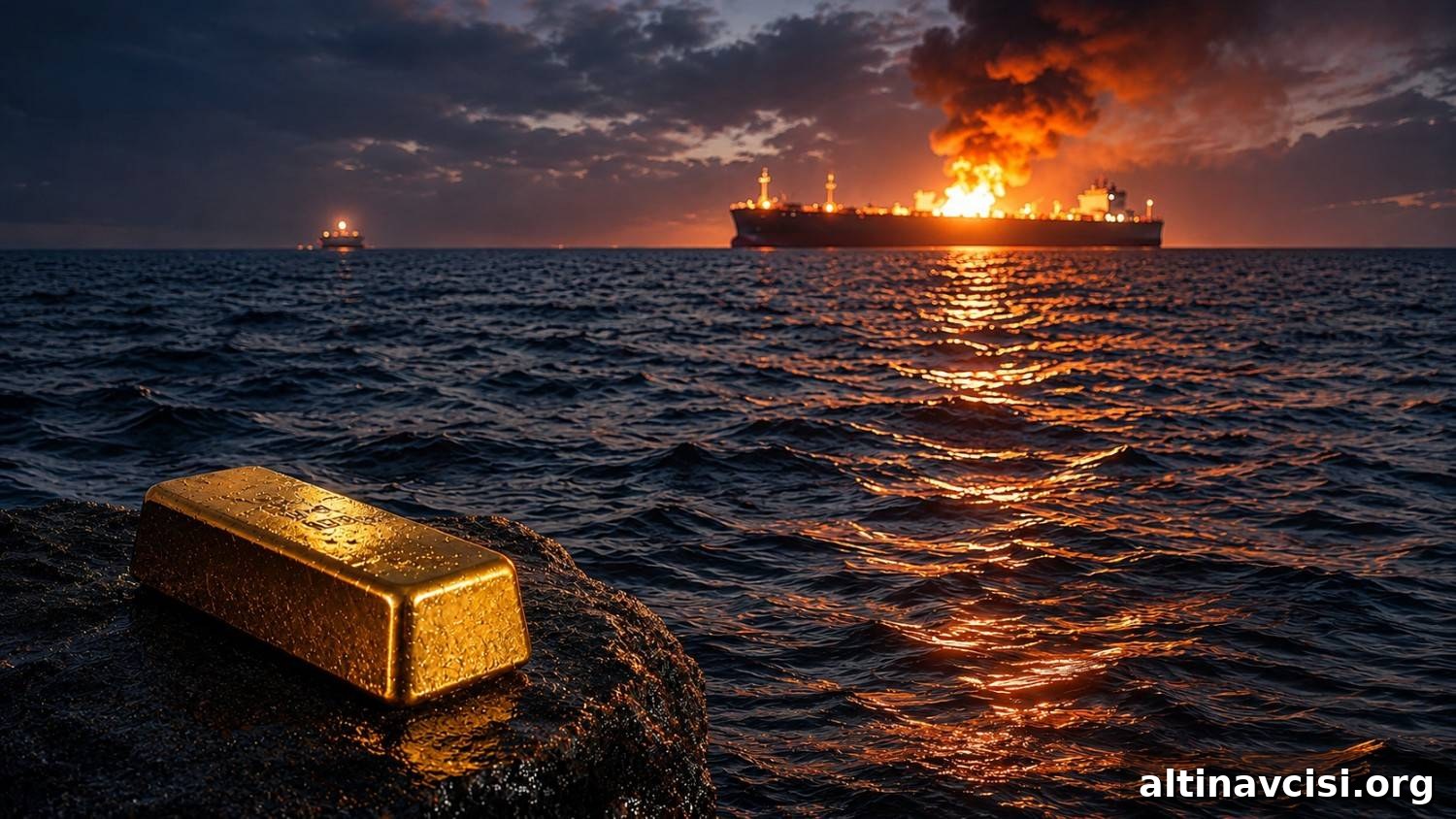
The two tankers targeted—Encelia and Layla—were Saudi-flagged vessels. The Houthis said they used ballistic missiles, cruise missiles, and drones after accusing those ships of violating a naval blockade imposed on Saudi Arabia earlier this week. Saudi state media confirmed the Encelia caught fire and said its crew were safe; the claim about the Layla was unconfirmed at the time of publication. Brent crude jumped as much as 2.5% to near $96 a barrel, a six-week high.
Geography matters. Much of the recent disruption occurred in the Strait of Hormuz, which links the Persian Gulf and the Arabian Sea. These Red Sea attacks hit the Bab el-Mandeb chokepoint, at the southern tip of the Arabian Peninsula, connecting the Red Sea to the Gulf of Aden. In normal times, about 10% of global seaborne oil trade moves through Bab el-Mandeb. Saudi Arabia had been rerouting shipments through the Red Sea as Hormuz disruptions forced changes to Gulf shipping routes. Now that alternate corridor faces attacks too, and several vessels are choosing new courses to avoid the area.
When shipping becomes more expensive and oil prices rise, headline inflation tends to stay higher. That is precisely the inflation problem the Federal Reserve is still grappling with.

The Edge Every Investor Needs
Smarter precious metals investing starts here. The Nuggets Newsletter brings you essential market insights, Fed updates, global trends, educational videos, and much more.
Why Does Oil Inflation Hurt the Gold Price Today?
Most coverage overlooks the full chain of cause and effect. The connection runs through inflation and interest-rate expectations, not directly through geopolitical risk alone.
The process runs in four steps. First, the Houthi strikes push Brent toward $96 a barrel. Second, higher oil lifts headline inflation and keeps it elevated—U.S. inflation was 3.5% in June 2026, down from a 4.2% peak in May but still well above the Fed’s 2% target. Third, stickier inflation makes it harder for the Federal Reserve to justify cutting rates and easier to justify raising them. Fourth, markets reprice the September FOMC meeting: the odds of a September rate hike rose above 60% as of this morning.
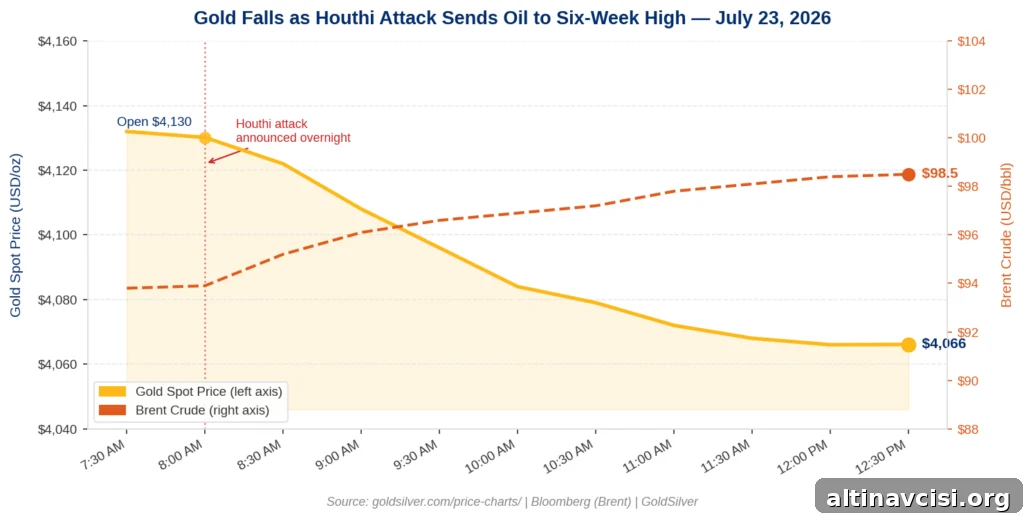
When rate expectations rise, so do real yields—the return investors earn after inflation. Gold produces no yield, so higher real yields make yield-bearing assets relatively more attractive to institutional investors. That arithmetic causes gold futures to drop quickly. This is a short-term market response, not a change to gold’s long-term value proposition.
A similar mechanism produced gold’s largest absolute monthly decline on record in March 2026, when a spike in oil-driven inflation flipped the Fed’s rate narrative and gold fell more than 10% in one month. The metal later recovered. The mechanism did not change; the oil price did.
Today the ECB also held its deposit rate at 2.25% after a rate hike in June. Two major central banks are therefore either tightening or maintaining a hawkish stance at the same time, and both cite energy-driven inflation from the Middle East conflict as a key factor.
What Does This Mean for Physical Gold Holders?
The short-term reaction in futures markets misses important long-term dynamics. Each Houthi strike that disrupts Saudi shipping raises the fiscal cost of the conflict. Every sustained barrel above $90 widens the U.S. trade deficit, boosts import-driven inflation, and increases pressure on a federal budget already running annual deficits in the trillions. Those same forces that pressure gold prices today are also the ones that, over time, increase the argument for holding physical gold.
An investor who understands this distinction can be calm. They watch the four-step inflation-rate mechanism play out on a short timeline while holding a tangible asset that responds to deeper structural forces over years. Since January’s peak of $5,589.38 per ounce, gold has pulled back, but it still sits roughly 20% higher year-over-year. The structural drivers—central bank purchases, fiscal expansion, and reserve diversification—remain intact. What has shifted is the short-term rate signal; when that signal reverses, gold typically regains ground.
What Should Gold and Silver Investors Watch Next?
Two catalysts will likely determine gold’s near-term path.
First: the June Personal Consumption Expenditures (PCE) report on July 30. The Fed’s preferred inflation gauge arrives the day after the July 29 FOMC decision. If core PCE prints hotter than expected, the probability of a September rate hike increases and gold faces more pressure. If it softens, the rate narrative could shift back in gold’s favor quickly.
Second: any credible diplomatic progress on the Iran conflict. A meaningful reduction in disruptions at Hormuz and Bab el-Mandeb would likely lower oil, ease inflationary pressure, and unwind the rate-hike logic that is weighing on gold. Statements attempting to separate local actors from state sponsors may be early moves in that diplomatic direction.
Until clear signs emerge on inflation or diplomacy, the position for physical metal holders remains straightforward: the mechanism pushing futures lower in the short term is the same set of forces that strengthen the long-term case for owning physical gold.
Stay On Top of Gold & Silver Prices
Get important market alerts sent straight to your inbox.
SOURCES
1. Reuters — Houthis say they attacked two Saudi tankers; Saudi Arabia confirms one ablaze, July 22–23, 2026
2. Bloomberg — Oil extends rally after Houthis attack two Saudi tankers in the Red Sea, July 23, 2026
3. CNBC — Houthis claim strikes on Saudi tankers; Rubio says Iran not ready to make a deal, July 23, 2026
4. EastPost / UNCTAD — Strait of Hormuz and Bab el-Mandeb put global trade under pressure, July 14, 2026
5. ECB — Rates held steady at 2.25%, July 23, 2026
6. GoldSilver — Gold Price Charts, July 23, 2026
7. CME Group — FedWatch Tool, September 2026 FOMC rate expectations, July 23, 2026
8. US Treasury — Fiscal Data: Debt to the Penny
9. US Bureau of Labor Statistics — Consumer Price Index, June 2026 (released July 14, 2026)
Disclaimer: This article is for informational purposes only and does not constitute financial or investment advice. Always consult a qualified financial adviser before making investment decisions.
You May Also Like:
- Gold Is About to Trade 24/7. A Prediction Market Just Filed to Make It Never Expire.
- Gold Hit a Two-Week High This Morning. Three Forces Arrived at Once.
- The Fed Meets July 29. Gold Says Hold Is Already Priced In. Silver Says Something Else.
- Silver Is Up Nearly 5% This Morning. Here Is Exactly Why.
- China Ends Paper Gold Trading July 24. For Physical Holders, That’s a Confirmation.
- Silver Is Up 1.5% Today. Oil Is Up 3%. Those Two Moves Shouldn’t Coexist. Here’s Why They Do.