
In four days, China’s biggest banks will stop offering retail clients leveraged paper gold products tied to the Shanghai Gold Exchange. The change was announced quietly in Beijing in late June and represents one of the most consequential structural shifts in the global gold market this year. Despite its significance, mainstream coverage has largely overlooked what this move actually means for prices, volatility, and long-term demand dynamics.
On June 24, 2026, Industrial and Commercial Bank of China (ICBC) — the world’s largest bank by assets — said it will end individual retail trading of SGE-linked paper gold after the clearing session on July 24, 2026. Several other major banks, including Postal Savings Bank of China, Ping An Bank, China Guangfa Bank, and China Construction Bank, issued identical notices. Retail customers are being given a short window to either close positions, liquidate holdings, or request physical delivery. After the deadline, the channels for margin-based paper gold trading will be disabled across mobile and online banking platforms as well as at branch counters.
Why did China’s banks exit paper gold trading?
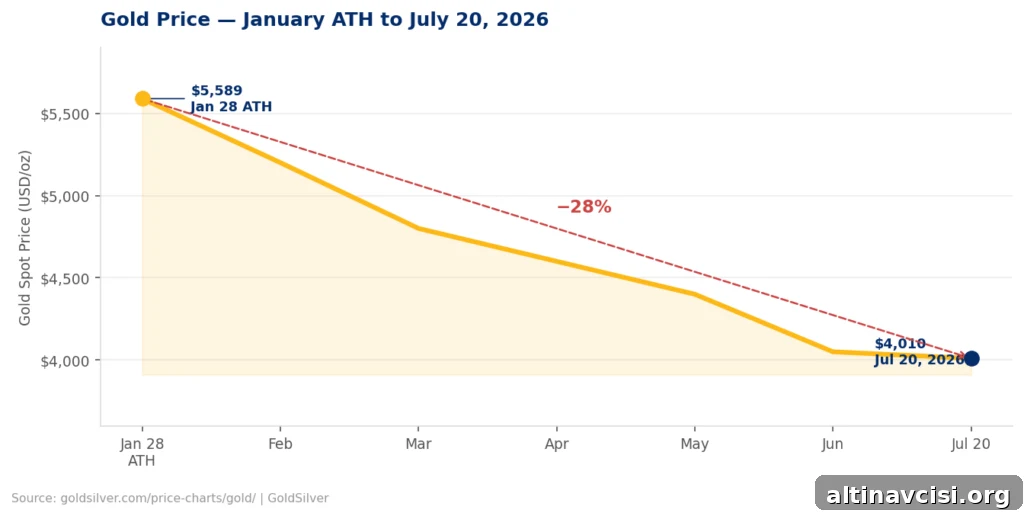
The official rationale centers on investor protection. Gold surged to a record near $5,589 an ounce in late January 2026 and then plunged to roughly $4,010 by July 20 — a roughly 28–30% decline in five months. That kind of volatility can turn leveraged retail positions into immediate, system-wide risks. In response, several banks increased margin requirements dramatically, making leverage economically impractical, and then announced a full suspension of these retail margin products.
A deeper motive traces back to institutional memory from earlier market episodes. In April 2020, a structured retail product tied to WTI crude collapsed when oil prices briefly went negative. That event left many retail customers with wiped-out balances and forced the issuing bank to absorb significant losses. Regulators responded by urging banks to tighten controls on complex retail products. The 2026 gold correction presented a similar risk: volatile commodity prices combined with widespread retail leverage could impose large losses on banks and, by extension, on the financial system. This time regulators and banks acted preemptively.
What does this China paper gold trading shutdown actually affect?
The suspension applies narrowly to leveraged, bank-intermediated retail trading products linked to the Shanghai Gold Exchange — for example, spot contracts such as Au99.99 and deferred-delivery margin contracts like Au (T+D). These are margin products that allowed ordinary investors to take leveraged exposure to gold prices inside their bank accounts.
Importantly, the move does not restrict physical gold purchases. Buying bars, coins, or accumulating physical metal through proper delivery channels remains fully available to Chinese retail and institutional buyers. It also does not affect listed gold exchange-traded funds (ETFs), the SGE’s institutional trading and settlement operations, or the People’s Bank of China’s official reserve purchases. In fact, physical demand in China was exceptionally strong in early 2026, underlining that this regulatory step targets speculative paper leverage rather than the core physical market.
How did paper speculation affect gold’s price — and what changes without it?
Leveraged retail positions acted as an amplifier in the bull run and the subsequent decline. In January 2026, a large number of retail accounts held leveraged long positions in gold. That collective exposure added upward pressure to prices, compounding demand from central banks and other physical buyers. When the price reversed, many of those same leveraged accounts were forced sellers, accelerating the drop.
Removing that amplifier changes market dynamics. With leveraged retail speculation curtailed, the market becomes more reliant on physical buyers: households purchasing bullion and accumulation-plan units, institutions moving allocated metal, and sovereign buyers adding to reserves. These types of buyers are less likely to liquidate in response to short-term price swings or margin calls. The result should be reduced short-term volatility and a stronger structural bid, because prices will reflect people who want to own metal rather than traders betting on directional moves.
What does this mean for investors who already own physical gold?
For long-term holders of allocated physical gold and silver, the July 24 deadline is reassuring rather than threatening. The suspension highlights the risks embedded in paper-based, bank-intermediated products: counterparty risk, settlement complexities, and shifting regulatory exposure. A physically allocated bar or coin avoids those risks when stored in secure, audited custody.
Over time, redirecting retail demand toward physical ownership should make price discovery more resilient. Markets dominated by genuine owners rather than leveraged speculators typically show lower volatility and a more defensible price floor. That shift reinforces the structural case for holding allocated metal for investors focused on long-term preservation.
That said, shorter-term macro events will still move gold. Monetary policy decisions and major economic data releases — for example, upcoming central bank meetings and inflation reports — can create short-term price swings. The regulatory change in China, however, shifts the long-run balance toward buyers who hold metal for ownership, which matters more for durable price support.
Sources (reported)
1. ICBC announcement on suspension of individual SGE precious metals trading, June 24, 2026.
2. Reporting on major Chinese banks suspending individual trading on the Shanghai Gold Exchange, June 25, 2026.
3. Coverage summarizing the end of retail bank gold leverage in China, June 25, 2026.
4. Archive reporting on the 2020 retail product losses tied to plunging oil prices.
5. World Gold Council — Gold Demand Trends Q1 2026 (physical demand data).
6. Live gold spot price data as of July 20, 2026 (spot context for the correction).
7. Market tools and commentary on FOMC rate probabilities for July 2026.
Disclaimer: This article is informational and does not constitute financial or investment advice. Consult a qualified financial adviser before making investment decisions.
You may also like:
- Silver market moves and the unusual divergence with oil in July 2026.
- Developments in Hong Kong gold clearing and implications for global settlement.
- How consumer inflation expectations and commodity swings have influenced gold’s short-term moves.
- Analysis of the July 2026 gold price correction versus the long-term case for owning bullion.