Key Takeaways
- The gold-silver ratio closed Friday at 69.3:1 — its highest weekly close since the Iran conflict peak weeks. This was driven by aggressive Fed repricing after the June 17 FOMC, which pushed September rate-hike odds from roughly 29% to about 68% in a single week.
- Thursday’s PCE data (headline 0.4% MoM, core 0.3% MoM, YoY headline 4.1%) trimmed September rate-hike odds back to about 63%, triggering gold’s bounce above $4,000 and a slight compression of the ratio — the first data-driven sign that the regime may be shifting.
- The gold-silver ratio is a regime diagnostic rather than a strict price forecast. At 69.3, it signals that rate-hike concerns are the dominant force pricing silver, not silver’s structural supply or industrial fundamentals, which remain intact amid a sixth consecutive annual supply deficit.
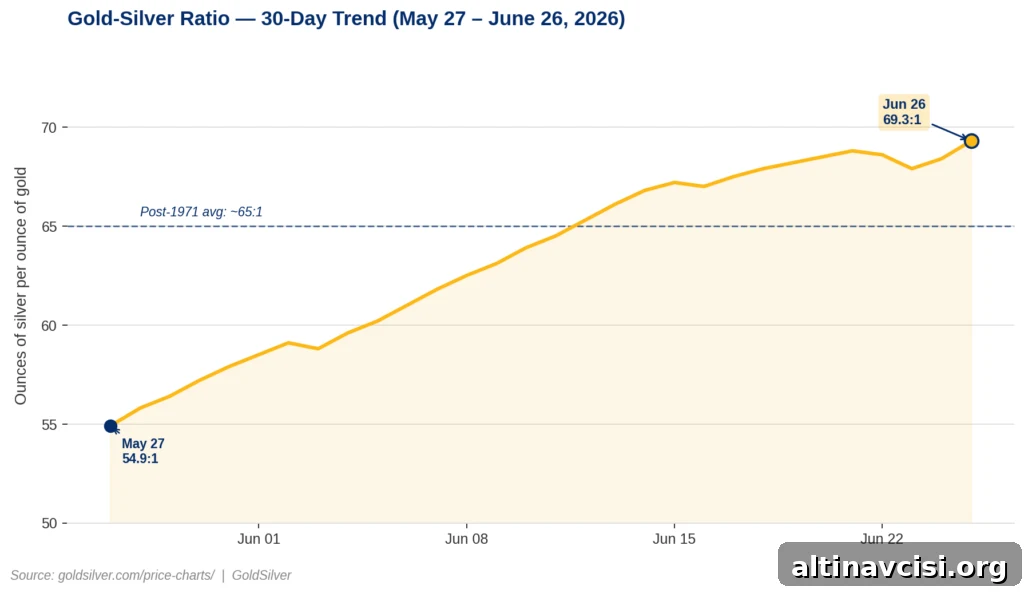
The gold-silver ratio represents how many ounces of silver are needed to buy one ounce of gold. It closed Friday at 69.3:1 — the highest weekly close since the early weeks of the US-Iran conflict. When the US-China tariff truce compressed the ratio to 54.9 in late May, narrowing by a single point required about 14 ounces of silver. Three weeks of unusually hawkish Federal Reserve repricing in June pushed the ratio back to 69, highlighting the asymmetry between monetary suspense and industrial demand expectations.
As of the close referenced in this analysis, gold traded near $4,044 and silver near $58.34. Both metals fell sharply during the week as higher rate expectations dominated paper-market pricing. The ratio’s movement reflects that relative performance more than underlying physical trends.
What the Ratio Is Telling You
The gold-silver ratio equals the price of one ounce of gold divided by the price of one ounce of silver. At 69.3, it takes 69.3 ounces of silver to buy one ounce of gold; the higher the ratio, the cheaper silver is relative to gold. Since the end of the gold standard in 1971, the ratio has averaged roughly 65:1. Extreme moves — like the 127:1 spike during the March 2020 COVID panic — reflect panic or dislocation. The compression to 54.9 in late May reflected a sudden surge in industrial-demand expectations tied to a tariff truce with China. Today’s reading above the long-run average is characteristic of periods where rate-hike fear dominates market pricing.

The Edge Every Investor Needs
Smarter precious metals investing starts here. The Nuggets Newsletter brings essential market insights, Fed updates, global trends, and educational resources to help investors stay informed.
Why Did the Gold-Silver Ratio Widen to 69:1?
Silver is driven by two simultaneous engines: a monetary engine that moves with real yields, inflation expectations, and the dollar, and an industrial engine that follows manufacturing cycles — solar panels, electric vehicles, data centers, semiconductors and other supply-chain trends. The Fed’s June 17 FOMC marked a hawkish shift that moved market expectations for tighter policy. With higher expected rates, real yields rose and the opportunity cost of holding non-yielding metals increased. The US dollar strengthened and both metals sold off, but silver declined more sharply than gold, stretching the ratio from roughly 62 to 69 in a little over a week.
What the Data Is Missing
The May PCE inflation data was collected before recent geopolitical developments that have since affected oil prices. Any deflationary effects from those events will not appear in official data until the June PCE release. In other words, the Fed’s guidance and market pricing may be reacting to data that do not yet reflect recent disinflationary inputs.
The May PCE print showed headline PCE at 0.4% month-over-month and core PCE at 0.3% month-over-month, with the annual headline rate near 4.1% and core annual rate around 3.4%. Those readings caused market-implied odds for a September rate hike to fall modestly, helping gold move back above $4,000 and slightly compressing the ratio. That modest compression is the first data-driven indication that the rate-hike narrative may be softening.
What History Says Happens Next
The ratio does not predict absolute price levels; it signals relative value between gold and silver. When the monetary headwinds that suppress silver ease, silver benefits from both its monetary and industrial engines at once — a structural advantage over gold, which is driven chiefly by monetary demand. Historical episodes show that when rate-cycle pressure peaks and then fades, silver can outperform gold as industrial demand recovers and investor preference shifts back toward physical exposure.
The late-May tariff-truce episode demonstrated the effect: the ratio compressed from about 67 to 54.9 in eleven trading days as industrial demand expectations surged alongside monetary re-pricing. The current environment is the reverse: monetary tightening lifted the ratio; any meaningful easing of rate expectations could reverse that move and favor silver.
Is the Silver Supply Deficit Still Intact?
Yes. Silver has been in an annual supply deficit for six consecutive years. Even with reductions in silver intensity from solar PV manufacturers in 2026, overall mine supply is contracting faster than industrial demand is falling, widening the deficit. Cumulatively, above-ground stocks have drawn down materially over multiple years. That structural deficit is not altered by short-term shifts in the Fed’s dot plot or quarterly paper-market positioning; it remains a long-term support for silver prices.
Major bank forecasts vary: some institutions trimmed year-end gold targets after removing expected rate cuts from their outlooks, while others remain more bullish. Those differing price targets imply significant upside from current gold levels, illustrating how forecasts depend heavily on macro assumptions about rates and central-bank behavior.
What to Watch
The next material input for the gold-silver ratio will be the June PCE release. That report should be the first official data to capture post-ceasefire oil prices and other recent shifts. If it shows cooling inflation, market odds of a September hike would likely fall, supporting a recovery in silver’s monetary engine and compressing the ratio. A move from 69 toward 60 would imply silver outperforming gold by roughly 13 percentage points, assuming gold’s price holds steady.
Remember: the ratio is diagnostic, not a direct buy signal. At 69.3:1 on a Friday close, it diagnoses a market where rate-hike fear has temporarily sidelined silver’s dual-engine recovery potential. The underlying fundamentals — a multi-year supply deficit and durable industrial demand from the energy transition — remain intact. That divergence between paper-market narrative and physical fundamentals creates a setup worth monitoring closely.
This is not a loss — it is a potential setup for future silver strength when monetary pressure eases and industrial demand reasserts itself.
SOURCES
1. Federal Reserve — Summary of Economic Projections, June 17, 2026.
2. Bureau of Economic Analysis — Personal Consumption Expenditures Price Index, May 2026.
3. CME Group — FedWatch Tool, June 26, 2026.
4. GoldSilver — Live Gold and Silver Price Charts.
5. Silver Institute — World Silver Survey 2026.
6. Goldman Sachs Global Investment Research — Gold price forecast revision, June 19, 2026.
7. J.P. Morgan Global Research — Gold price outlook 2026.
Disclaimer: This article is for informational purposes only and does not constitute financial or investment advice. Always consult a qualified financial adviser before making investment decisions.
You May Also Like:
- Q1 GDP Beat. Jobless Claims Beat. Gold Rose. Here’s Why.
- PCE Hit 4.1%. Gold Went Up. Here’s Why.
- 298 Tonnes of ETF Gold Is Underwater. Central Banks Aren’t.
- Hawkish Fed, Gold Below $4,000, Silver Below $60 — and a Market That Disagrees.
- Gold Just Broke $4,000. The Mainstream Called the Debasement Trade Dead. They’re Wrong.
- Two Things Are Hitting Gold Simultaneously. Only One Is About Gold.
- Why Is Silver Down 5%? The Gold-Silver Ratio Explains.