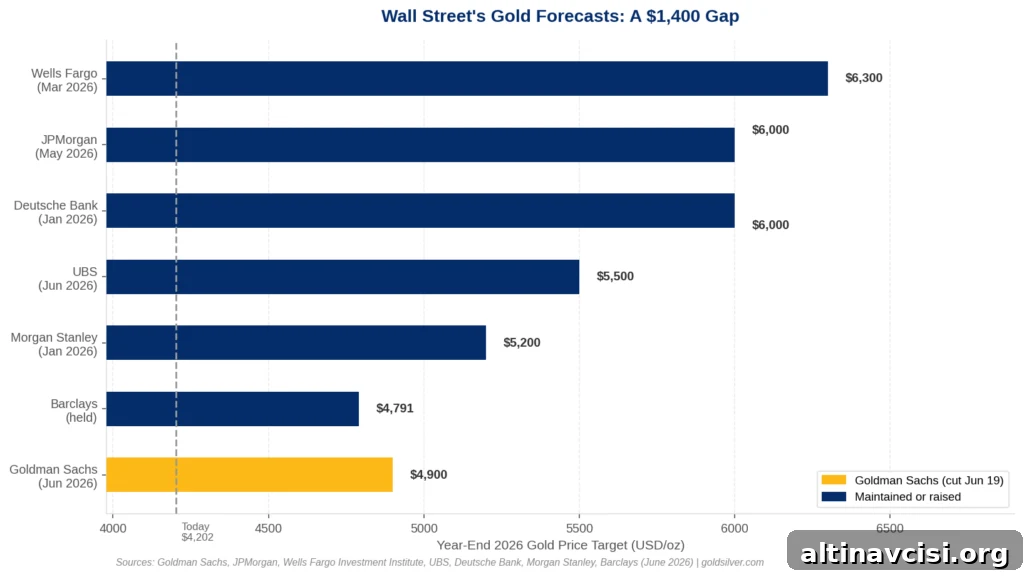
On June 19, Goldman Sachs analysts Lina Thomas and Daan Struyven revised their year-end gold price forecast, lowering it from $5,400 to $4,900 per ounce. The adjustment reflects a change in the bank’s view of the Federal Reserve’s path: Goldman no longer expects any rate cuts in 2026 and now sees the first easing as likely in June 2027.
Other major banks did not change their outlooks. JPMorgan maintains a year-end target of $6,000. Wells Fargo Investment Institute, which raised its range in March to $6,100–$6,300 for year-end 2026, has left that estimate intact. Deutsche Bank likewise continues to project $6,000.
At the time of writing, spot gold is trading around $4,202. That leaves a sizeable $1,400 spread between Goldman’s revised floor and Wells Fargo’s ceiling. That gap is meaningful: it highlights differing models and the priorities each bank uses to value gold.
Why Goldman Sachs moved
Goldman’s valuation framework explicitly ties the gold price to interest-rate expectations. In their model, each 50 basis-point reduction in policy rates adds roughly $120 per ounce of support to gold. Lower rates reduce the opportunity cost of holding a non-yielding asset and typically weaken the U.S. dollar, both of which lift gold prices.
Previously, Goldman had assumed a cut in late 2026 and another in early 2027; those moves were built into the $5,400 projection. After the Federal Reserve’s June policy meeting removed forward guidance from the statement and several policymakers signaled a more hawkish stance, Goldman’s economists eliminated 2026 cuts from their baseline. The direct effect of removing those two assumed cuts reduces rate-driven support by roughly $240 per ounce under Goldman’s rule-of-thumb. Adjustments to expectations for ETF flows and other demand assumptions account for the remainder of the downgrade, producing the $4,900 target and an explicit downside scenario near $4,400 should the Fed tighten further.
Goldman summarized the position as “structurally constructive but tactically cautious,” reflecting a view that longer-term drivers remain intact even as near-term price support is trimmed.

The Edge Every Investor Needs
Smarter precious metals investing starts here. The Nuggets newsletter provides concise market updates, Fed developments, and practical analysis.
Why JPMorgan and Wells Fargo didn’t
JPMorgan’s $6,000 projection rests on a demand-driven framework. The bank emphasizes quarterly physical demand — central bank purchases, ETF flows, and bullion demand from industrial and retail buyers — as the primary force moving gold prices. JPMorgan’s analysis suggests that changes in quarterly tonnage account for the majority of quarter-to-quarter price movement.
So far, that demand picture has remained robust. In the first quarter of 2026 central banks reportedly bought 244 tonnes of gold, a pattern reinforced by ongoing accumulation from major buyers. The People’s Bank of China, for example, added nearly 10 tonnes in May and has accumulated gold for many consecutive months. Surveys of central bank intentions indicate that a significant share of reserve managers plan to keep increasing gold allocations over the next year.
Because central bank reserve decisions are strategic and long-term, they are less sensitive to a single Fed meeting or to the timing of one or two rate cuts. Wells Fargo cited these same structural factors — persistent reserve demand, potential rate easing, and elevated policy uncertainty — when it raised its target earlier in the year and continues to treat price dips as buying opportunities rather than structural reversals.
Two different theories of what gold is
The divergence between Goldman’s $4,900 call and JPMorgan’s $6,000 outlook reflects not mere disagreement over data, but competing definitions of gold’s role. Goldman models gold primarily as a macro-sensitive asset whose value hinges on interest rates and the dollar. In that view, near-term rate decisions and shifts in real yields are the dominant drivers.
JPMorgan and Wells Fargo treat gold more as a reserve asset: a long-term store of value that central banks accumulate to diversify sovereign balance sheets and reduce exposure to any single currency. This demand is structural, slow-moving, and rooted in geopolitical and monetary-policy considerations, so it is far less reactive to individual policy announcements.
Both frameworks are internally consistent. For investors, the critical question is which description matches their reason for holding gold. If your position is a tactical play on Fed easing, Goldman’s model provides the indicators to watch. If you own gold as protection against long-term monetary erosion or as a reserve-style allocation, the demand-focused models from JPMorgan and Wells Fargo may be more relevant.
What Thursday’s PCE data does and doesn’t change
Upcoming monthly inflation readings — notably the Personal Consumption Expenditures (PCE) price index — will move markets on the release date. If core PCE prints hotter than expected, it would strengthen the case for Goldman’s downside scenario by reinforcing higher-for-longer rate expectations. A softer print would ease near-term rate-hike concerns and could draw tactical buyers back into the market.
Yet for central bank reserve buyers, a single PCE release is immaterial. Those institutions base reserve policy on strategic goals and long-term risk assessments, not on one-month inflation swings. That distinction between rate-sensitive traders and long-horizon reserve managers is the clearest explanation for the $1,400 difference in top-line forecasts.
Stay on top of gold & silver prices
Sign up to receive timely market alerts and concise analysis straight to your inbox.
Sources
Goldman Sachs Global Investment Research — Gold Price Target Revision, June 19, 2026; Federal Reserve — FOMC Statement and Summary of Economic Projections, June 2026; JPMorgan Global Research — Gold Price Forecast, May 2026; Wells Fargo Investment Institute — Gold Price Target Revision, March 28, 2026; World Gold Council — Gold Demand Trends Q1 2026; Mining.com — coverage of forecast changes; Federal Reserve Bank of Cleveland — inflation nowcasting. These sources informed the reporting and analysis above.
Disclaimer: This article is for informational purposes only and does not constitute financial or investment advice. Consult a qualified financial adviser before making investment decisions.
You may also like:
- Gold Price Today, June 19: What Juneteenth Trading Tells You
- Half the Fed Wants a Hike. 45% of Central Banks Are Buying More Gold.
- Silver Hit $69.85 This Morning. Then the FOMC Took It All Back.
- The Fed Went Silent. Gold Holders Don’t Need It to Speak.
- Five Signals That Say Gold’s Correction Is a Reset, Not a Reversal
- The Fed Just Killed Its Rate Roadmap. Here’s What That Means for Gold.
- Gold Holds at $4,347 While Stocks Hit All-Time Highs. Here’s Why.