
Key Takeaways
- PCE is the Fed’s preferred inflation gauge. It adjusts for substitution in consumer spending and covers a broader basket than CPI, making it the metric most directly tied to Federal Reserve policy decisions.
- May PCE is due Thursday, June 25. Core PCE ran at 3.3% in April. A hotter-than-expected reading near or above the Fed’s 3.6% year-end projection would increase pressure for rate hikes and weigh on gold. A softer reading below about 3.4% could sharply reduce the chance of a December hike and open a path for gold back toward $4,400.
- The structural case for real assets is broader than any single report. With real yields only marginally positive, central banks buying gold at record rates, and Fed projections showing inflation above target through year-end, the long-term rationale for gold as a protector of purchasing power remains intact regardless of Thursday’s print.
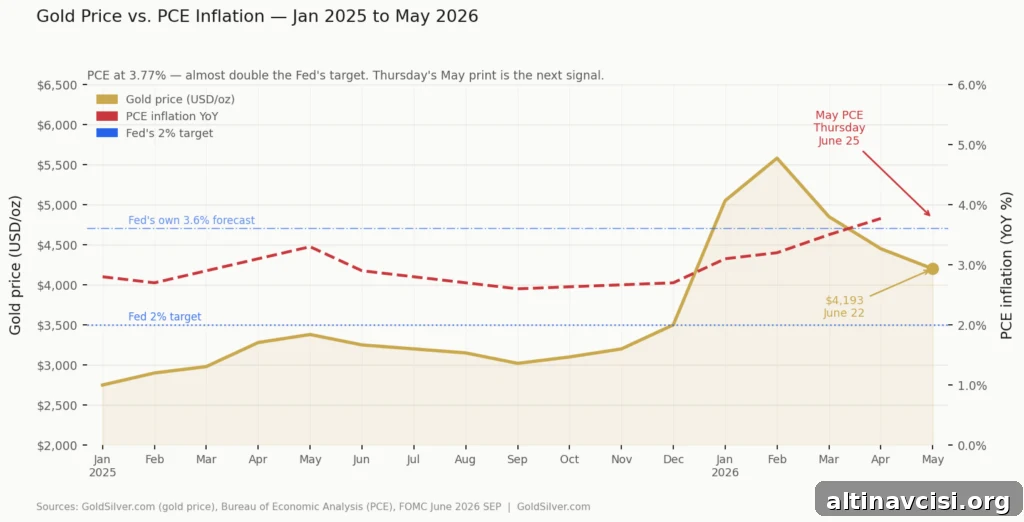
Gold is trading around $4,193 this Monday, recovering from last week’s low near $4,150. The US and Iran reached a 60-day roadmap agreement in Switzerland, which sent oil roughly 2% lower and helped ease some commodity pressure. Silver is around $66.05, outperforming gold after last week’s drop.
This week’s focal point for markets is the May PCE release on Thursday morning. The Personal Consumption Expenditures price index is the Federal Reserve’s preferred inflation measure and is central to the outlook for interest rates and precious metals.
What Is PCE Inflation — and Why Does the Fed Use It Instead of CPI?
Many investors watch the Consumer Price Index (CPI) because it headlines daily news. The Federal Reserve, however, focuses on the Personal Consumption Expenditures (PCE) price index, published monthly by the Bureau of Economic Analysis. The two measures differ in construction and emphasis, and those differences matter for policy.
CPI is based on a relatively fixed basket of goods and services. PCE adjusts for how consumers change spending when relative prices shift. If the price of one item rises and people substitute a cheaper alternative, PCE reflects that behavior; CPI does so less directly. Because of this substitution adjustment and its broader coverage, PCE typically runs about 0.3 to 0.5 percentage points lower than CPI and is viewed as a closer reflection of evolving consumer spending patterns.
PCE also captures costs paid on behalf of consumers—such as certain healthcare expenses covered by insurers—and includes some services and financial components that CPI does not fully account for. For these reasons, the Fed treats core PCE (excluding food and energy) as its primary inflation signal when setting and communicating policy.
The April PCE reading showed headline inflation at 3.77% year-over-year, with core PCE at 3.3%. The Fed’s target is 2%, but its revised year-end projection sits near 3.6%, implying inflation will remain well above target through 2026. That divergence between projected inflation and current policy rates creates the backdrop for markets and for how investors view gold.
How Does Thursday’s PCE Print Affect Gold Prices?
Thursday’s May PCE release is arguably the most important macro data point for precious metals this week. PCE directly influences the Fed’s rate path. After the June FOMC meeting, nine of 19 policymakers signaled at least one hike before year-end; that hawkish tilt pushed Treasury yields higher, strengthened the dollar, and pressured gold from levels above $4,400 down to last week’s low near $4,150.
The link between inflation and gold is mediated by real yields—nominal yields minus inflation. When inflation outpaces nominal yields, real yields compress and holding cash or bonds erodes purchasing power, making non-yielding assets like gold comparatively more attractive. If inflation prints hotter and the Fed accelerates hikes, nominal yields may rise faster than inflation, raising real yields and pressuring gold. Conversely, a softer inflation print weakens the case for hikes, compresses real yields, and tends to support higher gold prices.
Currently the 10-year Treasury yield is in the mid-4% range, while PCE remains near the high 3% area—leaving real yields barely positive. That narrow margin means Thursday’s number could sway market expectations meaningfully.
Two likely scenarios for Thursday:
1) PCE prints at or above ~3.6%: Such a reading would validate the Fed’s hawkish dots, reinforce the probability of a December hike, keep the dollar supported, and maintain upward pressure on real yields. Gold would likely remain under pressure and trade in the $4,100–$4,200 range.
2) PCE prints below ~3.4%: A genuine downside surprise would weaken the tightening narrative. Futures markets would reprice lower expected hikes, the dollar would likely soften, real yields would compress, and gold would have a clearer path back to prior levels around $4,400.
Why Is the Energy Component Complicating This Week’s Reading?
May’s CPI data showed that energy accounted for more than 60% of the monthly price gain, largely driven by geopolitical tensions and supply concerns. Because PCE’s headline includes energy, analysts expect May PCE to be elevated—estimates clustered around the low 4% area for the headline number.
The recent Iran agreement pushed oil roughly 2% lower today, which will ease inflationary pressures moving forward. However, the May PCE report reflects price developments in May; today’s oil decline mostly affects June’s data, not May’s. As a result, Thursday’s print may still look elevated, reflecting the earlier Iran-driven oil spike. Market reaction will hinge on whether investors treat the report as backward-looking or as informative for the Fed’s next steps.
Why Don’t Long-Term Gold Holders Need to Lose Sleep Over One Number?
While short-term trading can pivot on a single economic release, the structural case for gold is driven by longer-term forces. The Fed’s own projections show inflation above target for months ahead. Sovereign debt levels are high, and many central banks continue to accumulate gold reserves at a rapid pace—evidence that official buyers are positioning for an environment where inflation outlasts restrictive policy.
From a household perspective, the current yield on some short-term cash alternatives sits near the same level as headline inflation. When nominal yields and inflation are close, real returns for cash become effectively zero or negative, creating a persistent erosion of purchasing power. Gold, with no counterparty risk, is attractive as part of a diversified response to that reality.
Thursday’s PCE release will move markets and may change short-term positioning. But a single data point does not negate the longer-term drivers that support gold as a store of value across inflationary cycles and balance-sheet constraints.
What Should You Watch This Week?
Thursday, June 25: The Bureau of Economic Analysis releases May PCE alongside the final Q1 GDP revision and initial jobless claims. Core PCE is the most important figure to watch; it strips out volatile food and energy components and is the measure the Fed emphasizes. The prior core reading was 3.3% year-over-year.
Price levels to monitor: Gold support sits around $4,100–$4,150, with resistance near $4,400.
The decisive question: Does the energy disinflation beginning in June already affect May’s report, or does Thursday’s reading still reflect the earlier oil-driven spike? That distinction will largely determine gold’s near-term direction.
The Edge Every Investor NeedsSmarter precious metals investing starts with timely analysis. Sign up for concise market insights, Fed updates, and education about gold and silver.
Stay On Top of Gold & Silver Prices
Get important market alerts sent straight to your inbox.
SOURCES
1. Gold & Silver spot price and market commentary, June 22, 2026.
2. Bureau of Labor Statistics — Consumer Price Index summary for May 2026.
3. Bureau of Economic Analysis — PCE price index, April 2026.
4. Federal Reserve — Summary of Economic Projections, June 2026.
5. CME Group — Fed futures and FedWatch data, June 2026.
6. World Gold Council — Gold demand trends, Q1 2026.
7. US Treasury — 10-year constant maturity rate, June 22, 2026.
8. Vanguard — VMFXX 7-day yield, June 21, 2026.
9. Industry commentary on gold price outlook, June 2026.
Disclaimer: This article is for informational purposes only and does not constitute financial or investment advice. Consult a qualified financial adviser before making investment decisions.
You may also like:
- Goldman Sachs Gold Target Cut: What the $1,400 Gap Means
- Gold Price Today, June 19: What Juneteenth Trading Tells You
- Half the Fed Wants a Hike. 45% of Central Banks Are Buying More Gold.
- Silver Hit $69.85 This Morning. Then the FOMC Took It All Back.
- The Fed Went Silent. Gold Holders Don’t Need It to Speak.
- Five Signals That Say Gold’s Correction Is a Reset, Not a Reversal
- The Fed Just Killed Its Rate Roadmap. Here’s What That Means for Gold.
- Gold Holds at $4,347 While Stocks Hit All-Time Highs. Here’s Why.