Can’t decide whether to buy gold now or wait?
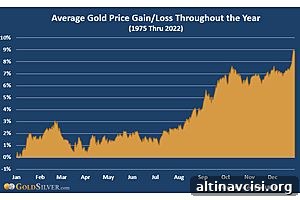
We reviewed historical data to see if there’s an optimal time of year to buy gold. Is there really a best season to purchase gold?
To answer that, let’s begin with the fundamentals.
Why Buy Gold?
Gold is rarely bought in isolation. Most investors include it as a portion of a diversified portfolio. Allocations to gold are chosen relative to other assets and often guided by the investor’s view of economic risk.
When people feel financially secure they take more risks: launching businesses, spending, and investing in stocks. That’s a risk-on environment where equities typically outperform safe havens. Conversely, when people feel uncertain about their finances they spend less, save more, and move capital into safer assets such as gold. That switch creates risk-off periods when gold tends to outperform stocks.
So when is the best time to buy gold?
The Dow/Gold Ratio
One useful way to read collective risk sentiment is to compare stocks and gold via the Dow/gold ratio. This ratio shows how stocks (the Dow Jones Industrial Average) perform relative to gold. Rising ratio values indicate a risk-on environment where stocks outperform gold; falling values indicate risk-off periods where gold outperforms stocks.
The ratio moves in long-term cycles, often spanning a decade or more. Short, sharp corrections usually favor gold, while extended risk-on cycles favor stocks.
As of 2024 the Dow/gold ratio sits around 19, well above its long-term mean of about 9.7 and median near 5.5. If the ratio reverts toward historical averages, gold would need to outperform stocks for a sustained period. That could present an attractive buying opportunity for gold investors. However, ratios can continue to move higher for long stretches, so timing remains uncertain.
If you believe the ratio will revert toward its historic levels, buying gold now could be prudent. If you expect stocks to continue outperforming, you might choose to wait.
The Gold Bull Market
Understanding the broader gold cycle helps with timing decisions. Gold prices move through long cycles. The major bull market of the 1970s was followed by a long bear market, and historically the most dramatic price moves have occurred during the final stages of a bull market—the so-called blow-off top—when momentum-driven buying pushes prices sharply higher.
Paul Tudor Jones describes this phenomenon well: in strong bull markets the early and middle phases are often driven by fundamentals, while the final phase becomes a frenzied, parabolic move.
For example, in 1979 gold rose rapidly: from $226 to $512 in a year, then shot to $873 within weeks. Those blow-off moves are extreme and difficult to predict, but if current conditions point toward the late stage of a long gold bull, buying now could capture significant upside.
The Best Time of Year to Buy Gold
When we examine monthly and quarterly patterns, the data show that timing by month makes little difference over the long term. What matters more is buying within the right multi-year market trend rather than picking a specific calendar month.
If your horizon is long term, buying this year rather than waiting until next year is likely to matter more than choosing a particular month. The number of ounces you own and the consistency of your purchases typically have a larger impact on long-term outcomes than attempting to catch the exact bottom.
Rather than timing a single lump-sum purchase, consider dollar cost averaging (DCA). DCA means investing a fixed amount at regular intervals regardless of price. This can reduce the risk of making a large investment at an inopportune time and encourages disciplined investing.
- Mitigates Timing Risk: Spreading purchases lessens exposure to short-term volatility.
- Consistency and Discipline: Regular investments help maintain a disciplined savings and investment plan.
- Accessible: You can begin with smaller amounts, making precious metals investing more accessible for any budget.
- Long-Term Fit: DCA suits long-term wealth-building objectives by smoothing purchase prices over time.
One practical way to dollar cost average into physical metals is through a fractional ownership platform that allows small, regular purchases and immediate liquidity.
Fractional Ownership and Ease of Access
Fractional ownership systems let you buy and sell allocated portions of large bullion bars. They provide the benefits of physical metal—low premiums relative to small retail coins—while allowing small, regular investments and instant liquidity.
Typical advantages include:
- No minimums: Buy in small increments or make larger investments as desired.
- Instant liquidity: Sell at market rates or add to your position when you choose.
- Delivery options: Convert fractional holdings into whole coins or bars and request insured delivery.
- Efficient pricing: Access bulk pricing via shared ownership of large bars.
- Allocated physical metal: Investments represent direct, labeled ownership of physical metals stored in secure vaults.
- Low spreads: Competitive buy/sell spreads that approximate spot pricing while providing real physical delivery options.
- Secure storage: Third-party vaults with insurance, surveillance, and regular audits protect holdings.
These features make fractional ownership convenient for investors who want the security of physical metals without the large upfront cost or storage logistics.
Delivery, Storage, and Fees
With fractional ownership you can often request conversion of your fractional ounces into whole-ounce coins or bars for delivery, subject to minimum conversion options and associated exchange and shipping fees. Not all large bars are deliverable as a single unit, but conversion to common whole-ounce products is usually available.
Storage and insurance fees for fractional holdings are generally modest and billed separately rather than deducted from your metal. These fees cover secure storage, insurance, and auditing. Such arrangements aim to keep ongoing costs low for investors while preserving full ownership of allocated physical metal.
Conclusion
Is now the best time of year to buy gold? For long-term investors who believe gold may outperform stocks over the coming years, purchasing this year rather than waiting could be advantageous. Month-to-month seasonality matters little compared with how many ounces you accumulate and whether you maintain a consistent, disciplined plan.
If you prefer to reduce timing risk, consider dollar cost averaging or fractional ownership options to build your position gradually while retaining the ability to convert to and take delivery of physical metal when you choose.