
Gold and silver market update — May 4, 2026
Key Takeaways
- The gold-silver ratio has widened to 62.05:1. Since April 22, silver has dropped about 7% versus gold’s roughly 4%, indicating silver is currently underperforming rather than leading.
- This widening reflects a short-term cyclical move as ceasefire pricing removes some of silver’s industrial risk premium; the longer-term structural case (a multi-year supply deficit, record China demand, and Basel III effects) remains intact.
- For sound-money investors, a Fed that remains on hold and keeps real yields suppressed is a significant hidden tailwind for silver. At 62:1, silver likely has more upside potential relative to gold if the monetary picture reasserts itself.
Two weeks ago silver was following the path many sound-money investors expected: the gold-silver ratio was compressing toward 60:1 and silver was outperforming gold as both metals retreated from the Iran-war driven highs. Since then, silver has fallen nearly twice as much as gold, pushing the ratio back to 62.05:1 as of May 5, 2026. That move is cyclical and does not erase silver’s structural fundamentals.
What Is the Gold-Silver Ratio and What Does It Mean Today?
The gold-silver ratio shows how many ounces of silver are required to buy one ounce of gold. At 62.05, it takes 62 ounces of silver to equal one ounce of gold. A rising ratio indicates silver is weakening relative to gold; a falling ratio indicates silver is strengthening.
Historically, under bimetallic standards the ratio was legally fixed near 15:1 (the U.S. Coinage Act of 1792 is the classic example). That anchor faded when silver lost its formal monetary role in the late 19th century. In modern markets the ratio has moved widely: since 2000 it has mostly traded between 50:1 and 90:1, spiking to extremes during crises — for example, briefly near 125:1 in March 2020 during the COVID liquidity panic and rising above 88:1 in late 2024 before silver’s historic rally.
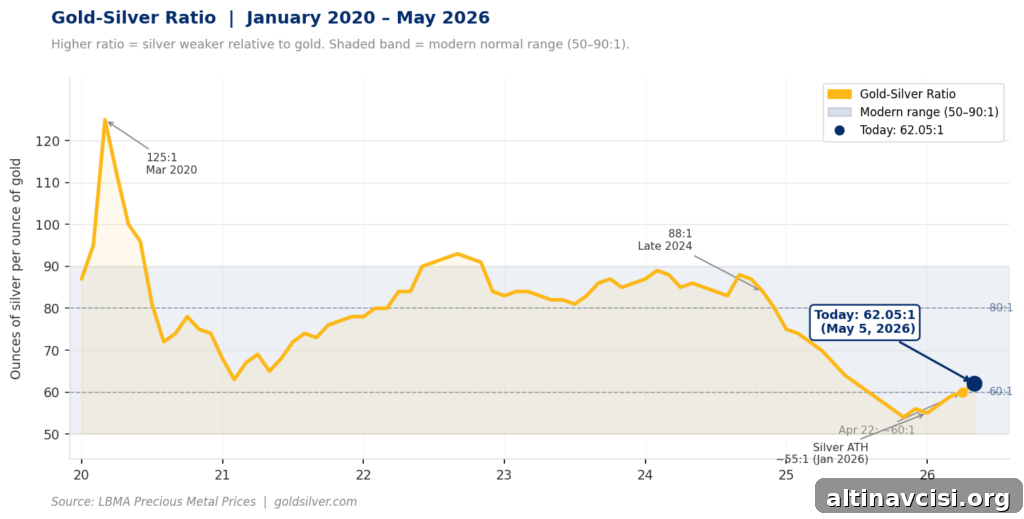
Today’s 62:1 level sits in the lower-middle of the modern range — not an extreme and not historically cheap. More important than the absolute level is the recent direction: the two-week expansion reflects short-term repositioning rather than a wholesale shift in silver’s long-term case.
Why Is Silver Underperforming Gold Right Now?
Silver has a dual role. One side is monetary — it has served as money for millennia, tracks gold in response to real yields and dollar moves, and attracts sound-money demand. The other side is industrial: roughly 60% of silver demand is industrial, driven by solar panels, electric vehicles, 5G infrastructure and semiconductors. That industrial exposure helps silver outperform during robust growth and underperform when growth or industrial demand appears at risk.
Since April 22 markets have priced in a potential de-escalation of the Iran conflict — not a final resolution but less acute geopolitical risk. As safe-haven premiums fall, both metals can retreat, but silver also carries the additional industrial angle: easing energy or supply concerns can reduce the near-term industrial risk premium and prompt selling in silver. The market sold more silver for that reason.
Data illustrate the move. Silver reached an all-time high of $121.62/oz on January 29, 2026, driven by combined monetary and industrial demand. It has since retreated roughly 39%, while gold has held up much better. The gold-silver ratio has moved away from its multi-year lows back toward the middle of the modern range.
Has the Structural Case for Silver Changed?
No. The recent ratio expansion is cyclical and tied to short-term positioning. The structural outlook for silver remains strong and may even be getting stronger.
The silver market is on track for its sixth consecutive annual supply deficit in 2026, according to the Silver Institute’s World Silver Survey 2026. Since 2021 the world has drawn down roughly 762 million ounces from above-ground inventories because production has not kept pace with demand.
China’s silver imports reached a monthly record in March 2026 driven by retail buyers using silver as a lower-cost alternative to gold and by solar manufacturers accelerating purchases ahead of China’s April 1 export tax rebate change. That surge reflects real, ongoing demand rather than a short-term trading blip.
Basel III regulatory changes are also reducing banks’ paper exposures to precious metals, which gradually removes leverage that has suppressed spot prices in the past. Banks have been trimming paper precious metals positions in anticipation of the new rules.
None of those structural conditions altered meaningfully between April 22 and today.
What Does the Gold-Silver Ratio at 62:1 Mean for Investors?
At roughly ~$4,578 for gold and ~$73.78 for silver, the 62:1 ratio implies three practical points for investors.
First, silver remains well below its all-time high relative to gold. When the ratio briefly neared 50:1 in early 2026, silver was trading closer to $90–95. A move back toward that range, with gold above $4,500, would imply materially higher silver prices. At 62:1, silver is not overheated but not at an extreme bargain either.
Second, the gap between supply fundamentals and current prices is widening, not narrowing. Historically, such divergences between fundamentals and market pricing tend to resolve quickly once positioning shifts. This observation describes past commodity behavior rather than a precise forecast.
Third, a paused Fed is an underappreciated tailwind for silver. The Fed faces a dilemma: it cannot raise into a weakening jobs backdrop, nor easily cut with ISM Prices Paid at elevated levels. A central bank stuck on hold keeps real yields suppressed, lowering the opportunity cost of holding non-yielding assets like gold and silver. If those monetary dynamics reassert, silver — trading at 62:1 — has room to outperform gold.
The Second Corner: What the Ratio Is Really Telling You
The immediate read of today’s ratio is simple: silver underperformed and the ratio widened — a short-term bearish signal. That’s the first corner: what happened.
The second corner provides context: silver underperforming gold in a short-term repositioning does not mean silver’s long-term structural case has weakened. It means the metal’s two demand drivers are temporarily pulling in different directions.
- The monetary case — multi-year deficits, Basel III capital impacts, and a persistent sound-money narrative — remains intact.
- The industrial case is facing short-term pressure from ceasefire-related repricing and manufacturing uncertainty.
For investors holding physical silver as part of a sound-money allocation, a 62:1 ratio is not a warning sign but a market snapshot where one of silver’s two demand drivers is temporarily out of favor. The multi-year supply deficit, robust solar-driven demand, record China imports and the Fed’s constrained policy path are structural realities that do not vanish with a two-week ratio move.
The gold-silver ratio in 2026 is giving you information. Make sure you are listening to the complete message before making allocation decisions.
Stay On Top of Gold & Silver Prices
Get important market alerts sent straight to your inbox.
SOURCES
1. GoldSilver.com — Live Gold & Silver Price Charts
2. GovInfo.gov — U.S. Coinage Act of 1792
3. U.S. Geological Survey — Silver Statistics and Information
4. London Bullion Market Association — Precious Metal Prices & Historical Data
5. The Silver Institute — World Silver Survey 2026
6. General Administration of Customs, People’s Republic of China — Trade Statistics
7. Institute for Supply Management — ISM Report on Business
8. Bank for International Settlements — Basel III Framework
Disclaimer: This article is for informational purposes only and does not constitute financial or investment advice. Always consult a qualified financial adviser before making investment decisions.
You May Also Like:
- Gold, Silver, and Stagflation: 5 Signals That Matter Now
- Why Gold Fell on the Hormuz Tanker Strike
- WGC Q1 2026: What Asia Knows That Wall Street Doesn’t
- BEA Stripped Silver From GDP. Here’s What It Means
- PCE at 3.5%, GDP Miss: Why This Is Bullish for Gold
- How Warsh’s Inflation Measure Could Move the Gold Price
- Gold Is Down 19%. This $3.8B Bet Says It Doesn’t Matter
- Gold, Oil, and the Fed: Why the Old Rules Don’t Apply