Daily News Nuggets | Today’s top stories for gold and silver investors
February 26th, 2026 | Brandon Sauerwein, Editor
Tariff Whiplash: What the Legal Chaos Means for Markets
Trade policy whiplash continues, and the uncertainty is strengthening the gold rally. Last Friday, the Supreme Court struck down the previous administration’s broad “Liberation Day” tariffs. Within hours, the president signed a new 10% global import tariff under Section 122 of the Trade Act of 1974, a rarely used authority that took effect the following Tuesday.
By midweek, the administration signaled a possible increase to 15% for certain trading partners “where appropriate,” while tariffs on some Chinese imports remain in the 35–50% range. Section 122 triggers a 150-day clock after which Congress must act to extend the measure; Democrats have already announced plans to oppose such an extension.
The legal and commercial fallout is broad. More than 900 companies have sued over the original tariffs, with potential refund obligations estimated above $160 billion. The European Union has paused ratification of a pending trade agreement with the United States while it seeks clarification on the policy’s future. Collectively, these developments increase policy uncertainty at a time when markets are already sensitive to geopolitical and macroeconomic shifts.
Markets typically dislike uncertainty more than bad news, and the current mix of legal rulings, new executive action, and threatened legislative pushback is amplifying that effect—pushing investors toward perceived safe havens like gold.
The Edge Every Investor Needs
Smarter precious metals investing starts here. The Nuggets Newsletter brings essential market insights, Fed updates, global trends, educational videos, and timely analysis for active investors.
Eight Months and Counting: Gold’s Historic Run
The gold price rally has continued to build momentum, placing the metal on track for one of the longest sustained winning streaks in modern markets. Gold has recorded eight consecutive monthly gains, an uncommon run for any asset class and especially notable for a commodity traditionally known for volatility.
Commodities often move in sharp cycles, so this steady advance suggests structural forces at work rather than short-term speculation. Key drivers include falling bond yields, persistent geopolitical risks, high sovereign debt levels, steady central bank purchases, and a softer U.S. dollar. Combined, these factors reinforce gold’s appeal as a portfolio stabilizer and macro hedge.
Sustained streaks can attract momentum-driven flows and increased speculative positioning, which are worth monitoring. The more important question is whether current conditions represent a shift toward long-term allocation to hard assets or simply an extended run that will eventually consolidate. Given that the fundamental pressures supporting this rally have not eased—and in many cases have intensified—the evidence leans toward a more structural change in demand.
The Gold-Silver Ratio Just Hit a 10-Year Low. Here’s Why It Matters.
Gold made modest gains as softer economic data renewed speculation about a Fed pivot. At the time of writing, gold traded around $5,175, up roughly 0.2%, while silver was near $86.75, down about 2.9%.
While the gold rally draws headlines, the gold-silver ratio may offer a clearer signal about market dynamics. The ratio—gold’s price divided by silver’s price—has fallen to about 60-to-1, well below the 80–90 range that characterized much of the past decade. Historically, sustained moves below long-term averages have often preceded powerful silver-led advances.
Gold Silver Ratio 10 Year Chart: Still at Historic Lows
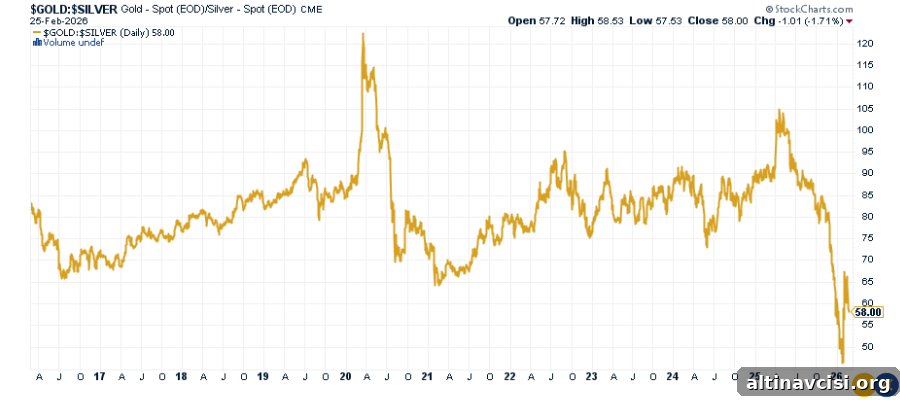
A low gold-silver ratio can signal robust silver momentum, but extreme readings often lead to mean reversion and profit-taking across the metals complex. With key inflation and employment reports due soon, the next market move may hinge on whether this cycle accelerates or begins to consolidate quietly.
India Just Opened a $385 Billion Door for Gold
India’s market regulator has widened the investment rules for the country’s $385 billion mutual fund industry, allowing equity-focused funds to increase exposure to gold via ETFs and gold-backed instruments. This change gives portfolio managers a new, regulated tool to manage market stress and currency swings.
India is already among the world’s largest physical gold markets, but this regulatory shift is different: it integrates gold into formal investment mandates, moving demand from cultural and retail channels into the institutional sphere. Allocations made within regulatory frameworks are typically steadier and less prone to panic selling; they rebalance instead of liquidating during stress.
As more regulators consider similar measures, gold’s demand base could become less cyclical and more structural. That gradual but persistent shift in how gold is held and allocated has the potential to reshape market dynamics over time.
Turkey Is Building a Gold Exchange. Istanbul Wants to Be the Next Financial Hub.
Turkey is preparing to launch a centralized commodities exchange in 2026 to consolidate fragmented markets, improve price transparency, and attract international participation across gold, agricultural products, and raw materials. Gold is expected to play a central role.
Turkey already has active retail demand and significant bullion imports. A formal exchange would introduce standardized contracts, stronger oversight, and deeper liquidity—features that help markets function more efficiently and attract foreign participants, especially in a country that has experienced notable currency volatility in recent years.
The broader ambition is to position Istanbul as a regional financial hub connecting Europe, the Middle East, and Asia. A centralized commodities market is a foundational piece of that strategy. Viewed alongside India’s move to incorporate gold into regulated investment mandates, a pattern emerges: emerging markets are not only large consumers of gold but increasingly building the institutional infrastructure that supports sustained, structural demand.
Daily price charts show the ongoing gold rally; these policy and market developments help explain why it may persist.
You May Also Like
- Metals Rise, Confidence Cracks, and the Affordability Gap Widens
- Gold Up 21%, Silver 25% YTD as AI and Inflation Risks Build
- Gold Hits $5,000. Is This the Next Leg Higher?
- Gold Support Levels Firm as Washington Backs Minerals
- Gold Slips Below $5K as Jobs Revisions Rattle Markets