
Daily News Nuggets | Today’s top stories for gold and silver investors
January 15th, 2026
Metals Rally Hits New Records Amid Global Turmoil
Uncertainty is widespread, and precious metals are benefitting. Gold surged past $4,600 per ounce this week while silver reached a new all-time high above $90.
The rally followed a series of geopolitical shocks: the U.S. capture of Venezuelan leader Nicolás Maduro, deadly protests in Iran, and public threats of military action that drove investors toward safe-haven assets.
Instability in Washington added to the risk backdrop. The Justice Department opened a criminal inquiry into Federal Reserve Chair Jerome Powell over renovation cost overruns at Fed headquarters. Powell called the probe a politically motivated pretext to influence interest-rate decisions.
Why it matters: questions about Fed independence and institutional stability are pushing both retail and institutional capital into gold and silver as insurance against policy uncertainty.
So far this year gold is up about 7% and silver roughly 26%. Tight physical supply, rising industrial demand for silver, and eroding trust in monetary institutions have all supported this momentum.

The Financial System Isn’t Safer — And You Know It
As risks mount, learn why gold and silver are expected to remain attractive through 2026 and beyond.
New Silver Trading Rules Could Push Prices Higher
The CME changed silver futures margining this week, moving from fixed dollar amounts to percentage-based requirements. Traders now must post roughly 9% of a contract’s value as collateral.
That shift most affects highly leveraged participants: as prices rise, margin calls grow automatically, pressuring short positions and increasing the risk of forced liquidations among overleveraged traders.
Note: physical buyers are not affected by this change — it applies only to paper contracts.
Fundamentals also support higher silver prices. Chinese export licensing is tightening available supply, industrial demand remains strong, and the market is running a structural deficit. With silver above $90 and year-to-date gains near 26%, $100 per ounce is a realistic near-term target if these trends continue.
Trump Says “No Plans” to Remove Powell (For Now)
President Trump told Reuters he currently has no plans to fire Fed Chair Jerome Powell, though he said it is “too early” to rule out changes. The two appear to be in a temporary holding pattern.
Powell’s Fed chair term expires in May, while his seat on the Board runs through 2028. Trump has publicly mentioned potential replacements in the past, but he has also reversed course before, so markets remain cautious.
This comment arrives amid the DOJ investigation into Powell and sustained presidential criticism over interest-rate policy. Markets are treating the likelihood of an early Fed rate cut as low, reflecting ongoing uncertainty about both policy direction and governance risks.
Inflation Looks Tame, But There’s a Catch
Headline CPI eased in December to 2.7%, while core CPI — excluding food and energy — fell to 2.6%, slightly below consensus expectations. On the surface, that reads as encouraging.
But many households aren’t feeling relief: food prices rose 0.7% in December, the largest monthly jump in over two years, leaving grocery inflation around 3.1% annually. Basics like groceries cannot be avoided, so this matters for real budgets.
Importantly, the Federal Reserve focuses on core PCE (Personal Consumption Expenditures), not CPI. PCE uses a different weighting and adjusts for shifting consumer behavior, and core PCE strips out food and energy entirely. That can make inflation appear milder on the Fed’s preferred measure than it does in everyday experience.
The divergence between headline CPI and core PCE helps explain why markets and policymakers may interpret recent data differently from consumers feeling higher costs at the register.
Workers Getting Record-Low Share of GDP
Workers received just 54% of U.S. GDP in the third quarter of 2025 — the smallest share on record since the government began tracking the series in the 1940s.
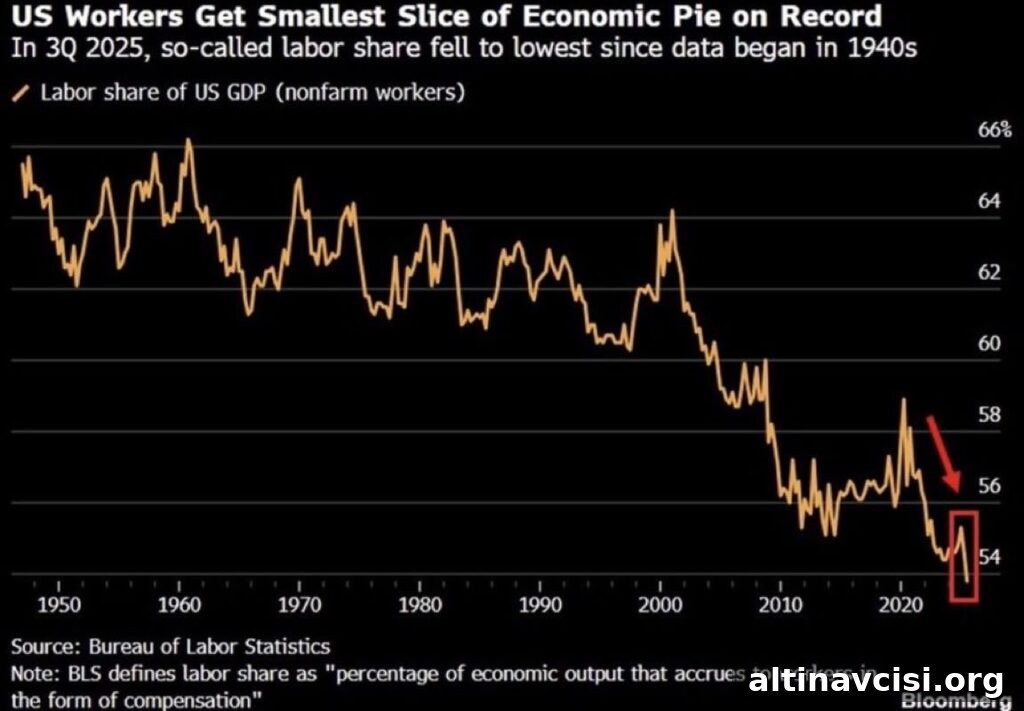
Labor share measures the portion of economic output that goes to wages and compensation versus capital and profits. The long-term decline since 2000 accelerated after the financial crisis and has continued, signaling a sustained shift of income toward capital owners.
This trend is more than an equity issue. When workers’ share of output declines, consumer purchasing power weakens, inequality rises, and the foundations of broad-based demand can erode. With consumer spending accounting for roughly 70% of U.S. GDP, prolonged pressure on wages creates a structural headwind for growth.
You May Also Like
- Silver Breaks $92, Citi Eyes $100 by March
- Silver Jumps 3% To $88 as Markets Downplay Risk
- Gold and Silver Soar as Fed Independence Comes Under Fire
- Gold Rises as Jobs Slow and Global Growth Falters
- Silver Slips on Index Rebalancing as Jobs Data Looms