How does gold do in a recession?
That’s a reasonable question. Recessions are usually challenging for investors, and gold is often thought of as an inflation hedge—seemingly the opposite of the typical environment during negative economic growth. To answer it, it helps to look at historical performance during past downturns.
Gold Price in a Recession
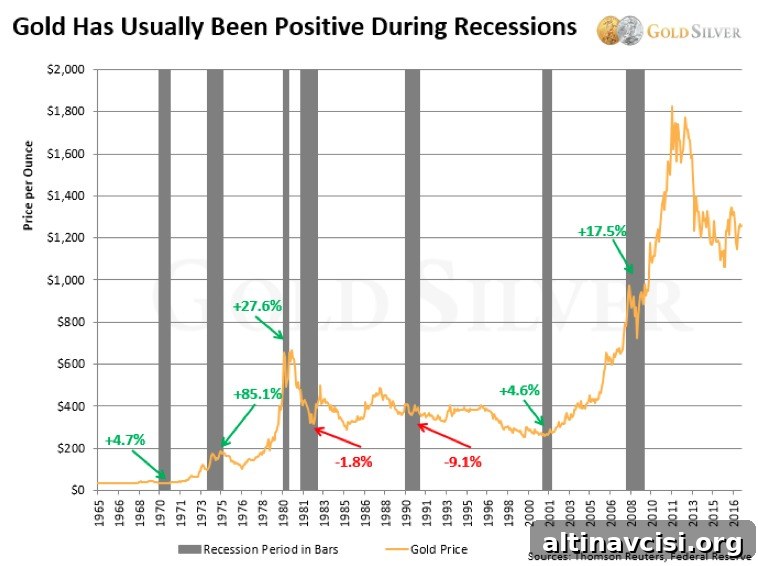
A common technical definition of a recession is two consecutive quarters of negative GDP growth. Since 1970, the United States has experienced seven official recessions. Examining those periods shows a clear pattern: in five of the seven recessions, the gold price was higher at the end of the recession than at the beginning. Only one decline was notable—a 9.1% drop in 1990—and gold was essentially flat during the 1982 downturn. In the other recessions, the price rose.
Even during the 2008–09 financial crisis, when markets were thrown into turmoil, gold ultimately appreciated. Although it fell initially in October 2008 as investors liquidated assets for cash, the metal rebounded and finished the recession about 17.5% higher. While each recession has its own characteristics, the historical record shows gold has tended to perform well more often than not when growth weakens.
Why Does Gold Usually Rise In a Recession?
Gold’s tendency to rise during recessions makes sense when you consider investor behavior. Economic slowdowns typically increase uncertainty and risk aversion, and gold is widely regarded as a safe haven in times of stress. Rather than being driven purely by inflation or deflation, gold responds strongly to fear and crisis—when investors seek assets that preserve value.
Historically, recessions are recurrent: there have been many over the centuries, even during periods when gold’s price was fixed under a gold standard. During severe crises, including the Great Depression, gold-related holdings for private citizens still showed strong gains. The inevitability of future recessions suggests it can be prudent to consider assets that historically provide protection during downturns.
The Message for Investors
History suggests investors in gold need not fear the next recession. Gold has more often risen than fallen across modern recessions, and its role goes beyond short-term performance in a single downturn. It can act as insurance against broader crisis scenarios, including sharp corrections or crashes in equity markets.
Gold possesses characteristics many other assets lack: liquidity in stressed markets, a long record as a store of value, and a reputation as a refuge during periods of uncertainty. Regardless of the exact timing or nature of the next recession, holding some gold can be a pragmatic way to hedge and diversify a portfolio against the negative impacts of economic contractions.