Key Takeaways
- On May 16, 2025, Moody’s downgraded the United States from Aaa to Aa1, completing the removal of the US from the top sovereign credit tier after S&P and Fitch had already taken similar steps.
- Gold closed at $3,237 per ounce on the day of the downgrade and trades around $4,550 today — more than a 40% gain over twelve months, based on LBMA spot pricing.
- Physical gold carries no counterparty risk: it has no issuer to downgrade, which helps explain why central banks have been net buyers for an extended period.
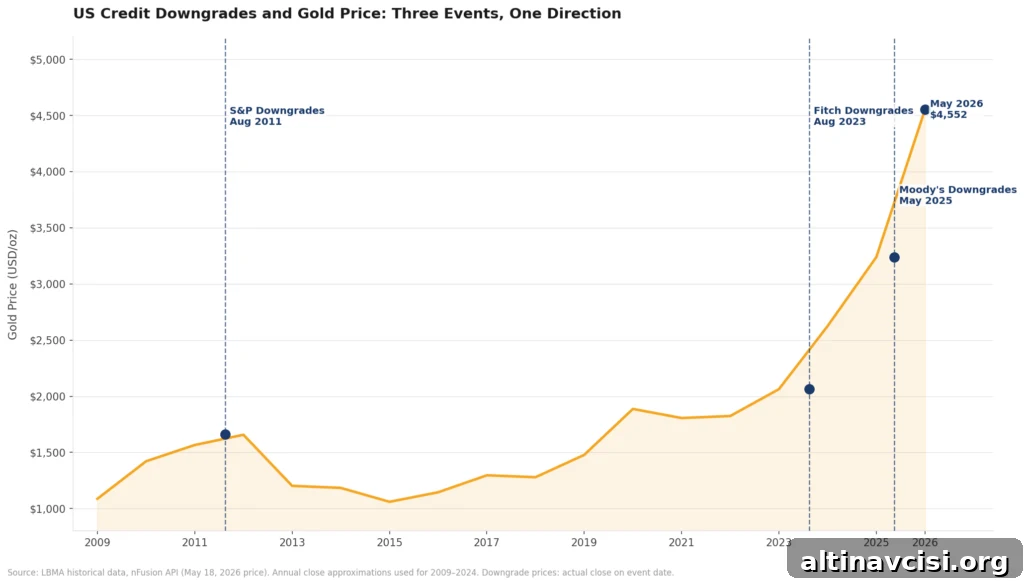
About a year ago a single rating action changed how many investors view US government debt. On May 16, 2025, Moody’s lowered the US sovereign rating from Aaa to Aa1, completing a process that began with S&P in 2011 and continued with Fitch in 2023. For the first time, none of the major ratings agencies considered US Treasuries the world’s highest-rated sovereign debt. Gold closed at $3,237 per ounce that day, according to LBMA spot data, and has since moved significantly higher.
That price path is not accidental; it reflects a market-level reassessment of what counts as “safe” in a world where sovereign credit risk for the US is treated differently than it was a decade ago.
Why Did Moody’s Downgrade the US?
Moody’s rationale focused on two interrelated pressures: the scale of federal debt and the rising cost of servicing it. US federal debt surpassed $36.8 trillion, and net interest payments exceeded $1 trillion in FY2026, according to the Congressional Budget Office — for the first time topping the US defense budget. When interest burdens grow faster than the economy and reach such large absolute levels, long-term rating models struggle to justify a top-tier score.
The downgrade was not a sudden realization but the culmination of a trend. S&P downgraded in 2011 when debt was much lower, and Fitch followed in 2023. Moody’s had previously relied on the dollar’s reserve status and Treasury market depth. Over time, the fiscal math overtook those defenses.
The Edge Every Investor Needs
Smarter precious metals investing starts here. The Nuggets Newsletter delivers market insights, Fed updates, global trends and educational content tailored for investors.
What Does a US Credit Downgrade Mean for Gold Prices?
Many reports frame the downgrade as a reputational issue for the US government. A more important effect is how it changes the definition of “safe” across portfolios. For decades, US Treasuries functioned as the canonical risk-free asset. Pension funds, insurers, and many investment mandates used Treasuries as the anchor for pricing other assets. Remove the assumption of top-tier sovereign backing and those risk models must be revisited.
Gold fills the gap because it carries no issuer, no counterparty, and no maturity: it cannot be downgraded by a ratings agency. That fundamental distinction helps explain why central banks and some institutional investors treat gold as a strategic reserve asset.
What Has Gold Done in the 12 Months Since the Downgrade?
Market reactions to sovereign downgrades tend to be structural rather than purely episodic. After S&P’s 2011 downgrade, gold spiked quickly to new highs. The response to Moody’s 2025 downgrade unfolded differently. Gold closed at $3,237 on May 16, 2025 and rose steadily in the following months. By January 2026, some market data showed an all-time high around $5,589 per ounce before a partial retracement; gold currently trades near $4,550, leaving a twelve-month gain of over 40% from the downgrade close, based on LBMA spot pricing.
That pattern—slow repricing as institutional frameworks adjust—fits how large pools of capital recalibrate mandates and risk assumptions rather than reacting in a single panic-driven move.
Is the Structural Case for Gold Still Intact?
Yes. Ratings agencies reflect market reality more than they create it. Central banks have been net buyers of gold for an extended period—data shows negative selling and consistent net purchases—indicating that official sector demand anticipated this shift. Some institutional mandates that required AAA sovereign holdings must reassess allocations now that US debt lacks that designation, creating marginal demand for alternatives.
Large Treasury markets remain central to global finance because of liquidity and scale, so abandonment is unlikely. Still, for investors and institutions seeking assets without sovereign credit risk, gold remains the principal option.
How Should Individual Investors React to This Downgrade?
Avoid panic and focus on portfolio alignment. The case for gold has not depended on an immediate collapse of the dollar; it rests on a long-term fiscal trajectory that raises sovereign credit concerns. The present move into gold is driven largely by central banks and institutional investors, not retail panic. That steady buying has helped push prices higher and then settle at levels that reflect both structural demand and changing macro expectations.
For most individual investors, the appropriate response is to review allocations, consider diversification away from sole reliance on sovereign debt as a risk-free anchor, and evaluate whether a measured exposure to physical gold or other non-sovereign assets fits their objectives and time horizon.
Stay On Top of Gold & Silver Prices
Get important market alerts sent straight to your inbox.
SOURCES
1. Moody’s Ratings — US Sovereign Downgrade Announcement
2. US Treasury Fiscal Data — Debt to the Penny
3. Congressional Budget Office — Budget and Economic Outlook: 2026 to 2036
4. LBMA — Gold Price Data
5. World Gold Council — Gold Demand Trends: Full Year 2025
6. GoldPrice.org — Gold Price on May 16, 2025
7. USAGOLD — Daily Gold Price History, January 2026 All-Time High
You May Also Like:
- No Deal, No Premium: Why Silver Fell 7% at the Trump-Xi Summit
- Gold Fell. China Bought Its Most in 17 Months. Here’s Why.
- Why Silver Falls Harder Than Gold — And What It Means
- Gold Near $4,700: The Chaos Isn’t a Ceiling. It’s a Floor
- 5 Forces Shaping Gold and Silver at the Beijing Summit
- The Real Reason Gold Falls When Inflation Surges
- CPI Hits 3.8%. Gold Falls. The Mechanism Nobody Explains
- Why the Gold Silver Ratio Is Falling — and What It Means