
Gold and silver market update — May 4, 2026
Key Takeaways
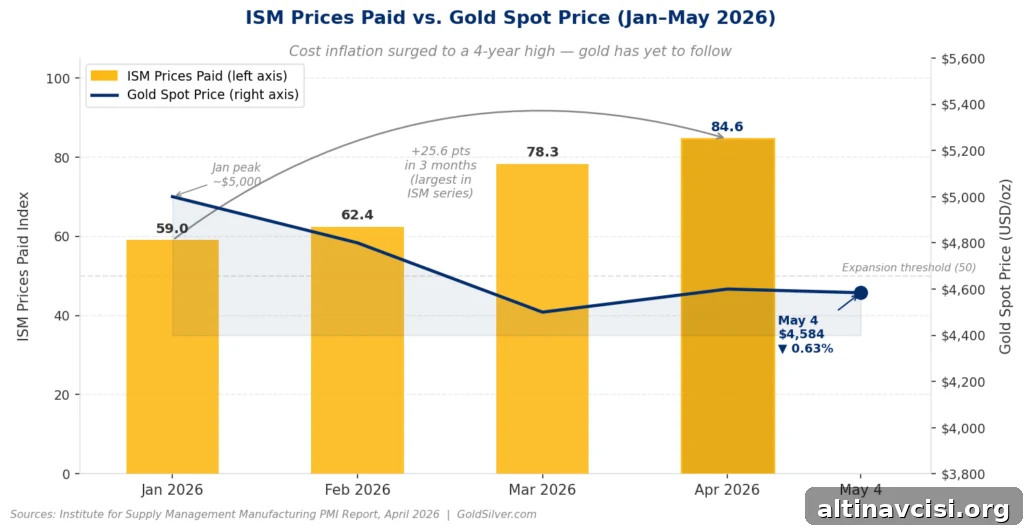
- Gold fell 0.63% to $4,584 on May 4, 2026 despite a tanker strike in the Strait of Hormuz and the largest ISM Prices Paid print since April 2022. The muted reaction suggests the war premium is already priced in, not that gold’s long-term case has weakened.
- ISM Prices Paid reached 84.6 in April 2026 — a 25.6-point rise over three months, the largest jump in the ISM series. At the same time, the Employment Index dropped to 46.4, the lowest reading of 2026. Manufacturing data now shows stagflation rather than just signaling it.
- The Federal Reserve is structurally constrained. It cannot comfortably raise rates into a weakening labor market, nor can it cut into elevated Prices Paid and a 3.5% PCE. Goldman Sachs keeps a year-end 2026 gold target of $5,400/oz, arguing that once markets accept the Fed’s paralysis, real yields will compress and gold will re-accelerate.
Two Catalysts That Should Have Lifted the Gold Price — But Didn’t
On the morning of May 4, a tanker was struck in the Strait of Hormuz. That same day the ISM released a manufacturing report showing sharply higher input costs. Both events would normally push investors toward gold, yet the metal fell.
As of May 4, 2026 (ET), gold is trading near $4,584, down 0.63% from last Friday’s close. Silver sits near $75, up roughly 1%.
Both developments arrived on the same day, and both carry clear implications.
First, the Strait of Hormuz incident. That waterway handles roughly one-fifth of global seaborne oil trade. Iran warned it would target U.S. forces entering the strait and asked commercial vessels to coordinate with Tehran. Now in its tenth week, the conflict has left the corridor largely nonfunctional.
Second, the ISM Manufacturing Report for April. The Prices Paid index climbed to 84.6 from 78.3 in March — the highest reading since April 2022. The three-month increase of 25.6 percentage points is the biggest move in the series. At the same time, the Employment Index fell to 46.4, signaling contracting manufacturing payrolls. Output is expanding, costs are surging, and hiring is weakening — a manufacturing-side stagflation signal made real by the data.
The Edge Every Investor Needs
Smarter precious metals investing starts here. The Nuggets Newsletter brings you essential market insights, Fed updates, global trends, educational videos, and more.
Why Did the Gold Price Fall on the Worst News Day in Months?
Since the Iran conflict began on February 28, 2026, gold has declined about 13% while oil has risen more than 50%. Those moves are consistent: war lifts oil, oil raises input costs, higher input costs feed consumer inflation, and rising inflation forces the Fed to hold or raise rates. Higher nominal rates reinforce real yields and a stronger dollar, which are headwinds for a non-yielding asset like gold. In short, the inflationary consequences of the conflict have become a drag on gold.
The Fed’s preferred inflation measure, PCE, was 3.5% in March 2026 and remains elevated. At the April 29 FOMC meeting — Jerome Powell’s final meeting as chair — the Fed left the funds rate at 3.50–3.75% with four dissents, the most divided vote since 1992. That division reflects the dilemma policymakers face.
Kevin Warsh’s nomination advanced in the Senate Banking Committee, and a full Senate vote is expected the week of May 11. Still, the market’s sense of Fed paralysis predates leadership changes.
The ISM data helps explain that paralysis. When manufacturers face record input costs while payrolls decline, consumer inflation tends to rise within one to three quarters. Official inflation gauges like PCE lag what manufacturers already experience, so current readings understate future pressure. Goldman Sachs maintains a year-end 2026 gold target of $5,400/oz, arguing that once markets accept the Fed won’t break this inflation cycle, real yields will compress and gold will accelerate. The ISM report moves that scenario closer.
What Does Gold’s Non-Reaction to the Hormuz Tanker Strike Actually Mean?
Gold barely moved after the tanker strike. That muted response is meaningful.
Historical comparisons illustrate the point: U.S.–Iran tensions in May 2019 pushed gold up about 2% intraday, and Russia’s invasion of Ukraine in February 2022 produced a 1.7% intraday gain. By contrast, when this Iran conflict began on February 28, 2026, gold fell. The market treated the war as an inflation event that constrained the Fed rather than as a pure safe-haven driver.
Put simply: the war premium appears to be saturated. Additional escalation added little new risk premium today. That doesn’t indicate structural weakness in gold; it shows that one major bullish factor is already reflected in price.
What remains in the price story is the ISM signal. A central bank that cannot comfortably raise rates with Prices Paid at 84.6 and payrolls contracting is cornered. Each month the Fed stays constrained, real yields compress incrementally and gold’s structural case quietly strengthens. For gold, time—rather than a single catalyst—often matters most.
What’s the Bear Case for the Gold Price Right Now?
The clear bear case: if PCE accelerates toward 4% or higher, the Fed may be forced into more aggressive hikes. That would lift real yields, strengthen the dollar, and likely trigger a material correction in gold.
That risk is real, but constraints limit how far policymakers can take rates. U.S. annual debt service already tops $1 trillion, and the federal deficit is running near $1.9 trillion for fiscal 2026. Aggressive rate hikes would increase fiscal stress and could destabilize government finances. While history shows the Fed can raise rates aggressively, today’s debt load makes a Volcker-scale policy response far less feasible. The bear case exists, but its practical ceiling is constrained by fiscal realities.
What to Watch: The May 8 Jobs Report and the Gold Price
The next key data point is the April jobs report, due Friday, May 8, 2026. Consensus expects roughly 53,000 new nonfarm payrolls, down from March’s 178,000. Inflation remains elevated while the labor market softens. Absent a clear path for the Fed to both tame inflation and avoid a sharp economic slowdown, policy will remain constrained — a backdrop that historically favors gold. This is not a price forecast for next week, but it describes the environment that supports precious metals over time.
Stay On Top of Gold & Silver Prices
Get important market alerts sent straight to your inbox.
SOURCES
1. Institute for Supply Management — Manufacturing PMI Report, April 2026
2. U.S. Bureau of Economic Analysis — Personal Income and Outlays, March 2026
3. Federal Reserve — FOMC Statement, April 29, 2026
4. Congressional Budget Office — Budget and Economic Outlook, February 2026
5. U.S. Energy Information Administration — The Strait of Hormuz Is the World’s Most Important Oil Transit Chokepoint
6. Goldman Sachs Commodity Research, May 2026 — available to institutional clients via Goldman Sachs Research portal
7. CME Group — Gold Futures & Options
8. U.S. Senate Committee on Banking, Housing, and Urban Affairs — Warsh Nomination, April 29, 2026
9. U.S. Bureau of Labor Statistics — Employment Situation Summary
Disclaimer: This article is for informational purposes only and does not constitute financial or investment advice. Always consult a qualified financial adviser before making investment decisions.
You May Also Like:
- Gold Is Up 41% From a Year Ago. The Fed Can’t Stop It
- 5 Economic Warning Signs Gold Investors Need to See Today
- WGC Q1 2026: What Asia Knows That Wall Street Doesn’t
- BEA Stripped Silver From GDP. Here’s What It Means
- PCE at 3.5%, GDP Miss: Why This Is Bullish for Gold
- How Warsh’s Inflation Measure Could Move the Gold Price
- Gold Is Down 19%. This $3.8B Bet Says It Doesn’t Matter
- Gold, Oil, and the Fed: Why the Old Rules Don’t Apply