
Key Takeaways at a Glance
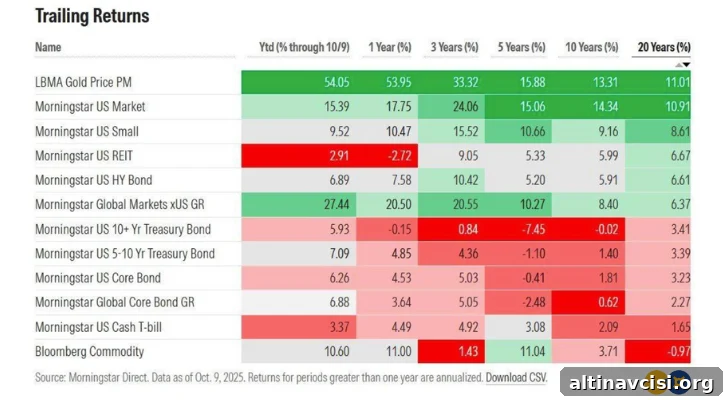
- Gold has led across timeframes in the latest trailing-returns snapshot: about 54% YTD and roughly 54% over 1 year, with double-digit annualized returns over 3, 5, 10 and 20 years.
- Over 20 years, gold’s annualized return is comparable to or higher than broad U.S. equities in the dataset, while bonds and commodities have lagged.
- Structural forces — notably central bank buying, increased geopolitical fragmentation, and persistent inflationary pressures — have reshaped gold’s role in portfolios.
- A 5–15% strategic allocation to gold has historically improved portfolio resilience by reducing drawdowns and volatility while helping preserve purchasing power.
For decades, the standard investing playbook was straightforward: stocks for growth, bonds for income and stability, and gold as crisis insurance. That familiar script is changing.
Morningstar’s recent trailing-returns snapshot shows gold has outperformed or matched traditional assets across nearly every measured horizon. Through October 9, 2025, gold posted roughly 54% year-to-date returns and double-digit annualized gains over 3, 5, 10 and 20 years. Over the past two decades, gold’s performance now rivals broad U.S. equities while bonds and commodities lag behind.
This is not a short-lived spike. Structural shifts are underpinning gold’s new behavior: central banks are accumulating large quantities, institutional demand is rising, and persistent inflation has reduced the appeal of income assets that once dominated portfolios. The longstanding criticism that gold offers no yield matters less when real yields and purchasing power are under pressure.
The relevant question for investors today is not whether gold belongs in a portfolio, but how much to allocate and how best to own it.
What the Numbers Actually Tell Us
Morningstar’s trailing-returns data places gold near the top across most timeframes:
- Short term: Around 54% year-to-date and 1-year gains, driven by safe-haven flows, central bank purchases, and periodic dollar weakness.
- Medium term: Low-to-mid-teens annualized returns over 3 and 5 years, even amid rising real interest rates.
- Long term: Low-double-digit annualized returns over 10 and 20 years, matching or outpacing U.S. equities while bonds and many commodities lagged.
Why this matters: gold has provided equity-like returns in some periods while offering diversification benefits similar to bonds. In an environment where inflation and macro shocks can hurt both stocks and bonds simultaneously, an asset that moves on a different cycle can materially improve portfolio resilience.
Why Gold Stopped Playing by the Old Rules
If recent price action has felt counterintuitive — gold reaching highs even as interest rates rose — that’s because the old relationships have shifted. Three structural trends explain the change:
1. Central banks became persistent buyers
Many central banks, particularly in emerging markets and across Asia, have been steadily increasing gold reserves. Their buying is strategic and long-term, aimed at diversifying reserve exposure and reducing reliance on any single currency. This consistent demand creates a structural floor under the market.
2. Geopolitical fragmentation and supply-chain shifts
Trade tensions, sanctions, and reshoring have increased macro volatility and uncertainty. In times of geopolitical stress, neutral assets that are not dependent on counterparties — like gold — become more attractive to sovereigns, institutions, and private investors alike.
3. Enduring inflationary pressures
Large fiscal deficits, supply constraints tied to energy transitions, and deglobalization have kept inflation risk elevated. When price pressures persist while growth is uneven, gold has historically performed well relative to equities and bonds.
Bottom line: Gold’s role has evolved from a niche crisis hedge to a core strategic reserve asset for central banks, institutions, and many individual investors.
The Portfolio Math: How Much Gold Should You Own?
You don’t need a large allocation to gain benefits. Historical data show that a modest allocation to gold — typically in the range of 5–15% — can improve risk-adjusted returns, lower volatility, and reduce drawdowns compared with a traditional 60/40 stock-bond mix, especially during periods of elevated inflation or market stress.
Institutional views are shifting as well. Some prominent strategists have proposed higher strategic weights for gold as bonds struggle to act as reliable diversifiers under persistent inflation. The practical question for most investors is aligning allocation with goals and time horizon. Common allocation frameworks include:
- Conservative (5% gold / 95% traditional): Low tracking error and measurable downside protection.
- Balanced (10% gold / 90% traditional): Historically improved risk-adjusted returns while preserving portfolio character.
- Defensive (15% gold / 85% traditional): Emphasizes resilience and capital preservation, particularly useful for those near retirement or with low tolerance for large drawdowns.
Whichever allocation you choose, maintain discipline: rebalance periodically and focus on long-term resilience rather than short-term market timing.
The objective isn’t to chase outsized returns but to build a portfolio that weathers diverse economic environments.
How to Own Gold the Right Way
Ownership method matters. Here are practical considerations when adding gold to a portfolio:
Physical bullion for direct ownership: If the goal is to eliminate counterparty risk and preserve wealth, physical coins and bars provide tangible ownership. Sovereign-minted coins and investment-grade bars in common sizes tend to offer the best liquidity.
Secure, insured storage: Home storage can create insurance and resale complications. Segregated, insured vault storage provides clear title, security, and simpler liquidation when needed.
Tax-advantaged accounts where applicable: Some investors use precious-metals IRAs or similar vehicles to defer or shelter gains. Ensure custodians and depositories meet applicable regulatory requirements.
Mind fees and transparency: Compare premiums, storage fees, and dealer spreads. Favor transparent pricing and reputable dealers to avoid hidden costs.
Choose the approach that matches your goals: direct physical ownership for worst-case protection, or regulated funds and ETFs for simplicity and trading ease — each carries trade-offs in cost, custody, and counterparty exposure.
Investing in Physical Metals Made Easy
People Also Ask
Did gold really beat stocks over the last 20 years?
Based on recent trailing-return snapshots, gold’s 20-year annualized performance is comparable to or higher than broad U.S. equities in the dataset, while bonds and commodities lagged. That supports treating a modest gold allocation as a strategic holding rather than purely crisis insurance.
How much gold should I have in my portfolio?
A practical range is 5–15%, adjusted for risk tolerance, time horizon, and income needs. That range has historically improved diversification and reduced drawdowns.
Why is gold rising even with higher interest rates?
Three structural forces support gold despite higher rates: sustained central-bank buying, geopolitical fragmentation, and persistent inflation risks. Together these factors have altered historical correlations between gold and real yields.
What’s the best way to own gold—physical bullion or ETFs?
ETFs offer convenience and liquidity but introduce fund and counterparty risks. Physical bullion provides direct ownership, high liquidity in many markets, and the option of insured vault storage. Choose the format that aligns with your objectives and risk tolerance.
Is now a good time to buy gold or should I wait?
Timing the market is difficult. Many investors phase in positions and rebalance periodically. A disciplined approach that targets a strategic 5–15% allocation and uses dollar-cost averaging can build resilience across cycles.
Get Gold & Silver Insights Direct to Your Inbox
Join thousands of investors who receive expert analysis, market updates, and offers delivered weekly.