
Daily News Nuggets | Today’s top stories for gold and silver investors
February 17th, 2026 | Brandon Sauerwein, Editor
The Jobs Report Mirage: Strong Headline, Weaker Reality
January’s headline payroll increase of 130,000 concealed a much larger story: sweeping benchmark revisions that substantially lowered 2025 payroll growth. Previously reported gains of roughly 584,000 were revised to about 181,000 — an average near 15,000 jobs per month — and March payrolls were adjusted down by nearly 900,000. This recalibration changes the narrative: the labor market is not collapsing, but it may be experiencing a “jobless expansion,” where output grows while hiring remains muted. Unemployment edged down to 4.3%, yet joblessness has risen more sharply for younger workers and Black Americans.
At the same time, inflation expectations remain anchored around 3%, and new tariffs are adding upward pressure on costs. With most tariff burdens falling on U.S. companies and consumers, the Federal Reserve faces a familiar trade-off: slowing employment against still-elevated inflation. The key question now is whether the U.S. economy stabilizes or drifts into a more fragile state.
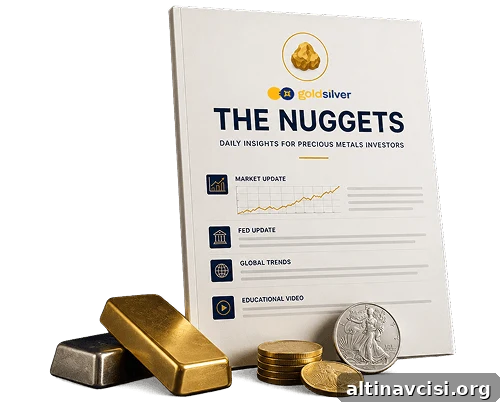
The Edge Every Investor Needs
Smarter precious metals investing starts here. The Nuggets Newsletter delivers concise market analysis, Fed updates, global trends, educational videos, and timely alerts to help you make informed decisions.
Gold Dips Below $5,000 as Markets Reassess Risk
After a sharp rally that pushed prices toward $5,600 earlier this year, gold briefly retreated under $5,000. The fundamental drivers supporting the metal remain in place: geopolitical uncertainty, persistent inflation concerns, rising sovereign debt burdens, and volatile bond yields. Equity valuations appear stretched and fiscal deficits keep widening, encouraging some investors to use gold as a hedge against policy and market risks.
Gold and Silver Prices Three Month Chart

This move is as much about portfolio positioning as it is about short-term price action. Many investors are treating gold as a stabilizer in a climate where policy risk and geopolitical fragmentation have not diminished. The core debate is less about near-term momentum and more about whether conventional asset mixes provide sufficient protection in a structurally uncertain environment.
While gold remains elevated, analysts differ on whether this signals the start of a broad commodities boom. For now, the metal’s strength looks driven by monetary and geopolitical considerations rather than synchronized global demand across raw materials.
Goldman Sachs: This Is a Gold Rally — Not a Commodity Supercycle
Gold’s rally has prompted comparisons to historical commodity supercycles, but Goldman Sachs argues the current move is different. The bank highlights structural drivers — central bank purchases, geopolitical fragmentation, and reserve diversification — rather than broad-based, demand-led growth that typically fuels commodity supercycles. Energy and industrial metals have not mirrored gold’s performance, underscoring that this is likely a focused rally in the monetary metal.
That distinction matters for investors. A true supercycle implies years of rising prices across many raw materials driven by booming demand. Gold’s advance appears more tied to monetary policy, sovereign debt concerns, and a reallocation of official reserves. Even if global growth slows, gold could remain supported, but a blanket commodities surge is far from certain.
Stay On Top of Gold & Silver Prices
Get important market alerts sent straight to your inbox.
Gold to $6,000? Analysts Debate the Next Big Move
Gold’s recent surge has produced a range of forecasts. Some, like Thomas Winmill of Midas Funds, project the metal could finish 2026 above $6,000 per ounce, citing persistent central bank purchases and policy choices that may erode confidence in dollar-denominated assets. Other analysts are more conservative, expecting gold to trade in the $4,000–$5,500 band over the next 12–18 months depending on the pace of interest-rate cuts and the depth of any economic slowdown.
Central bank accumulation remains a widely cited support for prices. While estimates vary, the overall outlook for gold in 2026 is generally constructive as observers weigh rising public debt, geopolitical risks, and sustained official demand. Few analysts foresee a sharp reversal; the debate centers on the magnitude and speed of further gains rather than whether the uptrend will persist.
Sweden Reopens Debate on Joining the Euro
Sweden has renewed discussions about adopting the euro as changing geopolitical dynamics and concerns over global stability prompt fresh consideration of its currency policy. Although Swedish voters rejected euro membership in 2003, factors such as Russia’s invasion of Ukraine, Sweden’s NATO accession, and deeper EU integration have altered the strategic backdrop. Proponents argue euro adoption could strengthen Sweden’s ties with Europe and reduce the krona’s vulnerability as a smaller, more exposed currency.
No referendum is planned, but the revived debate highlights how long-standing monetary choices can be revisited when the international order shifts. For investors, such discussions are another reminder that currency and reserve dynamics remain an important factor for asset allocation.
You May Also Like
- Gold Near $5,000 as Fed Faces Sticky Inflation
- Markets Eye Friday’s CPI, Credit Card Debt Hits Record High
- Silver Volatile, Gold Resilient After January Jobs Surprise
- Silver’s 7% Bounce Sparks Bullish Calls
- Gold Holds Above $5,000 as Hedge Funds Brace for Turbulence