Gold investment demand jumped 84% in 2025, reaching a record 2,175 tonnes — the highest annual total in more than a decade. A wave of new buyers entering the physical market face a common question: should they buy gold coins or gold bars? That choice affects cost, liquidity, storage, and long-term flexibility.
Both coins and bars contain the same metal and track the spot price, but they serve different investor needs. Understanding the differences helps you choose the form of physical gold that best matches your objectives.
What Are Gold Coins and How Are They Different from Gold Bars?
Gold coins are minted by sovereign governments and carry a face value, official designs, and a government-backed guarantee of weight and purity. Popular bullion coins include the American Gold Eagle, Canadian Gold Maple Leaf, and Austrian Gold Philharmonic. These coins are finished products intended for retail investors and collectors, and many include anti-counterfeiting features and standardized packaging.
Gold bars, sometimes called bullion bars or ingots, are produced by private refiners and government mints. They range in size from small gram bars to 400-ounce bars used by institutions. Bars are stamped with weight, purity, and the refiner’s hallmark but generally lack a national face value or sovereign design.
In short: coins are sovereign-backed, crafted retail pieces; bars are straightforward refined bullion. Both are real gold, but the economics and practicalities of buying, storing, and selling them differ.
Do Gold Coins Cost More Than Gold Bars?
Yes — typically. Sovereign bullion coins usually carry higher premiums over spot than bars of the same weight. For example, many 1 oz government-issued coins command higher retail markups than 1 oz bars from recognized refiners. That difference grows larger when comparing many fractional coins to a single large bar: a single 10 oz bar is usually cheaper per ounce than ten 1 oz coins.
Higher coin premiums reflect minting costs, design work, limited production runs, and security features. However, that premium is not necessarily “lost” because secondary-market buyers often pay similar premiums at resale. If your priority is purchasing the greatest possible quantity of gold for a given budget, bars are generally more cost efficient. If you value recognition, liquidity, and resale strength, coins often justify the extra cost.
Perth Mint, PAMP Suisse Lady Fortuna, Royal Canadian Mint, and PAMP Suisse 1 oz bars — all from LBMA-accredited refiners.
Which Is Easier to Sell — Gold Coins or Gold Bars?
Gold coins, especially widely recognized sovereign issues, generally offer the greatest liquidity. Coins like the American Gold Eagle are instantly recognizable to dealers worldwide and usually require no additional assay verification. That recognition speeds transactions and reduces uncertainty about authenticity.
Gold bars are also liquid, but there are caveats: larger bars (10 oz and above) or bars from lesser-known refiners may need assay or authentication before a dealer accepts them. That step can delay a sale and sometimes reduce the offer price. Smaller bars from reputable refiners can trade nearly as smoothly as coins, but sovereign coins remain the simplest to sell quickly across markets.

Your Gold Buying Guide Most investors overpay when they buy gold and then again when they sell. A clear buying plan helps you avoid unnecessary costs and choose the right mix of coins and bars for your goals.
How Does Storage Differ for Gold Coins vs Gold Bars?
Bars are more space-efficient. A stack of 10 oz bars occupies far less volume than the equivalent weight in individually packaged 1 oz coins. For investors building larger holdings, bars reduce storage footprint and can lower vault or safe costs measured by volume.
Coins take more space per ounce because of tubes, capsules, and packaging. That can increase storage costs for home safes or allocated vault storage billed by volume or item count. On the other hand, coins offer storage flexibility: smaller units make it easy to distribute holdings across multiple locations to reduce single-point-of-failure risk.
If compact storage and cost efficiency are the priorities, bars have the edge. If flexibility and spreading risk across locations matter more, coins are advantageous.
Are Gold Coins Better for Resale Flexibility?
Yes. Coins offer granular liquidity that bars often cannot. You cannot easily sell half a 10 oz bar, whereas a stack of ten 1 oz coins lets you sell exactly the amount you need without reducing your remaining position. This granularity is valuable for investors who may need to liquidate small amounts over time.
Bars are available in fractional sizes, but very small bars (grams, a few ounces) often carry high premiums that erode the cost advantage. For many retail investors, recognized bullion coins strike the best balance between resale flexibility and reasonable premiums.
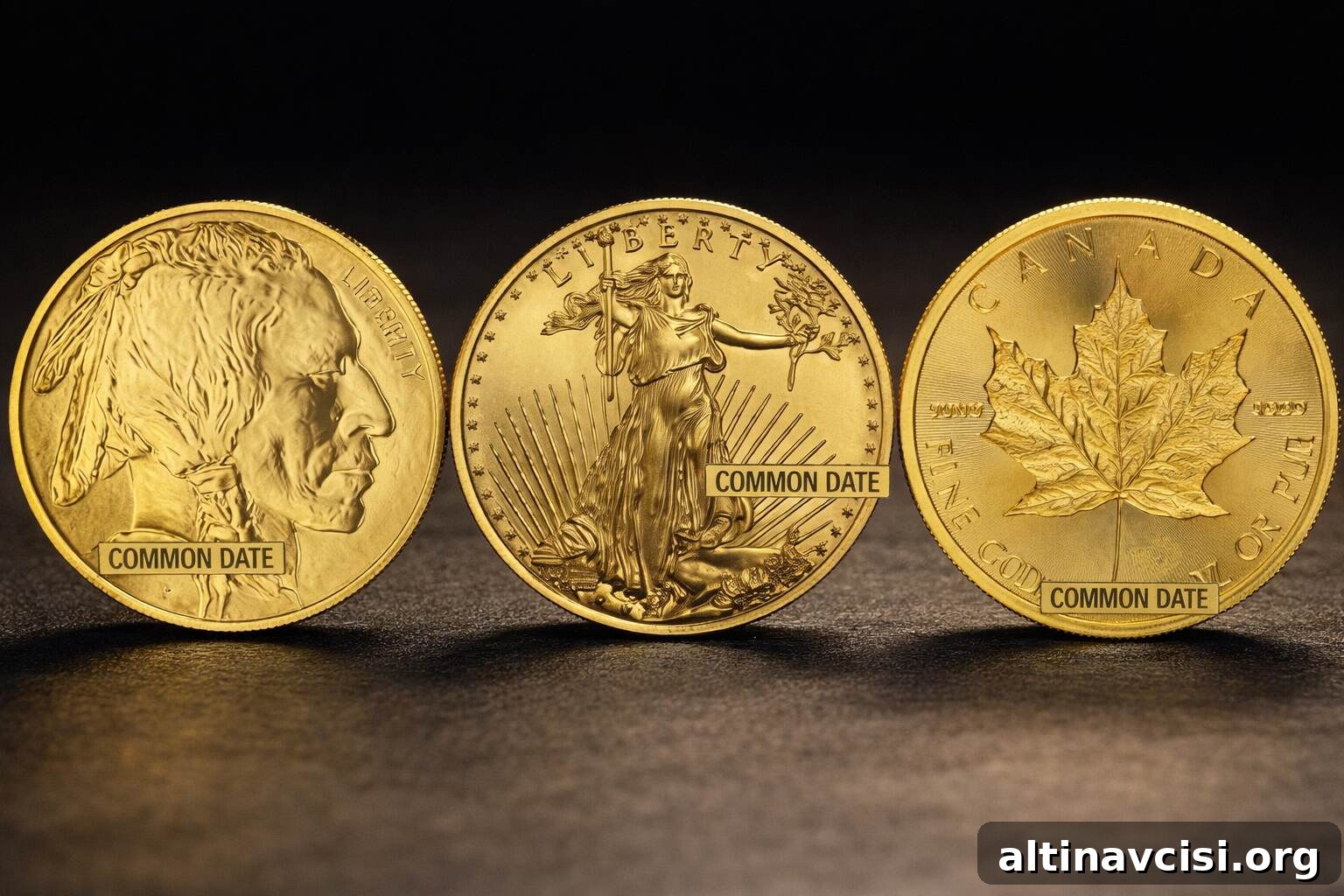
From left: American Gold Buffalo, American Gold Eagle, and Canadian Gold Maple Leaf. All three are IRA-eligible.
Can You Hold Gold Coins in an IRA?
Yes, certain gold coins and bars qualify for IRAs. U.S. tax rules require bullion to meet minimum purity standards (generally 99.5% for most approved pieces), though some coins—such as the American Gold Eagle—are specifically authorized despite lower fineness because of statutory exceptions. IRA-eligible coins commonly include the American Gold Eagle, American Gold Buffalo, Canadian Gold Maple Leaf, and Austrian Gold Philharmonic when they meet the required purity standards.
Approved bars also qualify if they meet purity and refiner accreditation requirements. IRA-held precious metals must be stored in an IRS-approved depository; home storage is not permitted and can cause taxable distributions and penalties. If you plan a Gold IRA, work with a dealer and custodian experienced in IRA-eligible products to ensure compliance and smooth setup.
What About Collectible or Numismatic Gold Coins?
This guide focuses on bullion coins—those valued primarily for their metal content. Collectible or numismatic coins trade on rarity, condition, and collector demand and can carry large, sometimes volatile premiums. Many numismatic pieces are classified as collectibles for tax purposes and are not permitted in retirement accounts. For investors seeking wealth preservation tied to the gold price, widely recognized bullion coins are the straightforward and lower-risk option.
Be cautious if a dealer emphasizes numismatic coins without clarifying the added risk and potential illiquidity. If your objective is financial protection rather than collecting, stick to mainstream bullion coins from sovereign mints.
So Which Should You Buy — Gold Coins or Gold Bars?
There’s no one-size-fits-all answer. Your choice depends on priorities:
- Choose bars if your main objective is maximizing ounces per dollar and minimizing storage volume for larger holdings.
- Choose coins if you want immediate worldwide recognition, easier resale in small amounts, and IRA-eligible options.
- Many experienced investors hold both: bars as the cost-efficient core and coins for liquidity and flexibility at the margin.
As a practical rule of thumb: investors with positions under about $25,000 often favor coins for liquidity and ease of use, while holdings above $50,000 commonly shift toward a majority of bars for cost efficiency, retaining some coins for quick access. But the most important step is owning authentic physical gold that meets your goals—whether coins, bars, or a mix of both.
Ready to Start?
When buying, work with a reputable dealer that offers transparent pricing, secure storage options, and clear IRA support if needed. Verify purity and refiner credentials, compare premiums, and choose the form of gold that aligns with your storage, liquidity, and cost priorities.
People Also Ask
Do gold coins cost more than gold bars?
Yes. Sovereign bullion coins typically carry higher premiums than comparable bars because of minting, packaging, and security features. Those premiums often hold value at resale, however, so they are not always a net loss.
Which is easier to sell — gold coins or gold bars?
Coins—especially recognized sovereign issues—are generally easier and faster to sell worldwide. Larger or lesser-known bars may require authentication steps that can slow the process.
Can you put gold coins in an IRA?
Yes. Certain bullion coins and bars that meet purity and accreditation requirements qualify for IRAs. Some statutory exceptions apply to widely used coins. IRA metals must be held in approved depositories, not at home.
SOURCES
World Gold Council — Gold demand trends 2025; U.S. Mint bullion coin programs; tax and IRS guidance on IRA-eligible metals; industry data on premiums and refiner accreditation.
This article is informational and not financial advice. Consult a qualified advisor before making investment decisions.
You May Also Like:
- Is Gold Jewelry a Good Investment? What Most Buyers Get Wrong
- How to Spot Fake Gold and Silver
- Numismatic vs. Bullion Coins: Know What You’re Buying
- Silver in AI Infrastructure: The Hidden Metal Behind Every AI Model
- Gold Price Forecasts for 2026, Revisited After Q1
- Gold ETFs Are Booming. But Do You Actually Own Gold?